


Quick answer
Hillside & Slope Construction in Mumbai typically costs On design in 2026. The final price depends on site access, soil and structure, specification and brands, and contract type. CRZ-governed coastal sites usually cost 15–25% more.
On this page
Key takeaways
- Typical range: On design.
- Ask for quantities, rates and brands per item.
- Keep a 5–8% contingency.
- Turnkey contracts reduce coordination cost.
01Indicative rates
For hillside & slope construction we usually quote On design across Mumbai, Navi Mumbai and Thane. CRZ-governed and creek-facing sites add clearance and marine-grade material costs.
02What drives the cost
The main factors:
- Site access and material haul distance
- Soil and foundation type
- Structural system and spans
- Specification and brands
- Contract type: turnkey, lump sum or item rate
- Season and schedule
03What a good BOQ looks like
Every item should list description, unit, quantity, rate and brand — for example, M25 concrete in cubic metres or vitrified tiles of a named brand and size in square feet. That makes quotes comparable and protects you from surprises.
- Slope study — itemised with quantity and rate
- Stepped foundations — itemised with quantity and rate
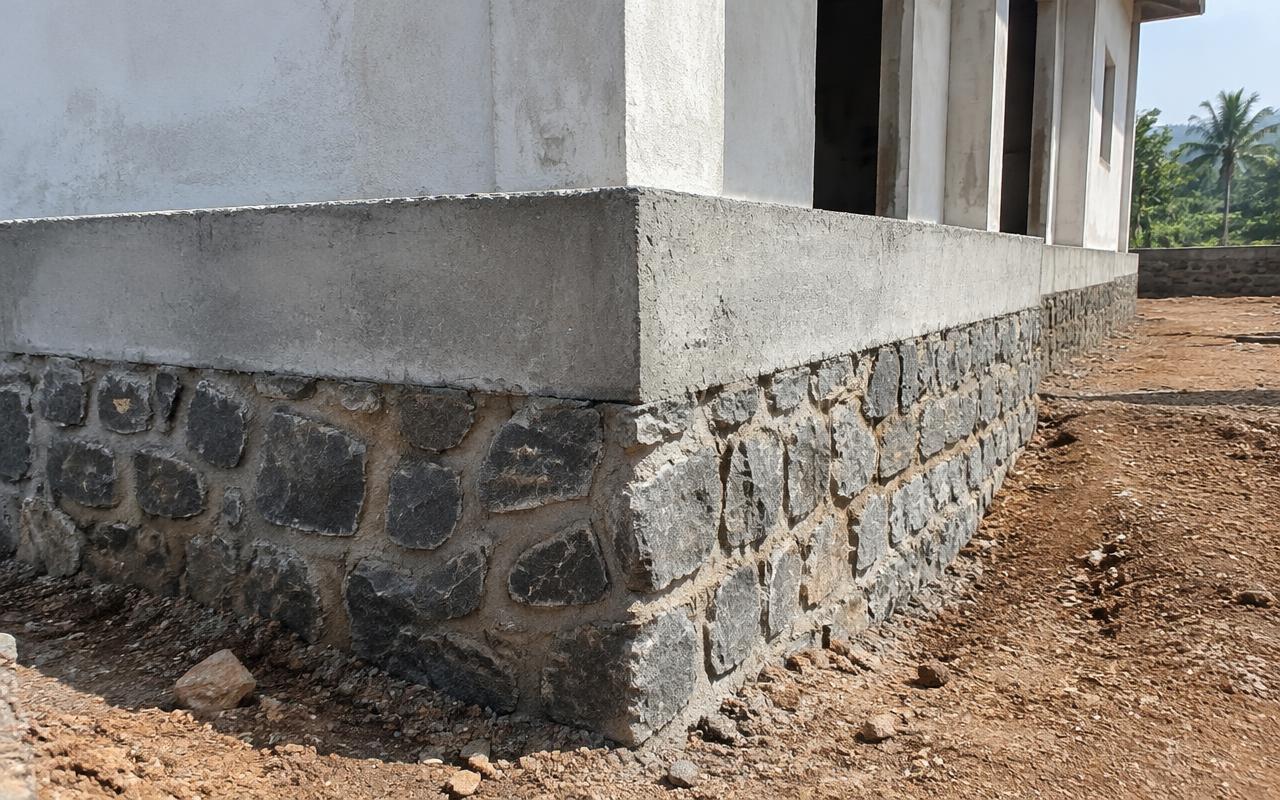
- Retaining — itemised with quantity and rate
- Access — itemised with quantity and rate
- Drainage — itemised with quantity and rate
- Monsoon plan — itemised with quantity and rate
04What drives a hillside foundation BOQ
Hill-slope projects price on design because every plot's slope, soil depth and rock profile is different, but the cost structure follows a consistent pattern. Slope study and geotechnical investigation is a larger share here than on flat sites — typically 6–8% of total project cost — because the design of stepped foundations and retaining structures depends entirely on what that study finds. Stepped foundation work itself (benching the slope, differential footing depths) runs 25–30%, retaining structures to hold back the cut or support the fill are 25–30%, and access road or approach construction up the slope is 10–15%.
Drainage provisioning — diverting surface runoff away from the structure and the slope face — is 8–10% but is the item most often underestimated in slope projects, because its importance only becomes visible during the first heavy monsoon after handover, by which point it's expensive to retrofit.
Access road or approach construction deserves specific scrutiny at quoting stage, since its cost depends heavily on gradient and the equipment access it needs to support during construction — a steep, narrow approach that can only take light vehicles forces material and equipment to be moved in smaller loads over more trips, a logistics cost that's easy to underestimate when quoting off a site visit rather than a proper gradient survey.
Material handling on a hillside plot adds a cost layer that a flat-site BOQ doesn't need to account for at all — concrete and steel often need to be moved up the slope in stages rather than delivered directly to the point of use, sometimes requiring a temporary hoist or winch system for a steep plot, and this handling cost should appear as its own line item rather than being folded invisibly into the rates for foundation and retaining work.
- Slope study & geotech investigation: 6–8%
- Stepped foundations: 25–30%
- Retaining structures: 25–30%
- Access/approach road: 10–15%
- Drainage system: 8–10%
- Monsoon protection plan: 5–7%
06Red flags specific to slope and hillside quotes
The most dangerous lowball in this category is a contractor who prices stepped foundations and retaining work off a visual site assessment instead of an actual slope-stability study, because the quote then has no real basis and tends to balloon once excavation reveals the slope behaves differently than assumed. Equally common is excluding a monsoon protection plan from the quote entirely, leaving a cut slope exposed and unprotected if the schedule slips into the rains — a genuine safety risk, not just a cost one.
Insist on a geotechnical slope-stability assessment before accepting a fixed quote, and get the monsoon protection and drainage-diversion measures itemised and costed upfront rather than treated as a contingency to be negotiated if and when the rains arrive mid-construction.
It's worth asking any prospective hillside contractor directly for examples of slope projects they've completed that have now been through at least one monsoon season, and whether those slopes have shown any sign of movement or drainage failure since. Slope performance is only genuinely provable over time, and a contractor with a real track record on slope sites specifically (not just flat-site RCC experience) is a materially different proposition from one without it.
A further red flag is a contractor unwilling to commit the benching and retaining sequence to a written method statement before starting — on a hillside, the order in which cuts are made and retaining structures installed matters as much as the structures themselves, since benching too much of the slope before the corresponding retaining work is in place leaves an extended stretch of exposed, unsupported cut face at risk through any unexpected rainfall.
07Payment structure for slope and hillside projects
Given the design-dependent and sequential nature of slope work — you generally can't start retaining structures before benching is complete, and can't backfill before drainage is in — payment is staged by construction phase rather than by a flat timeline. A typical structure is design and investigation paid as a fixed fee upfront, then progressive payment released on completion of benching, retaining structures, access road and drainage as separate, independently verified milestones.
Retention of 10% (higher than flat-site norms) is common here and is usually held through at least one full monsoon season, since slope stability and drainage performance can only genuinely be judged once the structure has faced real rainfall and runoff.
It's worth building a modest schedule float into any hillside project timeline specifically to absorb monsoon-related stoppages — slope work that would otherwise finish just before the rains but slips by even a few weeks can end up losing a full season of progress if a partially benched slope has to be stabilised and left until the rains pass, a timeline risk that's specific to this category and worth planning for rather than treating as an unforeseeable delay.
Get a free site visit in Mumbai
MumbaiConstructions is a civil construction company and turnkey contractor serving Mumbai and the wider Mumbai Metropolitan Region since 2009. Share your plot or building details and a project engineer will visit, check feasibility and send a line-item BOQ within 7 working days — no obligation.
Frequently asked questions
Why do hillside & slope construction quotes vary so much?
Different specifications, hidden exclusions and missing items. Compare on an identical BOQ.
Do you offer a fixed price?
Yes — after drawings are final we can offer a lump-sum turnkey price.