


Quick answer
Farmhouses near Karjat, Khopoli and Shahapur typically cost ₹2,200–₹3,600 per sq.ft. depending on access and finishes, plus borewell, compound wall and landscaping.
On this page
- Key takeaways
- The short answer
- Key points explained
- Cost breakdown for a typical farmhouse project
- Design choices suited to the monsoon-heavy Sahyadri belt
- A practical pre-construction checklist for this belt
- Security and caretaking for a weekday-empty property
- Utilities and self-sufficiency on a remote plot
- How this applies to your project
- Frequently asked questions
Key takeaways
- Check NA and access
- Plan water and power early
- Compound wall is a big line item
- Use local stone
01The short answer
Farmhouses near Karjat, Khopoli and Shahapur typically cost ₹2,200–₹3,600 per sq.ft. depending on access and finishes, plus borewell, compound wall and landscaping.
The cost premium over a comparable city-area house mostly comes from infrastructure the plot does not already have — water, power connection distance, and road access — rather than the core structure itself, which is why two owners building an identical house design in this belt can end up with noticeably different total budgets depending purely on their specific plot's existing infrastructure.
Buyers evaluating a rural plot for a future farmhouse should treat these infrastructure costs as part of the land-purchase decision itself, not as an afterthought to be dealt with once construction begins.
02Key points explained
Before design begins, confirm the plot's non-agricultural (NA) conversion status if it was originally agricultural land, and check actual vehicular access to the plot — some rural plots near Karjat and Khopoli are accessible only by a kutcha (unpaved) track that needs upgrading before construction material and machinery can even reach the site, adding a cost that is easy to overlook when evaluating the plot on paper.
Municipal water and power supply are often absent or unreliable at these rural and semi-rural locations, so a borewell with a submersible pump and an adequately sized power transformer or backup generator need to be planned and budgeted for at the outset, not treated as an afterthought once construction is underway and the absence of either becomes a genuine obstacle to progress.
A compound wall and gate at these plots is frequently a larger line item than in an urban setting, both because rural plot boundaries tend to be larger and because security and demarcation against encroachment matter more for a property that sits unoccupied through the week, making this an area where cutting corners tends to create problems later.
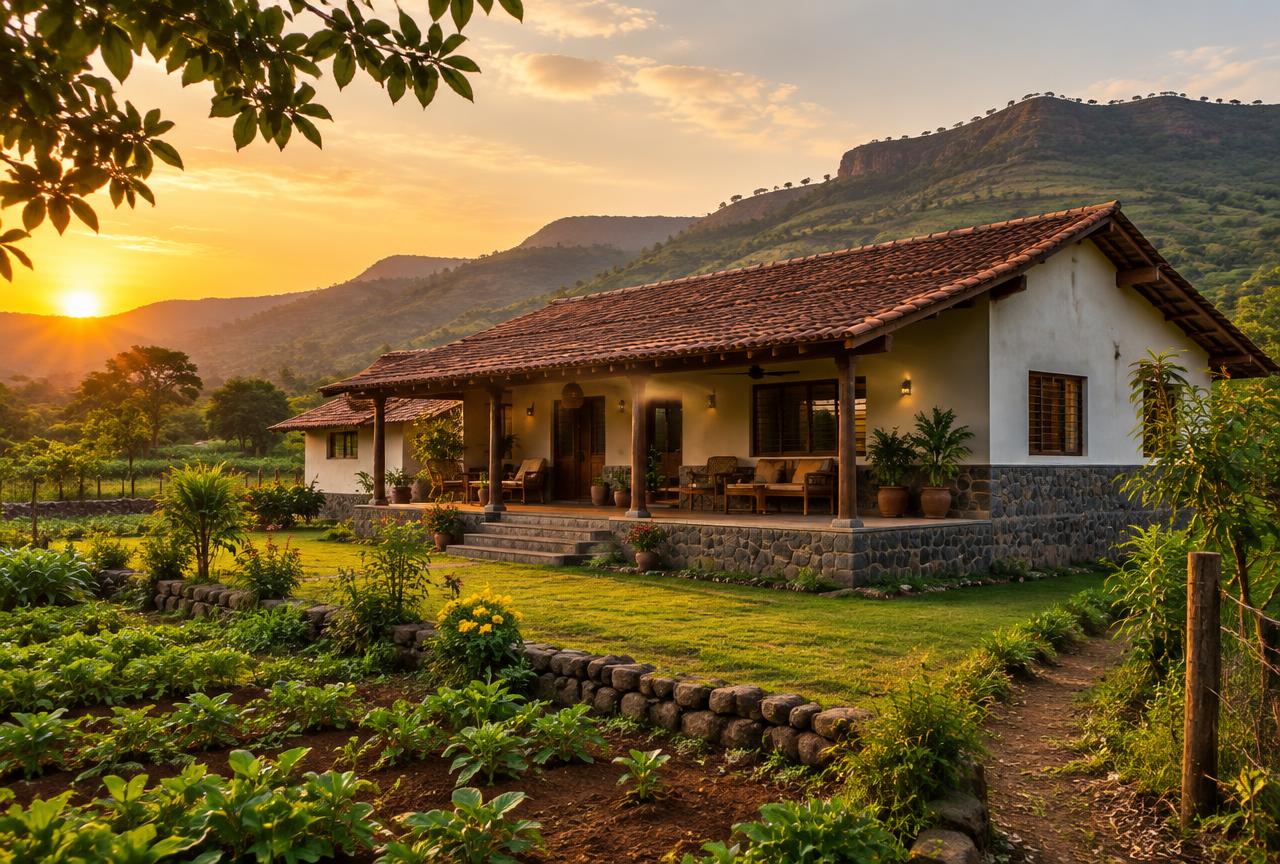
Locally available stone (basalt or laterite depending on the specific belt) is both authentic to the Sahyadri foothill aesthetic these farmhouses aim for and typically cheaper than transporting finishing material from the city, making it the practical choice for cladding, boundary walls and landscaping features that need to withstand the local climate over many years.
- Check NA and access
- Plan water and power early
- Compound wall is a big line item
- Use local stone
03Cost breakdown for a typical farmhouse project
Beyond the ₹2,200–₹3,600 per sq.ft. core construction cost, owners should budget separately for a borewell and pump (₹1.5–₹4 lakh depending on depth and yield), a compound wall around a larger-than-urban plot boundary (often ₹3–₹8 lakh depending on perimeter), power connection or generator backup (₹1–₹3 lakh), and basic landscaping with local stone paving (₹2–₹6 lakh) — together these can add 20–35% to the core construction estimate.
On a 2,000 sq.ft. farmhouse at the midpoint of the cost range, this means a core construction estimate of roughly ₹58 lakh can realistically become a total project cost of ₹70–₹78 lakh once these infrastructure items are included, a gap worth planning for from the very first budget conversation rather than discovering midway through the project.
04Design choices suited to the monsoon-heavy Sahyadri belt
This belt receives some of the heaviest rainfall in the wider Mumbai region, which favours sloped roofs over flat terraces for faster water shedding, generous eaves and overhangs to protect walls from wind-driven rain, and robust waterproofing detailing at every roof-wall junction, since a farmhouse standing empty through the working week gives leaks far longer to cause damage before anyone notices.
Verandas and covered outdoor sitting areas, a popular feature in this belt's farmhouse designs, also need their own drainage planning, since a poorly sloped veranda floor can direct water back towards the house rather than away from it during the heaviest monsoon spells.
05A practical pre-construction checklist for this belt
Before finalising a budget, verify NA status and access road condition in person (not from an old survey), get a water-yield test on any proposed borewell location, and confirm the nearest power line distance, since a transformer or long cable run to a remote plot can itself be a meaningful and easily underestimated cost.
It is also worth speaking to a few existing farmhouse owners in the same village or belt about their actual experience with water yield, monsoon access and security, since this kind of first-hand local knowledge often surfaces practical issues a formal site survey alone would not reveal.
06Security and caretaking for a weekday-empty property
A farmhouse left unattended through the working week is more exposed to petty theft of fittings, fixtures and even boundary-wall material than an occupied home, which is why many owners in this belt employ a local caretaker, often a nearby villager, to live on or regularly check the property rather than relying solely on a compound wall and gate for security.
Basic solar-powered security lighting and a simple CCTV system with remote viewing, both relatively inexpensive additions at the time of construction, give an owner some visibility into the property between visits and are worth including in the initial budget rather than retrofitting later once a security concern has already arisen.
07Utilities and self-sufficiency on a remote plot
Given how unreliable municipal power and water can be this far from urban infrastructure, many farmhouse owners invest in a modest rooftop solar setup to cover basic lighting and water-pump loads, and a rainwater harvesting system to supplement the borewell during drier months, both of which reduce the property's ongoing dependence on inconsistent external supply.
These additions typically cost ₹2–₹6 lakh combined depending on scale, and while they add to the upfront budget, they meaningfully reduce the frustration of visiting a weekend property only to find no water pressure or a power cut with no backup in place.
08How this applies to your project
Every plot is different — soil, access, approvals and budget change the right answer. MumbaiConstructions's engineers review your site and drawings and explain the options with costs, so you can decide with confidence.
Get a free site visit in Mumbai, Navi Mumbai & Thane
MumbaiConstructions is a civil construction company and turnkey contractor serving Mumbai, Navi Mumbai & Thane and the wider Mumbai Metropolitan Region since 2009. Share your plot or building details and a project engineer will visit, check feasibility and send a line-item BOQ within 7 working days — no obligation.
Frequently asked questions
Does MumbaiConstructions help with this?
Yes. We offer free site visits, feasibility advice and a line-item BOQ across Mumbai, Navi Mumbai, Thane, Panvel and nearby areas.
Where do you work?
Mumbai Island City and suburbs, Navi Mumbai, Thane, Kalyan-Dombivli, Panvel, Vasai-Virar and surrounding MMR towns.