


Quick answer
During the monsoon, protect excavations, stop concreting in heavy rain, cover cement and steel, and focus on indoor works. On coastal and low-lying sites, plan for 3–4 months of slowdown and flooding risk.
On this page
- Key takeaways
- The short answer
- Key points explained
- What work continues productively during the monsoon
- Coastal and low-lying site considerations
- A monsoon-readiness checklist for site managers
- How labour and material supply shift during the monsoon
- Insurance and liability during the monsoon
- How this applies to your project
- Frequently asked questions
Key takeaways
- Dewater excavations
- Cover materials
- Avoid external plaster in rain
- Waterproof roofs before June
01The short answer
During the monsoon, protect excavations, stop concreting in heavy rain, cover cement and steel, and focus on indoor works. On coastal and low-lying sites, plan for 3–4 months of slowdown and flooding risk.
Mumbai, Thane and Navi Mumbai all receive sustained monsoon rainfall from June through September, often with multi-day heavy spells, so a monsoon plan is not optional for any project whose schedule overlaps that window — it needs to be written down and agreed with the contractor before the rains start, not improvised once the first downpour arrives.
02Key points explained
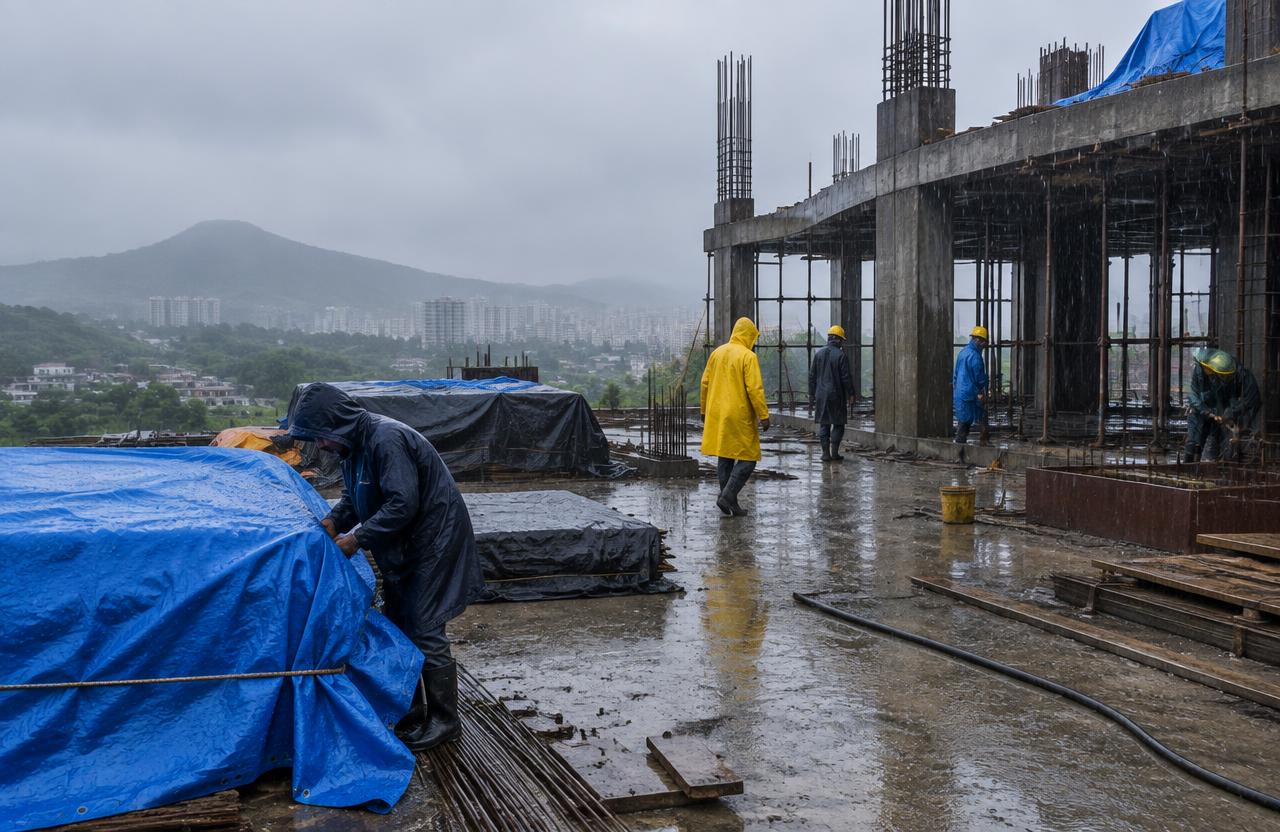
Open excavations and foundation trenches fill with water during sustained rain; submersible pumps should be staged on-site before the monsoon begins, and excavations ideally backfilled or covered with sheeting whenever work pauses for more than a day or two, since standing water softens the sides of a trench and risks collapse, particularly in the sandy or loose-fill soils common across much of the region.
Concrete cast during heavy, uninterrupted rain suffers from washout of cement paste from the surface and inconsistent curing; reputable contractors stop or cover active concreting during heavy spells and use tarpaulin shelters for any pour that cannot be postponed, protecting both the fresh concrete and the formwork beneath it. A pour that proceeds despite heavy rain without this protection can show surface honeycombing and reduced strength that only becomes apparent once the shuttering is removed.
Cement bags absorb moisture from humid air even without direct rain contact and lose strength; steel reinforcement left exposed develops surface rust that must be wire-brushed before use. Covered, raised storage — pallets under tarpaulin, away from standing water — is standard monsoon site practice, and cement older than about three months even under good storage should be tested or discarded rather than used on the assumption that the bag looks intact.
Roof and terrace waterproofing should be completed and tested before the monsoon arrives, since applying waterproofing membranes during active rain is both technically unreliable and often impossible — a terrace left unwaterproofed into June risks water ingress into the slab itself, a far costlier repair than the waterproofing would have been, and one that can affect the ceiling of every floor below if left unaddressed for an entire season.
- Dewater excavations
- Cover materials
- Avoid external plaster in rain
- Waterproof roofs before June
03What work continues productively during the monsoon
Internal plastering in covered floors, electrical and plumbing rough-in, tiling, painting of internal walls, and fabrication of doors, windows and modular furniture off-site all continue unaffected by rain, which is why a well-planned schedule shifts the project's external, weather-exposed tasks to the dry season and uses the monsoon for everything that happens under a completed roof.
A contractor who sequences work this way effectively treats the monsoon as a scheduled indoor-work phase rather than a forced pause, keeping the overall project moving at close to its normal pace even through the heaviest rainfall months, provided the roof and external envelope were completed before the rains began.
04Coastal and low-lying site considerations
Sites near Thane creek, Vasai-Virar, Panvel's low-lying stretches and parts of Navi Mumbai close to tidal water face a combined risk of rainfall and high tide backing up stormwater drains, sometimes causing waterlogging that lasts days rather than hours. These sites should budget for 3–4 months of meaningfully reduced productivity each monsoon, not just occasional rain days, and plan foundation and ground-level work to finish well clear of this window.
On these sites, it is worth raising ground-floor plinth levels above the typical regional norm specifically to account for observed waterlogging depth in past monsoons, a precaution inland plots generally do not need but which can prevent recurring water ingress at ground level for the lifetime of the building.
05A monsoon-readiness checklist for site managers
Before the first week of June, a site should have functioning submersible pumps and spare fuel/power on hand, all excavations either backfilled or sheeted, cement and steel moved to covered elevated storage, terrace and roof waterproofing completed and ponding-tested, and site drainage channels cleared so rainwater has a clear path away from the structure.
It is also worth assigning one person on the site team specific responsibility for monsoon readiness each year — checking pump function weekly, clearing debris from drains after each heavy spell, and inspecting tarpaulin covers for wear — since a checklist completed once in May is only useful if someone keeps maintaining it through a four-month rainy season.
06How labour and material supply shift during the monsoon
Some skilled trades, particularly those whose work is weather-dependent like external plastering and painting crews, see reduced availability during the heaviest monsoon weeks as demand for indoor work temporarily outpaces supply across many sites simultaneously — booking these crews for the post-monsoon external finishing stage well in advance avoids a scramble once the rains begin to clear.
Material suppliers also sometimes face their own monsoon-related logistics delays — flooded access roads, slower quarry operations for aggregate, and reduced production at some brick kilns — so ordering key bulk materials with a buffer ahead of when they are actually needed protects the schedule from supply-side delays that are outside the contractor's direct control.
07Insurance and liability during the monsoon
A contractor's all-risk insurance policy should specifically confirm whether monsoon-related damage — a flooded excavation, water-damaged material in storage — is covered, since some basic policies exclude weather-related loss or require specific monsoon-season riders that are easy to overlook until a claim is actually needed.
Owners should ask to see this confirmation in writing before the monsoon begins each year a project spans more than one rainy season, rather than assuming coverage exists, since the cost of adding an appropriate rider is typically small compared with the cost of an uninsured loss during a particularly heavy spell.
08How this applies to your project
Every plot is different — soil, access, approvals and budget change the right answer. MumbaiConstructions's engineers review your site and drawings and explain the options with costs, so you can decide with confidence.
Get a free site visit in Mumbai, Navi Mumbai & Thane
MumbaiConstructions is a civil construction company and turnkey contractor serving Mumbai, Navi Mumbai & Thane and the wider Mumbai Metropolitan Region since 2009. Share your plot or building details and a project engineer will visit, check feasibility and send a line-item BOQ within 7 working days — no obligation.
Frequently asked questions
Does MumbaiConstructions help with this?
Yes. We offer free site visits, feasibility advice and a line-item BOQ across Mumbai, Navi Mumbai, Thane, Panvel and nearby areas.
Where do you work?
Mumbai Island City and suburbs, Navi Mumbai, Thane, Kalyan-Dombivli, Panvel, Vasai-Virar and surrounding MMR towns.