


Quick answer
A soil test tells the structural engineer the safe bearing capacity of the ground, so the foundation is neither unsafe nor over-designed. In Mumbai, where reclaimed land, marshy soil and rock vary even within a plot, it typically costs ₹15,000–₹45,000 and can save lakhs.
On this page
- Key takeaways
- The short answer
- Key points explained
- What the test actually involves
- Reading the report: what to look for
- Cost versus consequence: a worked comparison
- When a second test is worth commissioning
- Questions to ask the testing agency before they begin
- How this applies to your project
- Frequently asked questions
Key takeaways
- Identifies reclaimed/filled land and rock depth
- Decides footing or piling type
- Avoids cracks and settlement
- Essential for G+3 and above
01The short answer
A soil test tells the structural engineer the safe bearing capacity of the ground, so the foundation is neither unsafe nor over-designed. In Mumbai, where reclaimed land, marshy soil and rock vary even within a plot, it typically costs ₹15,000–₹45,000 and can save lakhs.
Skipping it does not remove the risk — it simply shifts the discovery of a weak layer from the design stage, where it is cheap to address, to the construction stage, where it is not, and in the worst cases to years after handover, when the only remaining options are expensive and disruptive.
02Key points explained
Mumbai's geology is unusually mixed: parts of the Island City and the western suburbs sit on reclaimed or filled land, low-lying stretches near creeks hold marshy or soft clay soil, and basalt rock can appear anywhere from near the surface to several metres down — sometimes varying significantly across a single plot. A soil test identifies fill depth, soil layers and rock depth directly under your footprint rather than relying on a neighbour's foundation as a guide, since even adjacent plots can sit on different sub-surface conditions.
The bearing capacity and rock depth the test reveals decide whether the structure needs simple isolated footings, a raft foundation spreading load over a wider area, or pile foundations driven to a hard stratum — each with a very different cost and construction method, and getting this choice wrong at the design stage is far costlier to correct once excavation has begun.
Without a soil test, a structural engineer must assume a conservative (or, worse, an optimistic) bearing capacity. An overly optimistic assumption risks differential settlement and cracking once the building is loaded; an overly conservative one means paying for a far heavier foundation than the site actually needs — in practice this can mean tens of thousands of rupees of unnecessary concrete and steel poured into an over-engineered footing.
For anything G+3 and above, the load on the foundation is high enough that an incorrect assumption becomes expensive fast — a soil test costing under ₹50,000 is a rounding error against a foundation redesign or underpinning repair that can run into several lakh rupees, and against the far larger cost of a building that has to be partially vacated for remedial structural work.
- Identifies reclaimed/filled land and rock depth
- Decides footing or piling type
- Avoids cracks and settlement
- Essential for G+3 and above
03What the test actually involves
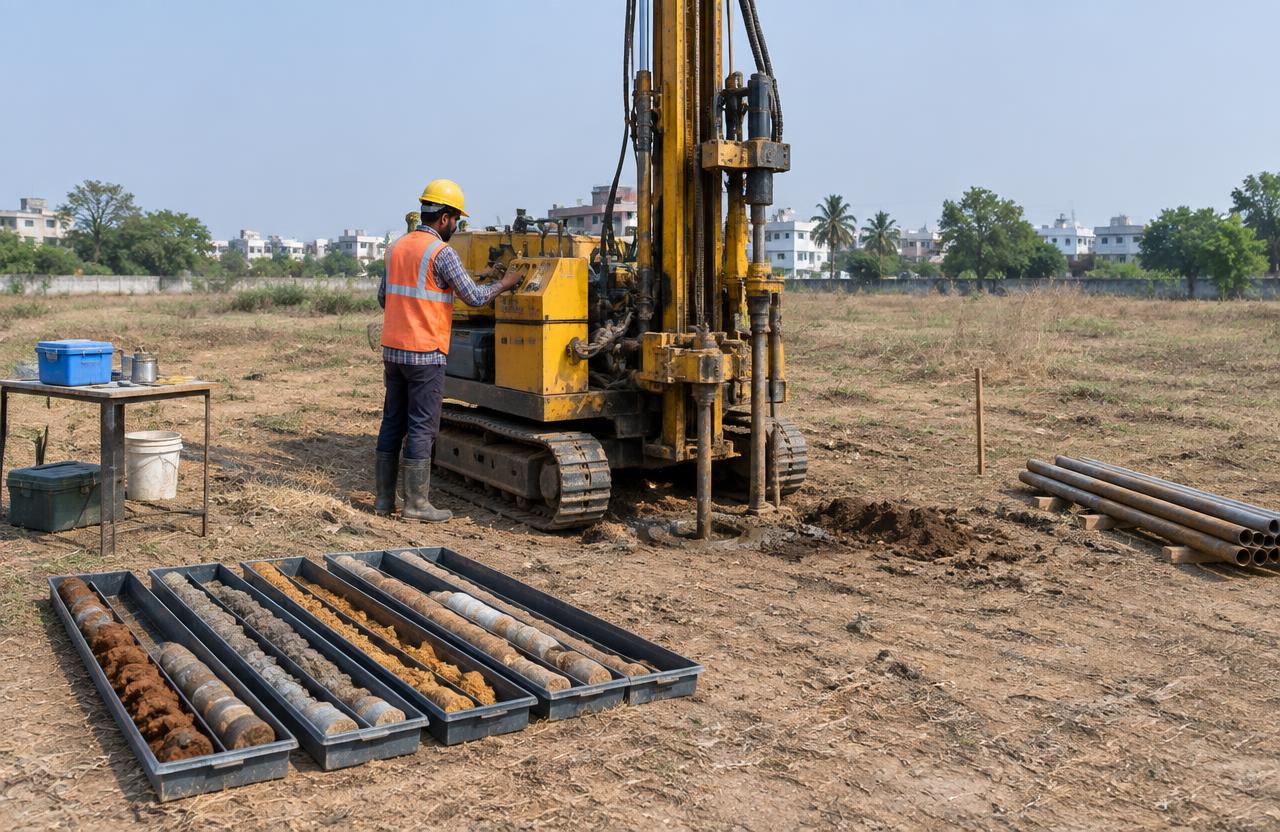
A standard penetration test (SPT) is bored at one or more points on the plot to the depth the structural engineer specifies, recording blow counts at regular intervals to estimate bearing capacity at each depth, alongside soil classification and, where needed, a water table reading — all compiled into a geotechnical report the structural engineer uses directly in foundation design.
For a typical residential plot, one to two bore points is usually sufficient; larger or irregularly shaped plots, or plots where earlier site history suggests variable fill, may warrant three or more bore points so the engineer is not extrapolating foundation design across a wider area than a single test point can reliably represent.
04Reading the report: what to look for
The key numbers to check in the report are the safe bearing capacity (SBC) at your intended foundation depth, the depth at which hard rock or a dense stratum is encountered, and the ground water table level, since a high water table near the coast or a creek changes both the foundation type and the waterproofing detailing needed at the base of the structure.
It is also worth asking the testing agency to flag any layer of loose or soft soil sandwiched between firmer layers, since this kind of "hidden" weak pocket is exactly the sort of condition that a visual inspection of the surface soil alone would never reveal, and is precisely why relying on a neighbouring building's apparently successful foundation is not a substitute for testing your own plot.
05Cost versus consequence: a worked comparison
A soil test for a typical residential plot in the Mumbai region costs roughly ₹15,000–₹45,000 depending on the number of bore points and depth required. Compare that with the cost of remedial underpinning or foundation strengthening after settlement cracks appear — commonly ₹3–₹8 lakh or more for a mid-sized house — and the test pays for itself many times over even in the single scenario where it reveals a problem.
Factor in the less tangible costs too: a family forced to vacate part of a home for underpinning work, the stress and delay of an unplanned structural repair, and the resale-value impact of a documented structural repair history — none of these show up in a simple cost comparison, but all of them make the ₹15,000–₹45,000 spent upfront look like one of the cheapest insurance policies available on any construction project.
06When a second test is worth commissioning
If construction is delayed by more than two to three years after the original soil test, or if neighbouring excavation, a new borewell, or significant groundwater extraction has occurred near the plot in the interim, it is worth commissioning a fresh test rather than relying on the old report, since ground conditions — particularly water table levels near the coast and creeks — can shift meaningfully over that span and silently invalidate the original foundation design assumptions.
07Questions to ask the testing agency before they begin
Confirm how many bore points the agency plans and at what spacing, what depth they intend to reach relative to the proposed foundation level, and how quickly the final report will be delivered after fieldwork is complete — a vague answer to any of these three questions is worth pressing on before work begins, since a rushed or under-scoped test can be nearly as unhelpful as skipping one entirely.
It is also reasonable to ask whether the same agency has tested plots in your immediate neighbourhood before and, without needing specific confidential details, what general pattern of soil conditions they have found there — local experience of this kind, treated as a sanity check rather than a substitute for your own test, can flag an unusual or inconsistent result worth double-checking.
08How this applies to your project
Every plot is different — soil, access, approvals and budget change the right answer. MumbaiConstructions's engineers review your site and drawings and explain the options with costs, so you can decide with confidence.
Get a free site visit in Mumbai, Navi Mumbai & Thane
MumbaiConstructions is a civil construction company and turnkey contractor serving Mumbai, Navi Mumbai & Thane and the wider Mumbai Metropolitan Region since 2009. Share your plot or building details and a project engineer will visit, check feasibility and send a line-item BOQ within 7 working days — no obligation.
Frequently asked questions
Does MumbaiConstructions help with this?
Yes. We offer free site visits, feasibility advice and a line-item BOQ across Mumbai, Navi Mumbai, Thane, Panvel and nearby areas.
Where do you work?
Mumbai Island City and suburbs, Navi Mumbai, Thane, Kalyan-Dombivli, Panvel, Vasai-Virar and surrounding MMR towns.