


Quick answer
Buildings older than 15 years should get a structural audit, and BMC regularly issues notices to older and cessed buildings before the monsoon. An audit typically costs ₹4–₹12 per sq.ft. and recommends repair or redevelopment.
On this page
Key takeaways
- Mandatory for older buildings on notice
- Visual survey plus NDT tests
- Report recommends repair or rebuild
- Key input for redevelopment decisions
01The short answer
Buildings older than 15 years should get a structural audit, and BMC regularly issues notices to older and cessed buildings before the monsoon. An audit typically costs ₹4–₹12 per sq.ft. and recommends repair or redevelopment.
An audit is not just a compliance formality — it is the single most reliable way for a society or owner to know whether a building is safe to continue living in, needs targeted repair, or has reached the point where redevelopment is the more sensible path, and acting on its findings quickly is almost always cheaper than waiting for visible damage to force the issue.
In practice, many societies only commission their first audit after receiving a formal notice, by which point minor, cheaply fixable deterioration has often already progressed into something more expensive — getting ahead of the notice cycle by auditing proactively around the 15-year mark is the better financial decision.
02Key points explained
Buildings that have crossed 15 years, and particularly those above 30 years, fall within the age bracket where BMC and other civic bodies routinely issue structural audit notices, especially ahead of the monsoon when water ingress accelerates deterioration of ageing concrete and steel reinforcement, and a building that ignores such a notice risks further municipal action beyond the audit requirement itself.
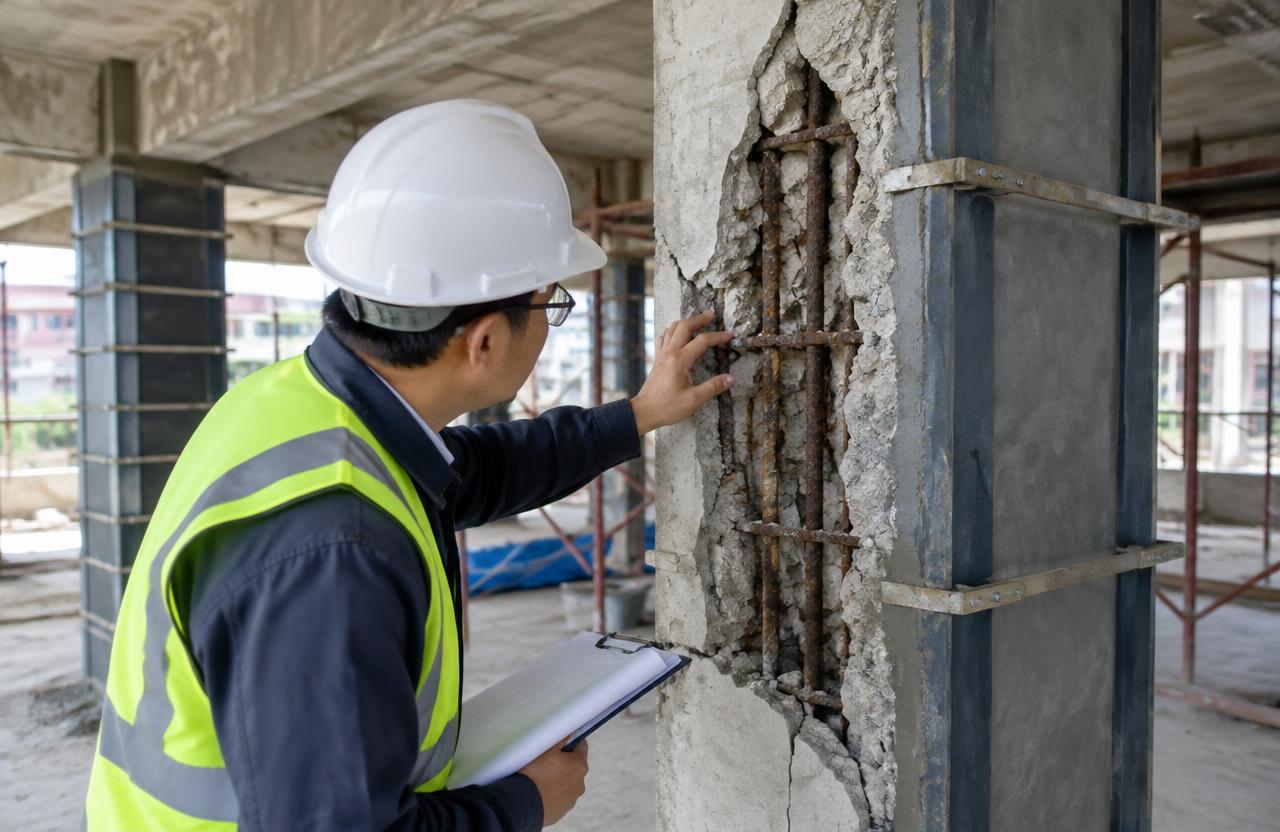
A structural audit starts with a visual survey of cracks, spalling concrete, exposed or rusted reinforcement and water seepage, followed by non-destructive tests (NDT) such as rebound hammer tests for concrete strength and in some cases core sampling or carbonation testing to assess how far corrosion has progressed into the structure, giving a far more objective picture than a visual inspection alone could provide.
The audit report classifies the building's condition — commonly into categories ranging from structurally sound with minor repair needs, to requiring major structural repair, to unsafe for continued occupation — and this classification is what the society or owner, and the civic authority, act on, often directly determining whether a society is permitted to continue occupying the building without immediate remedial work.
For a cessed or very old building, the audit's recommendation is frequently the deciding factor in whether a society pursues repair and extended maintenance, or begins the redevelopment process, since lenders, developers and the MHADA Mumbai Building Repair & Reconstruction Board (for registered cessed buildings) all rely on this report as a baseline document that frames every subsequent decision about the building's future.
- Mandatory for older buildings on notice
- Visual survey plus NDT tests
- Report recommends repair or rebuild
- Key input for redevelopment decisions
03What the audit process covers, step by step
A thorough structural audit generally follows a fixed sequence: document review of original drawings where available, a floor-by-floor visual inspection noting every crack, seepage point and area of spalling, rebound hammer testing at multiple points to estimate in-situ concrete strength, carbonation or chloride testing where corrosion is suspected, and a final written report with a condition rating and specific repair or rebuild recommendations.
For a mid-sized society building, this process typically takes two to four weeks from the initial site visit to the final written report, though buildings with extensive damage or requiring core sampling can take longer, since samples sometimes need to be sent to a laboratory for testing rather than assessed on-site.
04Typical findings and what they mean
Spalling concrete with visible rusted reinforcement usually indicates the reinforcement cover has failed and corrosion has begun expanding the steel, cracking the surrounding concrete from within — this needs the affected concrete broken out, the steel treated or replaced, and the section recast, not just surface plastering over the visible damage.
Widespread carbonation (loss of the concrete's natural alkaline protection to the steel) across many structural members, rather than isolated spots, is usually the signal that pushes a recommendation towards redevelopment rather than repair, since repairing dozens of individually corroding members throughout a building often costs close to what redevelopment would, without extending the building's functional life nearly as far.
05Cost range and what drives it
₹4–₹12 per sq.ft. is the typical range for the audit itself, with the lower end covering a visual survey and basic NDT for a straightforward low-rise building, and the upper end reflecting a larger or taller building needing more extensive testing, core sampling, or detailed reporting for a redevelopment feasibility submission.
On a typical 10,000 sq.ft. society building, this translates to roughly ₹40,000–₹1.2 lakh for the audit — a modest sum compared with even a single round of inappropriate or ineffective patch repairs undertaken without first understanding the true extent of the deterioration.
06What happens after the report is submitted
If the audit recommends repair, the society typically commissions a structural repair contractor to carry out the specific works identified — jacketing, re-plastering with corrosion-inhibiting treatments, or waterproofing upgrades — and may be required to submit a compliance report to the civic authority confirming the work is complete.
If the audit recommends redevelopment, the report becomes the first supporting document in any subsequent feasibility study, Section 79A self-redevelopment proposal, or developer negotiation, since it establishes an independent, professional basis for the building's condition that all other parties in the process will reference.
07Choosing the right structural auditor
Look for a structural engineer or auditing firm with specific experience auditing buildings of a similar age and construction type in the Mumbai region, rather than a general engineering consultancy whose main work is new construction, since the diagnostic skill needed to read ageing concrete and corrosion patterns is a distinct specialisation from designing new structures.
It is reasonable to ask for sample audit reports from past projects (with identifying details removed if needed) to judge whether the auditor produces the kind of detailed, actionable report a society can actually use to make a repair-versus-redevelopment decision, rather than a brief, generic document that restates the obvious without giving clear technical direction.
08How this applies to your project
Every plot is different — soil, access, approvals and budget change the right answer. MumbaiConstructions's engineers review your site and drawings and explain the options with costs, so you can decide with confidence.
Get a free site visit in Mumbai, Navi Mumbai & Thane
MumbaiConstructions is a civil construction company and turnkey contractor serving Mumbai, Navi Mumbai & Thane and the wider Mumbai Metropolitan Region since 2009. Share your plot or building details and a project engineer will visit, check feasibility and send a line-item BOQ within 7 working days — no obligation.
Frequently asked questions
Does MumbaiConstructions help with this?
Yes. We offer free site visits, feasibility advice and a line-item BOQ across Mumbai, Navi Mumbai, Thane, Panvel and nearby areas.
Where do you work?
Mumbai Island City and suburbs, Navi Mumbai, Thane, Kalyan-Dombivli, Panvel, Vasai-Virar and surrounding MMR towns.