


Quick answer
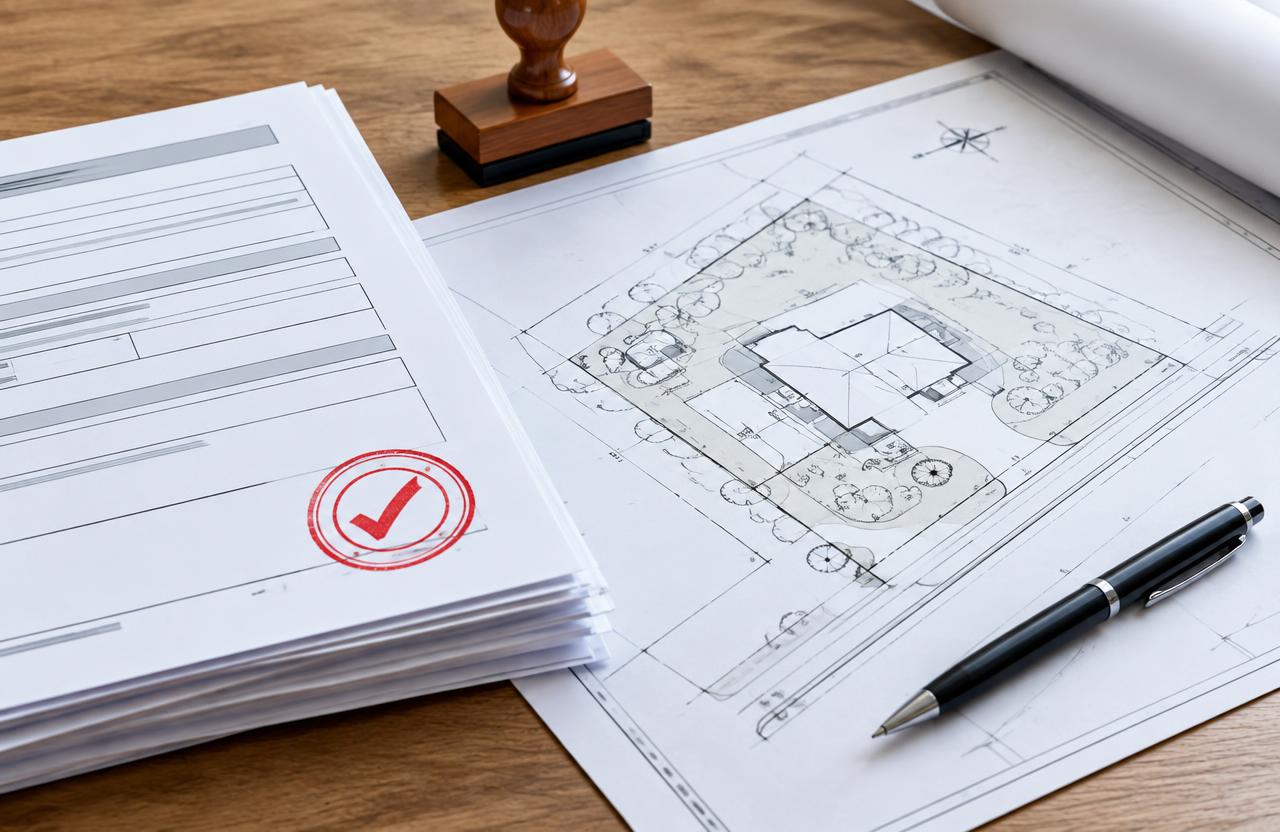
An occupancy certificate (OC) confirms the building is built as per sanctioned plans and is fit to occupy. Without it, utility connections, resale and loans can be difficult.
On this page
- Key takeaways
- The short answer
- Key points explained
- What happens without an OC
- Partial occupancy certificates
- What a buyer or owner should verify
- Regularising an existing building without an OC
- The OC's role in a housing society's collective interest
- A checklist for the society formation documentation handover
- Occupancy certificate status for commercial and mixed-use buildings
- How an OC fits into the overall project-completion sequence
- How this applies to your project
- Frequently asked questions
Key takeaways
- Apply after completion
- Built as per plan
- Needed for resale
- Fire NOC for tall buildings
01The short answer
An occupancy certificate (OC) confirms the building is built as per sanctioned plans and is fit to occupy. Without it, utility connections, resale and loans can be difficult.
Many owners move in before the OC is issued because the building looks finished — but an unfinished approval trail can resurface as a serious problem years later, at resale or refinancing.
02Key points explained
Applying for the OC happens after construction is completed, once the developer or owner submits completion documents to the local authority (BMC within Mumbai city, the respective municipal corporation elsewhere in the MMR) for inspection and sign-off against the sanctioned plan. This application should be filed promptly on completion rather than left pending, since the longer a building is occupied without an OC, the harder the eventual paperwork trail becomes to reconstruct.
Built as per plan is the core test the authority applies: any deviation from the sanctioned drawings — an extra room, an enclosed balcony, a changed floor layout — can hold up the OC until it is either regularised (where permissible) or rectified to match the approved plan. This is exactly why unauthorised alterations made during or after construction, even seemingly minor ones, should always be checked against the sanctioned plan before they are built.
Needed for resale is a practical reality because most buyers' lawyers and most banks funding a resale purchase will specifically ask for the OC as part of due diligence; its absence is a red flag that complicates, delays or sometimes kills a resale transaction. A seller who cannot produce an OC frequently has to accept a lower price or a longer negotiation to compensate the buyer for the added risk.
A fire NOC for tall buildings (and increasingly for a wide range of building types and heights under evolving fire safety rules) is typically a precondition to the OC itself, since occupancy sign-off assumes the building's fire safety systems — staircases, refuge areas, fire-fighting equipment — are installed and functional, not merely planned.
Each of these four points is really a different stakeholder's reason to care about the same certificate: the authority cares that the building matches what it approved, a buyer's bank cares that the asset is legally mortgageable, a resale buyer cares about undisturbed future use, and a tall building's occupants specifically depend on the fire systems the OC confirms are actually functional — which is why the OC functions as a single document that satisfies several very different, and equally important, concerns at once.
- Apply after completion
- Built as per plan
- Needed for resale
- Fire NOC for tall buildings
03What happens without an OC
Buildings occupied without an OC commonly face difficulty getting permanent water and electricity connections (utilities sometimes allow only temporary connections pending the OC, or none at all), cannot be mortgaged cleanly for a fresh home loan in many cases, and carry real legal exposure since occupying a building without an OC can itself attract penalties from the local authority.
None of this stops people occupying such buildings in practice across the MMR, but it does mean the exposure sits latent until a resale, refinance, or a civic enforcement drive brings it to the surface — usually at the least convenient moment for the owner holding the property at that time.
04Partial occupancy certificates
For large or phased projects, a Partial Occupancy Certificate (part-OC) is sometimes issued for completed wings or floors of a building while other sections are still under construction — this lets owners occupy finished portions legally without waiting for the entire project to complete, provided the completed portion independently meets safety and completion requirements such as fire exits and services.
05What a buyer or owner should verify
Ask to see the actual OC document (not just a verbal assurance it has been 'applied for'), cross-check the OC covers the specific unit and wing being purchased (large projects sometimes have OCs for some wings but not others), and if only a Commencement Certificate or completion certificate is available, understand clearly that these are not the same as an OC and do not carry the same legal standing.
06Regularising an existing building without an OC
Where a building has been occupied for years without an OC, the practical route is usually to engage an architect to assess the actual deviations from the sanctioned plan, determine whether they can be regularised under the applicable rules (some minor deviations can be compounded on payment of a penalty, while structural deviations affecting safety typically cannot), and then formally apply for the OC with any necessary rectification completed first.
This process can take considerably longer than an OC application filed promptly at original completion, which is precisely why timely application — rather than waiting and hoping the gap goes unnoticed — remains the better strategy for any owner or developer currently mid-construction.
07The OC's role in a housing society's collective interest
In a multi-unit building, the OC typically covers the building or wing as a whole rather than being issued flat by flat, which means an individual flat owner's ability to resolve an OC gap can depend on the cooperation of the developer or the housing society managing the building's completion documentation as a collective effort.
This is one of the reasons housing society formation and the developer's handover of complete building documentation (including the OC) is an important milestone in its own right — a society that takes over building management without first securing this documentation from the developer often finds itself needing to coordinate a much more difficult, after-the-fact OC application on the developer's behalf, sometimes years after the building was first occupied.
08A checklist for the society formation documentation handover
When a society is formed and takes over from the developer, the handover documentation should explicitly include the OC (or a written status update on its application if still pending), the sanctioned building plan, fire NOC, structural stability certificate, and completion certificate — a society that signs off on taking over building management without confirming all of these are in hand loses significant leverage to compel the developer to complete them later.
Many state housing-society frameworks give the managing committee the right to withhold full handover acceptance from the developer until this document set is complete, and exercising that right at the handover stage is considerably easier than pursuing the same documents from an unresponsive developer years after possession.
09Occupancy certificate status for commercial and mixed-use buildings
Commercial and mixed-use buildings face the same OC requirement as residential ones, but often with additional scrutiny on fire safety and parking compliance given higher occupant density and vehicular traffic, and a commercial tenant's own business licensing in many cases depends on the building itself holding a valid OC — meaning an OC gap at the building level can indirectly block an individual shop or office tenant from obtaining their own trade licence even though the tenant personally did nothing wrong.
Prospective commercial tenants are well advised to verify the building's OC status as part of their own due diligence before signing a lease, for exactly this reason — a attractively priced commercial space in a building without a valid OC can turn into a costly problem once the tenant discovers their own licensing is blocked by a building-level documentation gap they had no part in creating.
10How an OC fits into the overall project-completion sequence
The OC is typically the last major milestone in a well-run construction project, following the completion certificate and preceding or coinciding with final handover to residents or buyers — treating it as the genuine finishing line for the project, rather than a formality to chase up after occupants have already moved in, keeps the right incentive structure in place for the developer or owner to close out every other compliance requirement (fire NOC, structural stability certificate, lift certification) that the OC application itself depends on.
For this reason, a sensible project completion checklist places the OC application near the very top of the final-stage task list, not the bottom, since nearly every other completion document feeds into it and a missing precondition discovered only when the OC application is actually filed can add unnecessary weeks to what should otherwise be a routine final step.
11How this applies to your project
Every plot is different — soil, access, approvals and budget change the right answer. MumbaiConstructions's engineers review your site and drawings and explain the options with costs, so you can decide with confidence.
Get a free site visit in Mumbai, Navi Mumbai & Thane
MumbaiConstructions is a civil construction company and turnkey contractor serving Mumbai, Navi Mumbai & Thane and the wider Mumbai Metropolitan Region since 2009. Share your plot or building details and a project engineer will visit, check feasibility and send a line-item BOQ within 7 working days — no obligation.
Frequently asked questions
Does MumbaiConstructions help with this?
Yes. We offer free site visits, feasibility advice and a line-item BOQ across Mumbai, Navi Mumbai, Thane, Panvel and nearby areas.
Where do you work?
Mumbai Island City and suburbs, Navi Mumbai, Thane, Kalyan-Dombivli, Panvel, Vasai-Virar and surrounding MMR towns.