


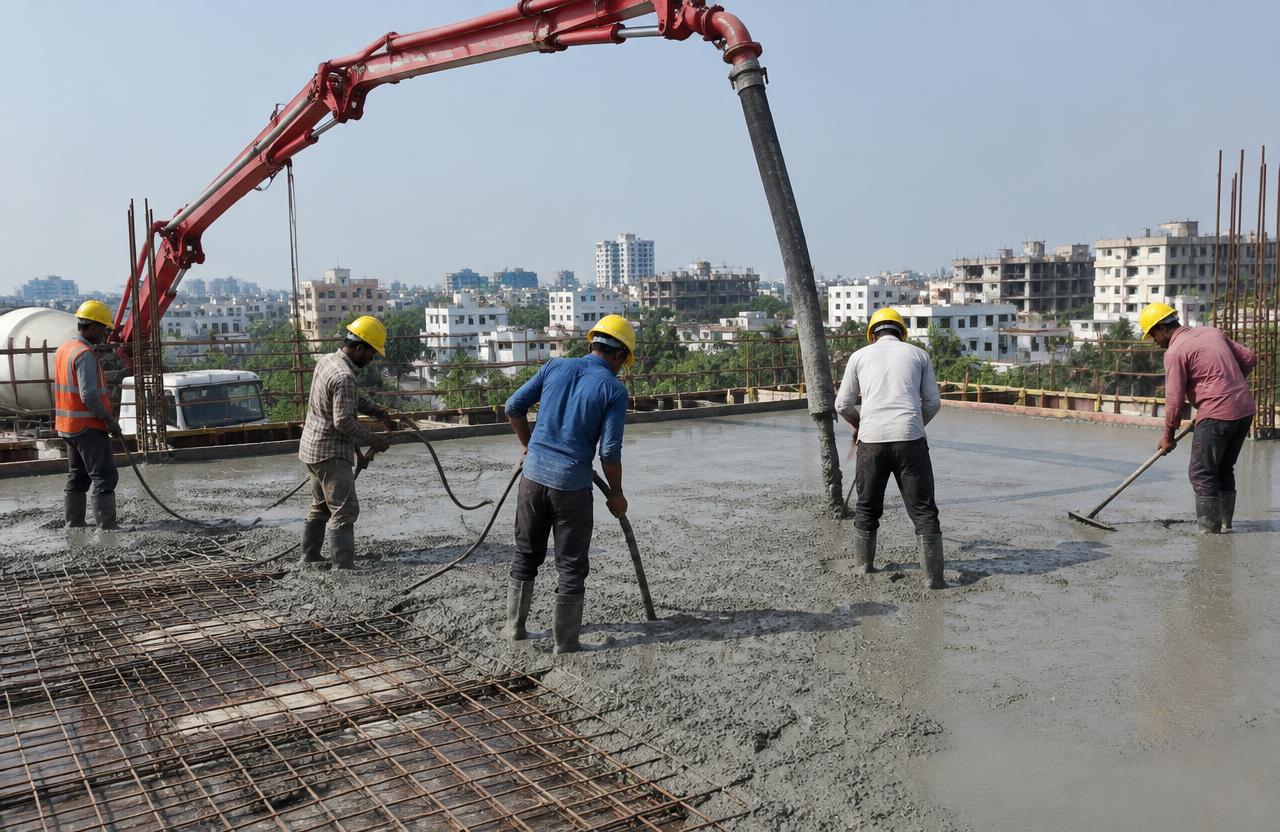
Quick answer
Concrete roads for societies and planned townships use M30–M40 PQC over a compacted sub-base, with joints and curing. They outlast asphalt and need little maintenance.
On this page
- Key takeaways
- The short answer
- Key points explained
- Construction sequence step by step
- Concrete versus asphalt for a township
- What a society should check before signing off
- Budgeting for a township road network
- Why concrete pays off over a society's maintenance cycle
- Speed bumps, utility cuts and other long-term maintenance traps
- How this applies to your project
- Frequently asked questions
Key takeaways
- Proper sub-base
- Joints every 4–5 m
- 14-day curing
- Drainage on both sides
01The short answer
Concrete roads for societies and planned townships use M30–M40 PQC over a compacted sub-base, with joints and curing. They outlast asphalt and need little maintenance.
They cost more upfront than asphalt but are the better choice wherever heavy vehicles, water-logging or a 20-plus year design life matter more than the initial budget. For a society that will not resurface its internal roads every few years, the lifetime cost usually favours concrete.
02Key points explained
A proper sub-base — usually compacted murum or Granular Sub-base (GSB) followed by a Wet Mix Macadam (WMM) layer, sometimes with a Dry Lean Concrete (DLC) layer beneath the final slab — is what actually carries the load; skipping or thinning this layer is the single biggest cause of concrete roads cracking within a few years. A sub-base that looks adequately compacted by eye can still fail a density test, which is why the test result matters more than visual inspection.
Joints are cut into the pavement quality concrete (PQC) every 4–5 metres, both as contraction joints to control where shrinkage cracks appear and as construction joints between daily pours; sealing these joints with a bituminous or polysulphide sealant afterwards keeps water and grit out of the joint. An unsealed joint lets monsoon water seep straight down to the sub-base, undermining the very layer the joint was designed to protect.
Curing for at least 14 days — by ponding water, covering with wet hessian, or spraying a curing compound — is non-negotiable for M30–M40 concrete to reach its design strength; concrete that dries out in the first week never recovers that lost strength even if it is cured properly afterwards. A road opened to traffic early because curing was cut short typically shows surface cracking and raveling within the first year.
Drainage on both sides of the road, typically a lined stormwater channel with periodic catch pits connecting to the township's main drainage, has to be built alongside the road rather than as an afterthought — concrete roads do not flex to shed water the way asphalt can, so poor side drainage shows up as standing water and algae within one monsoon. A road built without this drainage channel often needs one retrofitted within a year or two, at a cost well above what building it in from the start would have been.
These four requirements are really one continuous system rather than four independent checkboxes: a sub-base that cannot carry the load eventually cracks the slab regardless of how well the joints are cut; joints that are not sealed let water reach that same sub-base and accelerate its failure; and drainage that cannot clear water away keeps the sub-base saturated for longer after every monsoon shower, compounding all of the above. A road built to skimp on any one of these four elements typically fails years earlier than its design life, even though each individual shortcut looks minor in isolation.
- Proper sub-base
- Joints every 4–5 m
- 14-day curing
- Drainage on both sides
03Construction sequence step by step
The sequence runs: subgrade preparation and compaction (checked by field density test), GSB laying and rolling, WMM layer and rolling, an optional DLC layer for heavy-traffic internal roads, steel reinforcement or dowel bars at joints for load transfer, PQC pour in alternate bays using a screed or paver, surface texturing for skid resistance, saw-cutting of joints within 6–18 hours of the pour (before random cracking starts), joint sealing, and finally a minimum 14-day curing period before the road is opened to any vehicle traffic.
Internal society roads built with manual screeding typically achieve 150–200 mm slab thickness for car traffic, while township spine roads carrying trucks and fire tenders are usually designed at 200–250 mm with a DLC base — this difference is decided by the pavement design, not guessed on site. Skipping the design calculation and using a flat thickness across a whole township is a common way heavy-vehicle routes fail earlier than the rest of the road network.
04Concrete versus asphalt for a township
Asphalt roads cost roughly 20–30% less to lay initially and can be opened to traffic within a day of rolling, which is why many townships still asphalt their outer access roads. But asphalt softens in Mumbai's summer heat, ruts under parked heavy vehicles, and typically needs a resurfacing layer every 5–8 years, each resurfacing cycle adding up over a few decades to more than the original concrete alternative would have cost.
Concrete roads cost more upfront and need the full curing period before use, but a well-built PQC road in a society commonly lasts 20–25 years with only joint-sealant touch-ups, which is why most developers now concrete the internal roads and parking courts even when the approach road stays asphalt. The decision often comes down to traffic type: a quiet, low-traffic internal lane can justify asphalt's lower upfront cost, while a road carrying garbage trucks, fire tenders or frequent heavy deliveries benefits from concrete's durability.
05What a society should check before signing off
Ask for the sub-base compaction test report (usually a Proctor density test result) before the PQC pour begins — once concrete is poured, a weak sub-base cannot be fixed without breaking the road open again. Confirm the concrete grade on the pour day's delivery challan matches the design mix (M30 for car roads, M40 for fire-tender and heavy-vehicle routes), and insist that curing water or curing compound is visibly applied daily for the full period — a photo log from the contractor for each day of curing is a reasonable ask for a society-funded road.
It is also worth checking that joint spacing and sealing match the drawing before the road is handed over, since poorly sealed or missing joints are difficult to spot on a casual drive-through inspection but are exactly where the first monsoon-season failures tend to begin.
06Budgeting for a township road network
Concrete road cost in the MMR is usually quoted per square metre rather than per running metre, since width varies across internal lanes, spine roads and parking courts; a society should ask for the rate broken down by pavement thickness (150 mm, 200 mm, 250 mm) so that a spine road correctly costed at the thicker, heavy-duty specification is not quietly averaged in with thinner internal-lane pricing.
Phasing road construction around the monsoon calendar also affects cost — pouring concrete and achieving full curing before the rains arrive avoids the common, expensive pattern of a partially cured road being damaged by the season's first heavy showers and needing partial reconstruction before the township can even open the road to residents.
07Why concrete pays off over a society's maintenance cycle
A society that resurfaces an asphalt road every 6–7 years, and factors in the disruption of repeated resurfacing work to residents' vehicles and daily access, is effectively paying for the road multiple times over a 25-year span, whereas a concrete road built once to the correct sub-base and curing specification needs only joint resealing in that same period — a far smaller, less disruptive maintenance task.
This is the central reason most developers and larger townships in the MMR have shifted toward concreting their internal road network even where the approach road from the public highway remains asphalt: the internal roads are where the society bears the long-term maintenance cost directly, and that is exactly where concrete's lifetime-cost advantage matters most.
08Speed bumps, utility cuts and other long-term maintenance traps
Speed bumps on a concrete internal road should be formed as part of the original pour or added using a properly bonded, engineered hump rather than simply mounded with loose asphalt patching afterward, since an improperly bonded add-on hump tends to crack away from the surrounding slab within a season or two of vehicle impact.
Utility cuts — trenches later dug into a finished concrete road to lay a new cable or pipe — are one of the most common sources of premature road failure in societies, since the reinstated patch rarely matches the original slab's thickness, sub-base compaction or curing quality; coordinating all utility routing to be completed before the road is poured, rather than after, avoids this entirely foreseeable and avoidable damage to an otherwise durable road.
09How this applies to your project
Every plot is different — soil, access, approvals and budget change the right answer. MumbaiConstructions's engineers review your site and drawings and explain the options with costs, so you can decide with confidence.
Get a free site visit in Mumbai, Navi Mumbai & Thane
MumbaiConstructions is a civil construction company and turnkey contractor serving Mumbai, Navi Mumbai & Thane and the wider Mumbai Metropolitan Region since 2009. Share your plot or building details and a project engineer will visit, check feasibility and send a line-item BOQ within 7 working days — no obligation.
Frequently asked questions
Does MumbaiConstructions help with this?
Yes. We offer free site visits, feasibility advice and a line-item BOQ across Mumbai, Navi Mumbai, Thane, Panvel and nearby areas.
Where do you work?
Mumbai Island City and suburbs, Navi Mumbai, Thane, Kalyan-Dombivli, Panvel, Vasai-Virar and surrounding MMR towns.