


Quick answer
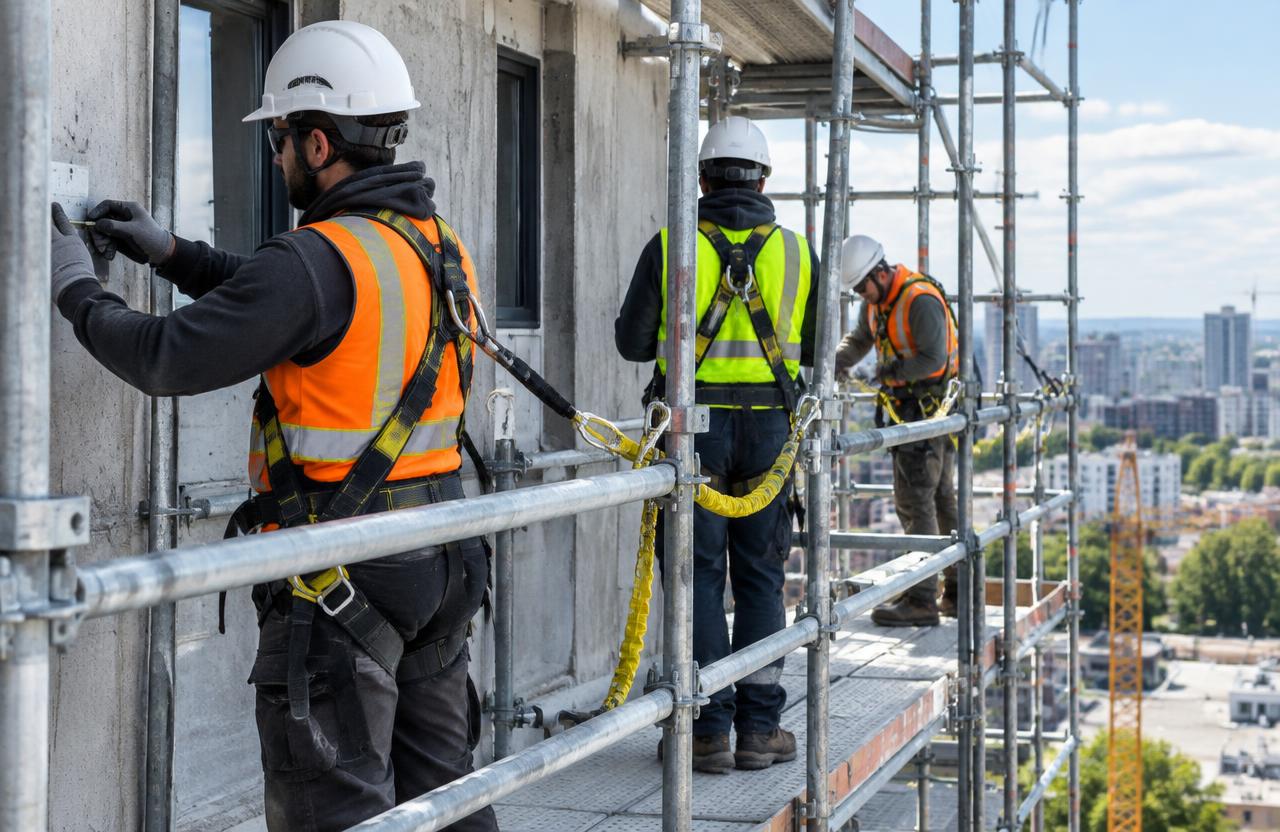
A safe site has barricading, helmets, harnesses for work at height, edge protection on slabs, safe scaffolding and first-aid. Ask your contractor for a safety plan.
On this page
- Key takeaways
- The short answer
- Key points explained
- What a written site safety plan should cover
- Where responsibility sits between contractor and owner
- Monsoon-specific site safety
- What an owner can reasonably inspect on a site visit
- Why safety culture correlates with overall site performance
- Insurance and liability considerations around site safety
- Building a culture of reporting without fear
- Safety equipment maintenance, not just provision
- Fire safety during construction itself
- How this applies to your project
- Frequently asked questions
Key takeaways
- PPE for all workers
- Edge protection
- Safe scaffolding
- Daily toolbox talks
01The short answer
A safe site has barricading, helmets, harnesses for work at height, edge protection on slabs, safe scaffolding and first-aid. Ask your contractor for a safety plan.
A visible, enforced safety plan is also one of the simplest ways for an owner to judge a contractor's overall site discipline — a site that is careless about safety is very often careless about quality as well.
02Key points explained
PPE (personal protective equipment) for all workers — helmets, safety shoes, high-visibility vests, and gloves or eye protection for specific trades like grinding or welding — is the baseline expectation on any site, and should be worn consistently, not just produced for a client visit. A site where PPE visibly disappears the moment a client leaves is a site where compliance is cosmetic rather than genuine.
Edge protection on slabs and open floor edges — guard rails, toe boards, or at minimum clearly barricaded and signed danger zones at every open edge above a modest height — directly addresses falls from height, which are among the most common and most serious construction site incidents.
Safe scaffolding — properly braced, tied to the structure where required, with secure working platforms and guard rails, inspected periodically rather than erected once and left unchecked for months — is essential wherever masonry, plastering or painting work happens above ground level. A scaffolding structure that has not been re-checked since it was first erected, even weeks earlier, is a common source of accidents once loading on it changes as work progresses.
Daily toolbox talks — brief, five-to-ten-minute briefings before each day's work begins, covering the specific hazards of that day's tasks (working at height, handling a particular machine, confined-space entry) — keep safety awareness current rather than relying on a one-time induction that workers forget within weeks.
These four measures address the most common ways construction site injuries actually occur — unprotected bodies, unprotected edges, unstable working platforms, and workers unaware of a specific day's risk — which is why a site that is consistently strong on all four tends to have a markedly better safety record than one that is strong on paper but inconsistent in daily practice.
- PPE for all workers
- Edge protection
- Safe scaffolding
- Daily toolbox talks
03What a written site safety plan should cover
A genuine safety plan names a responsible safety supervisor or officer for the site, lists site-specific hazards (working at height, excavation, electrical work, material handling, in some cases confined spaces), specifies the PPE and controls required for each, sets out an emergency response procedure (nearest hospital, emergency contacts, first-aid station location and stocked kit), and includes a schedule for routine safety inspections of scaffolding, electrical wiring and lifting equipment.
An owner is entitled to ask to see this document, not just be told verbally that 'safety is taken seriously' — and a contractor who cannot produce a written plan on request is usually one who has not actually put the thinking into it that a site genuinely needs.
04Where responsibility sits between contractor and owner
The contractor is generally responsible for day-to-day site safety management — PPE provision, scaffolding safety, worker training and supervision — since they control the workforce and the work methods. The owner's responsibility is narrower but still real: confirming the contract explicitly requires a safety plan and adequate insurance (including workmen's compensation cover for site labour), and raising concerns promptly if unsafe practices are visible during site visits, rather than assuming safety is entirely someone else's problem once a contract is signed.
05Monsoon-specific site safety
During Mumbai's monsoon months, additional risks appear: waterlogged excavations and trenches, slippery scaffolding and working platforms, and electrical hazards from water ingress into temporary power connections. A responsible contractor adjusts the safety plan seasonally — covering open excavations, improving drainage around the site, checking scaffolding grip and stability more frequently, and ensuring all temporary electrical connections are properly earthed and protected from water — rather than running an unchanged, dry-season safety routine through the wettest months of the year.
06What an owner can reasonably inspect on a site visit
Without any specialist training, an owner can still check a few visible indicators on any site visit: whether workers at height are wearing harnesses clipped to an anchor point (not just wearing one loosely), whether open floor edges and stairwell openings are barricaded, whether electrical cabling on the ground is intact rather than frayed or spliced with tape, and whether a first-aid box is visibly present and not empty.
None of these checks require technical expertise, and a contractor who is uncomfortable with an owner walking the site and asking about safety practice is itself a signal worth taking seriously.
07Why safety culture correlates with overall site performance
Contractors who invest consistently in safety training, equipment and supervision tend to also have lower worker turnover, since experienced workers prefer to stay on sites where they feel genuinely protected, and lower worker turnover in turn correlates with better continuity of skill and fewer costly mistakes across the project.
This is why an owner evaluating competing contractors is well served by treating demonstrated safety practice not as a separate, optional consideration from quality and schedule performance, but as one of the more reliable leading indicators of how disciplined and well-managed the contractor's overall site operation is likely to be.
08Insurance and liability considerations around site safety
Workmen's compensation insurance, covering injury or death of site labour during the course of their work, is a legal requirement in most jurisdictions and should be confirmed as current and adequate before work begins, not assumed to exist simply because the contractor is an established business — an owner can reasonably ask to see the policy document rather than relying on a verbal assurance.
Public liability cover, protecting against injury to a visitor, passerby or neighbouring property from site activity, is a separate and equally important policy, particularly relevant on urban infill sites in the MMR where construction activity often takes place close to a public footpath or an occupied neighbouring building.
09Building a culture of reporting without fear
Sites with the strongest safety records typically have a simple, low-friction way for workers to report a hazard or near-miss without fear of blame, since a worker who stays silent about a frayed cable or a loose scaffold plank out of fear of getting in trouble is far more dangerous to overall site safety than one who feels able to flag it immediately.
This culture is set by site leadership rather than by a written policy alone — a supervisor who reacts constructively to a reported hazard, rather than treating the report itself as a complaint to be managed, is what actually determines whether workers keep reporting problems or simply stop mentioning them.
10Safety equipment maintenance, not just provision
Providing harnesses, helmets and scaffolding is only the first half of a safety programme — equipment that is damaged, past its usable life, or stored improperly between uses provides a false sense of protection that can be worse than having no equipment at all, since workers may rely on gear that will not actually perform as expected in a fall or impact.
A simple periodic equipment check — inspecting harness webbing and stitching for wear, confirming helmet shells have no cracks, checking that scaffolding couplers and planks show no corrosion or damage — costs very little time relative to the protection it preserves, and should be a routine item on whatever safety inspection schedule the site maintains.
11Fire safety during construction itself
Active construction sites carry their own fire risks — stored fuel for generators and equipment, welding and grinding sparks near combustible formwork timber, and electrical wiring that is often temporary and less rigorously installed than a finished building's permanent wiring — and a site safety plan should address fire prevention and firefighting readiness during construction, not only the finished building's eventual fire safety systems.
Basic measures — keeping fire extinguishers at key points around an active site, storing fuel and flammable material away from welding or cutting areas, and maintaining clear emergency exit routes even while the building itself is incomplete — are inexpensive precautions against a risk that is easy to overlook amid the many other hazards a construction site presents.
12How this applies to your project
Every plot is different — soil, access, approvals and budget change the right answer. MumbaiConstructions's engineers review your site and drawings and explain the options with costs, so you can decide with confidence.
Get a free site visit in Mumbai, Navi Mumbai & Thane
MumbaiConstructions is a civil construction company and turnkey contractor serving Mumbai, Navi Mumbai & Thane and the wider Mumbai Metropolitan Region since 2009. Share your plot or building details and a project engineer will visit, check feasibility and send a line-item BOQ within 7 working days — no obligation.
Frequently asked questions
Does MumbaiConstructions help with this?
Yes. We offer free site visits, feasibility advice and a line-item BOQ across Mumbai, Navi Mumbai, Thane, Panvel and nearby areas.
Where do you work?
Mumbai Island City and suburbs, Navi Mumbai, Thane, Kalyan-Dombivli, Panvel, Vasai-Virar and surrounding MMR towns.