


Quick answer
For Mumbai's high-rainfall terraces, the most reliable systems are polyurethane or APP membrane with protective screed, or brickbat coba with a modern coating. Expect ₹70–₹200 per sq.ft. and a 5–10 year guarantee.
On this page
- Key takeaways
- The short answer
- Key points explained
- Cost and guarantee comparison
- Why slope and drainage matter as much as the membrane
- Common reasons terrace waterproofing fails early
- Maintenance that extends the guarantee period in practice
- Choosing between a new application and a re-waterproofing job
- How this applies to your project
- Frequently asked questions
Key takeaways
- PU membrane: flexible, long-life
- APP membrane: robust, needs protection
- Brickbat coba: traditional, heavy
- Always do a 48-hour ponding test
01The short answer
For Mumbai's high-rainfall terraces, the most reliable systems are polyurethane or APP membrane with protective screed, or brickbat coba with a modern coating. Expect ₹70–₹200 per sq.ft. and a 5–10 year guarantee.
The right choice depends on the terrace's usage (accessible or not), existing slab condition, and budget, but every system should be validated with a ponding test before it is accepted as complete — skipping this single verification step is the most common reason a seemingly good waterproofing job fails within its first year.
02Key points explained
A liquid-applied polyurethane (PU) membrane is flexible enough to bridge hairline cracks that open and close with temperature movement, making it well suited to Mumbai's terraces that see both intense monsoon rain and strong sun. It typically costs ₹90–₹160 per sq.ft. and is a strong choice for accessible terraces that will see foot traffic or furniture, since its elasticity tolerates the minor structural movement a roof slab naturally undergoes across seasons.
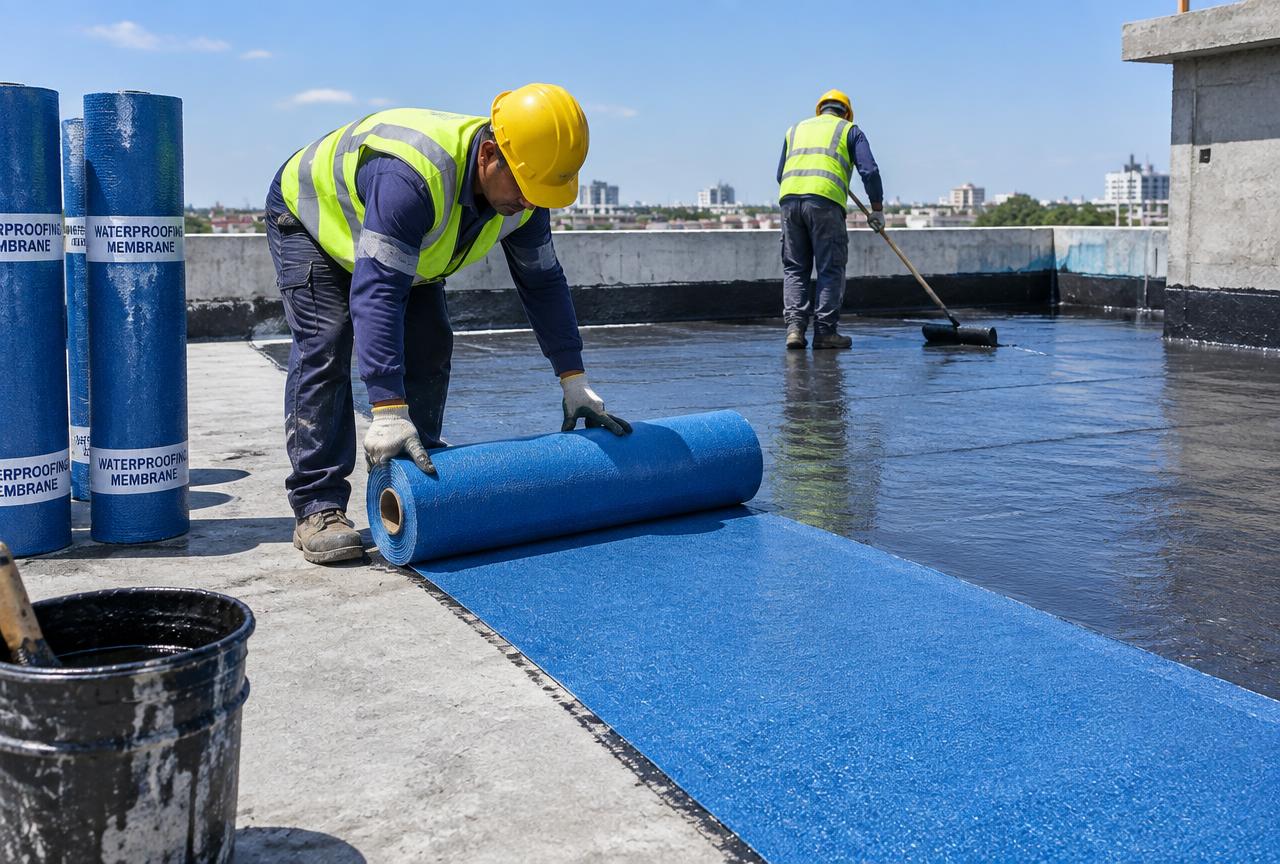
APP (modified bitumen) membrane, torch-applied in sheets, is a robust, proven system commonly used on large flat terraces, but being less flexible than PU it needs a protective screed or tiles over it to prevent puncture damage from foot traffic or stored items, and seams must be properly torch-welded to avoid leak points — a poorly welded seam is, in practice, the single most common failure point in an otherwise correctly specified APP installation.
Brickbat coba — a traditional layer of broken brick bats laid in a cement-sand mortar with a waterproof additive, finished with a screed and slope — is heavier and thicker than membrane systems but has a long track record in Mumbai's climate; pairing it with a modern elastomeric coating on top improves its crack resistance and lifespan, and its mass gives it a thermal-insulation benefit the thinner membrane systems do not offer to the same degree.
Regardless of system chosen, a 48-hour ponding test — flooding the terrace to a few centimetres depth and checking the ceiling below for any dampness — is the only reliable way to confirm the waterproofing actually works before tiles or a protective screed are laid over it and the work becomes invisible. Any damp patch discovered during this test should be investigated and resolved before covering, since once tiled over, the same leak becomes dramatically more expensive to trace and repair.
- PU membrane: flexible, long-life
- APP membrane: robust, needs protection
- Brickbat coba: traditional, heavy
- Always do a 48-hour ponding test
03Cost and guarantee comparison
Costs and warranty periods vary meaningfully by system, and a cheaper quote often means a thinner application or a shorter guarantee rather than genuine savings:
- PU membrane: ₹90–₹160/sq.ft., 7–10 year guarantee typical
- APP membrane: ₹70–₹120/sq.ft., 5–8 year guarantee typical
- Brickbat coba with coating: ₹100–₹200/sq.ft., 8–10 year guarantee typical
- Crystalline/cementitious coating alone: ₹40–₹70/sq.ft., shortest lifespan, best for minor touch-ups only
04Why slope and drainage matter as much as the membrane
No waterproofing system survives standing water indefinitely. The screed above any membrane needs a slope of at least 1:100 towards outlets, and terrace drains and rainwater pipes must be sized and positioned to clear water quickly during heavy monsoon downpours — a well-chosen membrane laid over a poorly sloped terrace will still fail at the one low spot where water collects.
A terrace with multiple outlets positioned at genuinely low points, rather than a single outlet relying on a long, shallow slope to reach it, drains measurably faster during the heaviest monsoon downpours and reduces the depth and duration of standing water that any waterproofing layer has to resist.
05Common reasons terrace waterproofing fails early
The most frequent causes of premature failure are skipping the ponding test before covering the membrane, puncturing a membrane with satellite dish mounts or planters installed without protective padding, poor detailing at parapet junctions and pipe penetrations, and choosing the cheapest system without checking its guarantee terms and whether the applicator is an authorised installer for that product.
A further common cause specific to older Mumbai buildings is re-waterproofing over a failed previous layer without removing it first — trapped moisture between two membrane layers can migrate sideways and resurface as a leak far from where the original defect actually sits, making diagnosis after the fact needlessly difficult.
06Maintenance that extends the guarantee period in practice
Even a well-installed system benefits from basic annual upkeep: clearing debris from drain outlets before the monsoon, checking for any new cracks in the protective screed or tiles above the membrane, and avoiding dragging heavy furniture or planters across the surface without protective padding underneath — none of this is complicated, but skipping it for several years in a row is a common reason an otherwise sound installation fails before its stated guarantee period ends.
Most reputable waterproofing contractors offer a maintenance visit as part of their guarantee terms, typically once a year before the monsoon, and taking up this visit rather than ignoring it is a simple way to catch a developing issue — a hairline crack in the screed, a slightly blocked drain — before it becomes an active leak.
07Choosing between a new application and a re-waterproofing job
On a new building, waterproofing is applied directly onto the structural slab before any screed or tiling, giving the installer full control over surface preparation and detailing; on an older terrace where the existing waterproofing has failed, the old layer generally needs to be identified and either removed or properly keyed into before a new membrane is applied, since simply coating over a failed system without understanding why it failed often just delays the same leak by a year or two.
A reputable contractor asked to re-waterproof an older terrace should be willing to explain specifically what caused the earlier failure — poor slope, a punctured membrane, inadequate upturns — before quoting the new work, since a repair that does not address the original cause is likely to fail again in roughly the same way.
08How this applies to your project
Every plot is different — soil, access, approvals and budget change the right answer. MumbaiConstructions's engineers review your site and drawings and explain the options with costs, so you can decide with confidence.
Get a free site visit in Mumbai, Navi Mumbai & Thane
MumbaiConstructions is a civil construction company and turnkey contractor serving Mumbai, Navi Mumbai & Thane and the wider Mumbai Metropolitan Region since 2009. Share your plot or building details and a project engineer will visit, check feasibility and send a line-item BOQ within 7 working days — no obligation.
Frequently asked questions
Does MumbaiConstructions help with this?
Yes. We offer free site visits, feasibility advice and a line-item BOQ across Mumbai, Navi Mumbai, Thane, Panvel and nearby areas.
Where do you work?
Mumbai Island City and suburbs, Navi Mumbai, Thane, Kalyan-Dombivli, Panvel, Vasai-Virar and surrounding MMR towns.