


Quick answer
Hairline plaster cracks are usually harmless shrinkage; diagonal cracks wider than 3 mm, cracks in beams or columns, or cracks that keep growing indicate structural problems and need an engineer's inspection.
On this page
Key takeaways
- Hairline: cosmetic
- Diagonal >3 mm: investigate
- Beam/column cracks: urgent
- Monitor with tell-tales
01The short answer
Hairline plaster cracks are usually harmless shrinkage; diagonal cracks wider than 3 mm, cracks in beams or columns, or cracks that keep growing indicate structural problems and need an engineer's inspection.
The key is not the presence of a crack — almost every building develops some — but its width, direction, location and whether it is still moving, each of which points to a different cause and a different level of urgency, and conflating a cosmetic crack with a structural one in either direction causes real problems: unnecessary panic in one case, and dangerous complacency in the other.
Most owners encounter both kinds over the life of a building, which is exactly why learning to tell them apart — rather than reacting to every crack the same way — is a genuinely useful skill.
02Key points explained
Hairline cracks under roughly 1.5 mm wide, running in no particular pattern through plaster only, are typically shrinkage cracks from the plaster curing and are cosmetic — they can be filled with a flexible crack filler and repainted without structural concern, and tend to appear within the first year or two after plastering as the material fully dries and settles.
A diagonal crack wider than 3 mm, especially one running from a door or window corner upward at 45 degrees, often indicates differential settlement of the foundation below that section of wall or genuine structural movement, and should be shown to a structural engineer before simply replastering over it, since repainting over a structural crack only hides the symptom while the underlying movement continues.
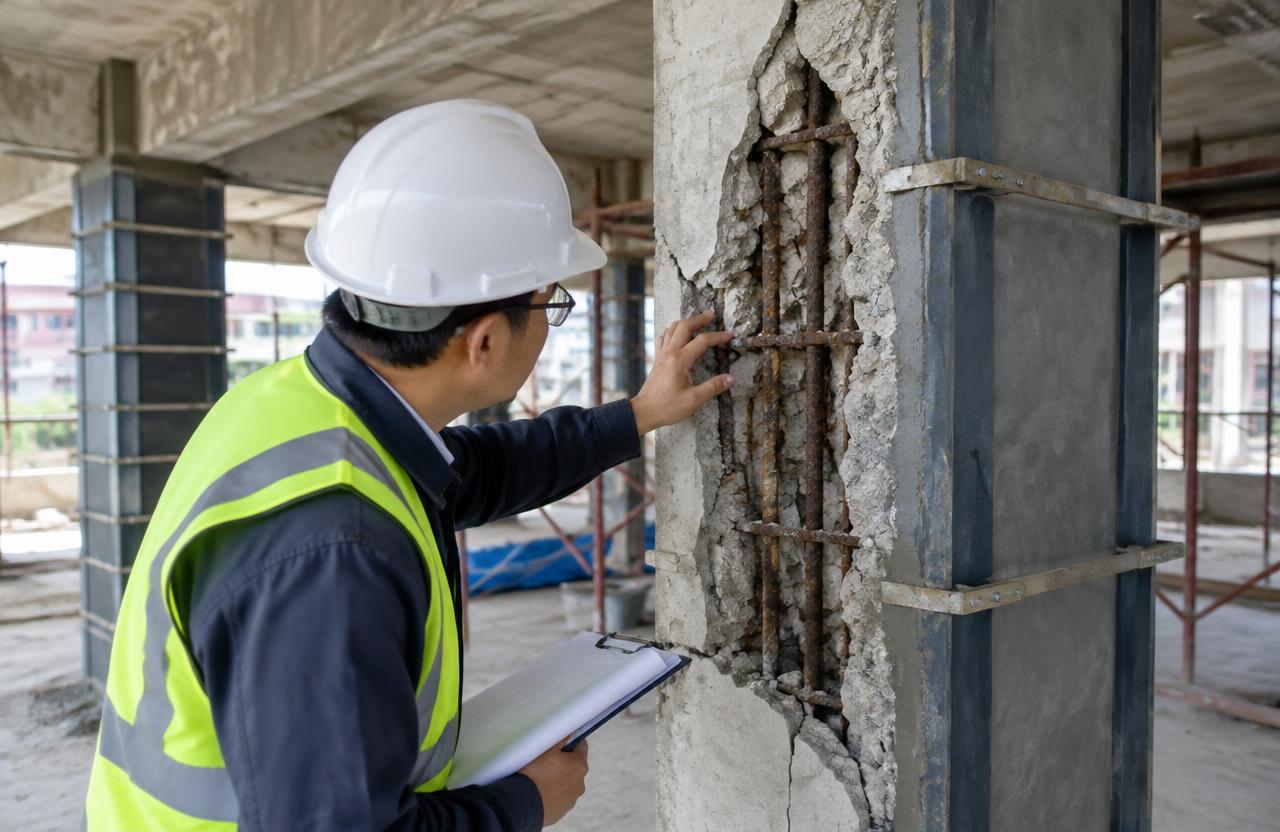
Any crack in a beam or column — as opposed to the infill brick wall between them — is urgent regardless of width, because beams and columns are the load-bearing members of an RCC frame structure; a crack here can signal reinforcement corrosion, overloading or a construction defect and needs immediate professional assessment, since these members carry the building's actual structural load rather than simply enclosing space the way infill walls do.
The single most useful diagnostic tool for a homeowner is a tell-tale: a small strip of glass or a dated plaster patch fixed across the crack. If it breaks or a visible gap reopens over the following weeks or months, the crack is still active and structural, not merely historical shrinkage that has already stabilised — a tell-tale that remains intact for two to three months is generally a reassuring sign, though it is still worth having an engineer confirm the diagnosis rather than relying solely on this test.
- Hairline: cosmetic
- Diagonal >3 mm: investigate
- Beam/column cracks: urgent
- Monitor with tell-tales
03A quick severity framework
A practical way to triage a crack without professional help (as a first step, not a final diagnosis) is to check it against four markers: width (under 1.5 mm is low concern, over 3 mm needs investigation), location (plaster-only is lower risk than beam/column), pattern (vertical/horizontal is usually less serious than diagonal), and movement (static for 2–3 months after a tell-tale is applied is reassuring; growing is not).
None of these markers alone is conclusive — a wide crack in a non-load-bearing partition wall, for instance, can still be relatively low-risk compared with a narrower crack in a beam — which is why this framework should guide when to call an engineer, rather than replace the engineer's own assessment once called.
Owners sometimes also notice cracks appearing specifically along the junction between a brick wall and an RCC column or beam, running in a straight vertical or horizontal line rather than diagonally; these are usually shrinkage cracks at the junction of two different materials rather than structural damage, though they are worth pointing out to whoever repairs them so the crack is properly bridged rather than simply filled.
04Repair methods by crack type
Cosmetic hairline cracks are repaired with a flexible acrylic crack filler and a coat of elastomeric paint, a straightforward job most painting contractors can handle competently without any engineering input required beyond confirming the crack is genuinely cosmetic in the first place.
Moderate non-structural cracks benefit from raking out the crack, applying a polymer-modified mortar, and reinforcing with fibre mesh tape before replastering — this method bridges the crack rather than simply filling it, which matters because a crack filled without reinforcement frequently reopens along exactly the same line within a year or two.
Structural cracks in beams, columns or load-bearing walls require an engineer-specified repair — commonly epoxy injection grouting to restore the member's integrity, sometimes combined with jacketing (adding reinforced concrete around the existing member) if load capacity has been compromised. This kind of repair should never be attempted by a mason working from general experience alone, since the correct method depends entirely on what is actually causing that specific crack.
05When to call a structural engineer versus a mason
A mason or contractor can reasonably handle cosmetic plaster cracks and simple repainting. Any crack involving a beam, column, load-bearing wall, a staircase, or a crack that keeps reopening after repair should go to a structural engineer first — a cosmetic repair applied over an unaddressed structural issue only hides the warning sign without fixing the cause.
A reasonable rule of thumb for an uncertain case: if explaining the crack to a mason produces a shrug and a quote to simply fill it, and the crack is wider than a few millimetres or located anywhere near a beam or column, get a second opinion from a structural engineer before accepting that quote, since the cost of a professional inspection is small compared with the risk of leaving a genuine structural issue unaddressed.
06Typical repair costs by severity
Cosmetic hairline crack repair and repainting for a typical room runs roughly ₹15–₹35 per sq.ft. of wall area, a modest cost most owners handle as routine maintenance every few years as part of general upkeep rather than treating it as an emergency.
Moderate crack repair with mesh reinforcement typically costs ₹40–₹80 per sq.ft. of the affected wall section, reflecting the extra labour of raking out the crack properly and applying reinforcement rather than simply filling the surface.
Structural repairs involving epoxy grouting or jacketing of a beam or column are priced per member rather than per sq.ft. and can range from ₹8,000 to ₹40,000 or more per member depending on its size and the extent of damage, with a full structural audit (₹4–₹12 per sq.ft. of the building) often recommended first to confirm the extent of the problem across the whole structure rather than treating each visible crack as an isolated issue.
For a society managing several units showing similar cracking patterns across different flats, it is almost always more cost-effective to commission one building-wide structural audit than to pay for repeated individual crack assessments flat by flat, since a shared underlying cause — a common structural issue affecting the whole wing, for instance — is easy to miss when each case is looked at in isolation.
07How this applies to your project
Every plot is different — soil, access, approvals and budget change the right answer. MumbaiConstructions's engineers review your site and drawings and explain the options with costs, so you can decide with confidence.
Get a free site visit in Mumbai, Navi Mumbai & Thane
MumbaiConstructions is a civil construction company and turnkey contractor serving Mumbai, Navi Mumbai & Thane and the wider Mumbai Metropolitan Region since 2009. Share your plot or building details and a project engineer will visit, check feasibility and send a line-item BOQ within 7 working days — no obligation.
Frequently asked questions
Does MumbaiConstructions help with this?
Yes. We offer free site visits, feasibility advice and a line-item BOQ across Mumbai, Navi Mumbai, Thane, Panvel and nearby areas.
Where do you work?
Mumbai Island City and suburbs, Navi Mumbai, Thane, Kalyan-Dombivli, Panvel, Vasai-Virar and surrounding MMR towns.