


Quick answer
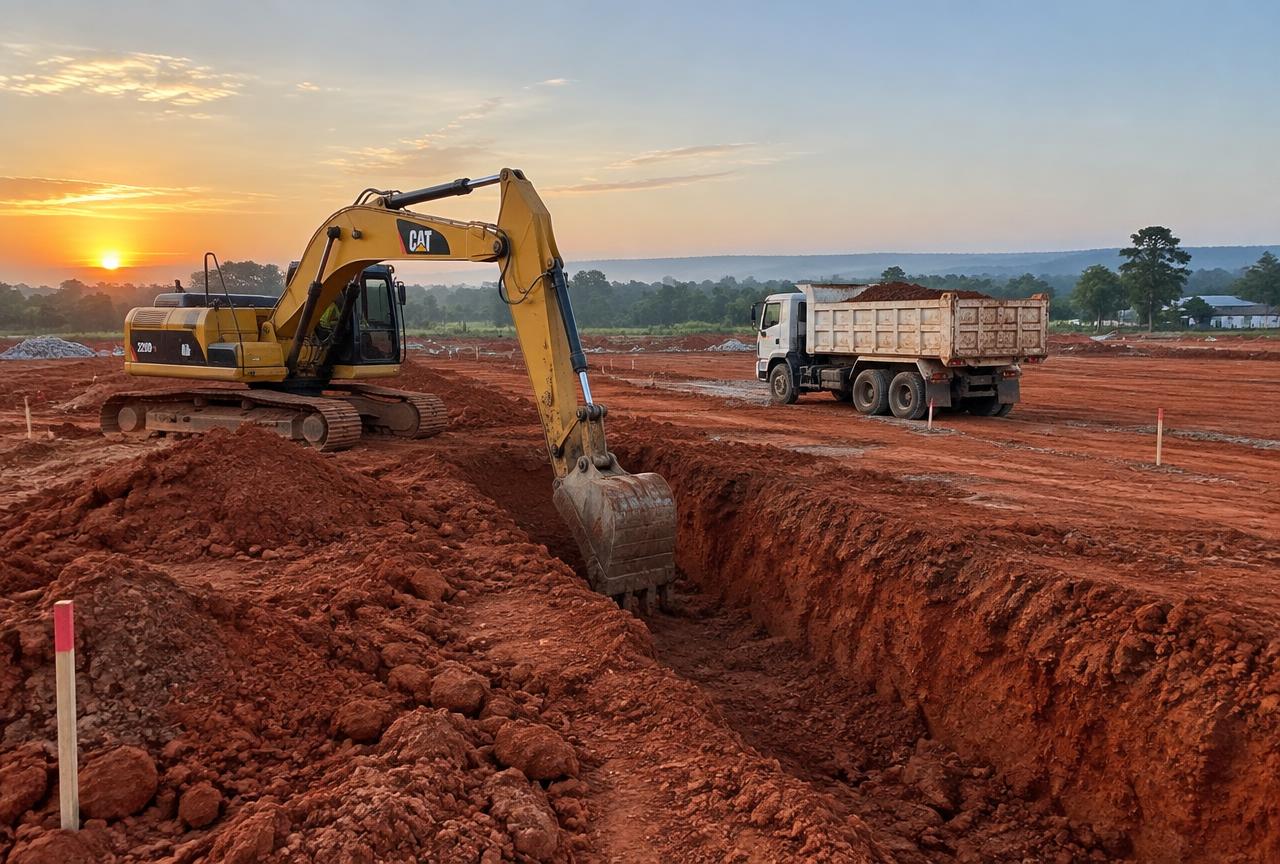
Excavation, rock breaking, cutting, filling and site levelling. To plan excavation & earthwork well across Mumbai, Navi Mumbai, Thane and Panvel, freeze the scope and drawings, get a line-item BOQ (indicative ₹180 – ₹600 / cu.m.), confirm approvals, sign a contract with stage-linked payments, and insist on documented quality checks at every stage.
On this page
- Key takeaways
- What excavation & earthwork includes
- Planning checklist
- Common mistakes to avoid
- Quality checks that matter
- Worked Example: Cut-and-Fill for a Sloped 5,000 Sq.M. Plot
- Material and Equipment Selection for Earthwork
- Site-Readiness Checklist Before Excavation Begins
- Warranty and Liability on Earthwork and Filling
- Frequently asked questions
Key takeaways
- Indicative rate: ₹180 – ₹600 / cu.m..
- Drawings first, contract second, work third.
- Stage-linked payments protect your money.
- Ask for test reports: cubes, steel, waterproofing.
01What excavation & earthwork includes
Excavation, rock breaking, cutting, filling and site levelling.
- Survey
- Excavation
- Rock breaking
- Filling
- Compaction
- Disposal
02Planning checklist
Use this before you sign anything:
- Define budget and must-haves
- Soil test and site survey
- Architectural and structural drawings
- Approvals and NOCs
- BOQ with brands and quantities
- Contract with timeline, penalties and defect liability
- Payment schedule linked to stages
03Common mistakes to avoid
Choosing on the lowest sq.ft. rate, starting without structural drawings, skipping waterproofing, changing design mid-way and paying large advances without milestones are the five mistakes we see most often.
04Quality checks that matter
Concrete cube tests, rebar inspection before every pour, curing for at least 7–14 days, ponding tests for waterproofing, and pressure tests for plumbing should all be documented and shared with you.
05Worked Example: Cut-and-Fill for a Sloped 5,000 Sq.M. Plot
A sloped plot in the Khopoli-Karjat corridor with roughly 2-3 metres of level difference across its width typically needs a cut-and-fill earthwork plan rather than uniform excavation. Survey and levelling (3-5 days) establish the final finished-ground-level, after which cutting on the higher side and filling on the lower side are balanced where soil quality allows reuse, avoiding costly off-site disposal and import.
Rock breaking, if encountered, adds significant time — a basalt outcrop under 20-30% of a plot can double the excavation schedule since it requires hydraulic breakers or controlled blasting rather than normal excavator work. Compaction of filled areas in 200-300mm layers with a plate compactor or roller, tested for density before foundation work starts on top of it, typically adds 1-2 weeks but prevents the single most common cause of post-construction settlement cracks on filled plots.
For a 5,000 sq.m. plot at this scale, a realistic total earthwork duration excluding rock breaking runs 3-4 weeks; with substantial rock encountered across the footprint, this can extend to 6-8 weeks, which is exactly the kind of variance a fixed-price quote given before a proper soil and rock survey tends to miss, leaving the owner exposed to a cost escalation mid-project rather than before it starts.
Sequencing the cut-and-fill carefully also affects how much material ultimately needs to be trucked off-site: starting excavation from the uphill end and progressively filling the downhill side as the cut advances lets soil be moved once rather than stockpiled and re-handled, which on a plot this size can be the difference between a handful of disposal truckloads and dozens, a detail that materially affects both cost and the number of heavy-vehicle trips through what is often a narrow approach road.
06Material and Equipment Selection for Earthwork
Not all excavated soil is reusable as fill — soil with high organic content, demolition debris, or excessive clay that won't compact properly should be flagged for disposal rather than reused, even though reuse is cheaper, because poorly compacted fill under a foundation is a problem that surfaces years later as uneven settlement. Where imported fill is needed, murum (weathered rock fill) compacts far more reliably than loose soil and is the standard choice across the MMR for plinth filling.
Equipment choice follows soil type and site access: a standard excavator suits open plots, but narrow hill-slope access often means a compact excavator or manual labour is the only physically possible option, which should be priced and scheduled realistically rather than assumed away.
On rocky ground, the choice between hydraulic rock breakers and controlled blasting has real consequences beyond cost — blasting is faster but requires statutory permissions and careful vibration monitoring near any existing structure, while breakers are slower but need no special permission and carry far less risk to a neighbouring building's foundation. For plots in dense residential pockets, breakers are almost always the practical choice regardless of the time saved by blasting.
07Site-Readiness Checklist Before Excavation Begins
Excavation is the one stage that is genuinely hard to undo once machines are on site, so these checks are worth confirming before mobilisation rather than discovering mid-dig when a stop-work order or a damaged utility line is far costlier to resolve.
- Topographic survey and levelling completed, not just the plot boundary survey, so cut-and-fill volumes are calculated against real ground levels
- Underground utility locations confirmed — water lines, drainage, electrical cables — before any machine excavation, ideally with a physical trial pit at suspected crossing points
- Soil investigation report available to flag expected rock or high water-table depth, so equipment and schedule assumptions are realistic rather than optimistic
- Disposal site or vehicle route for excess spoil arranged and permitted, since an unplanned disposal run can stall the whole excavation crew for days
- Adjoining property owners informed where excavation runs close to a shared boundary, with a joint condition survey done beforehand to avoid later disputes over existing cracks
- Dewatering pumps on standby if excavation depth is likely to hit the water table, sized to the actual expected inflow rather than a generic pump
- Monsoon timing checked — bulk excavation is best finished before heavy rain turns cut faces unstable and waterlogs the excavated pit
08Warranty and Liability on Earthwork and Filling
Earthwork itself is not typically warrantied the way finished construction is, since it is a preparatory activity rather than a finished product — but the compaction standard achieved directly affects the structural warranty of everything built on top of it. For this reason, reputable earthwork contractors provide compaction test records (proctor density tests) as a condition of handover, and these records should be retained alongside the soil investigation report.
Where filling is done to raise a plot's level ahead of construction, a settlement observation period of several months before foundation work starts is good practice on deep fills, since freshly placed fill continues consolidating under its own weight for some time even after mechanical compaction.
If a structural defect is later traced back to inadequate fill compaction, liability typically depends entirely on whether compaction test records exist — without them, a dispute over whether the earthwork or the structural design was at fault can drag on indefinitely, which is the strongest practical argument for insisting on density testing even on a modestly sized fill job where it might otherwise feel like an unnecessary expense.
Owners sometimes treat earthwork as a commodity service best awarded purely on the lowest quote, since on paper it looks like straightforward excavation and trucking — but the compaction records, rock-handling method, and disposal logistics described above are exactly where an inexperienced or corner-cutting earthwork contractor saves money invisibly, making a reference check on past projects and a request to see sample test records a worthwhile step before awarding this contract on price alone.
Get a free site visit in Mumbai, Navi Mumbai & Thane
MumbaiConstructions is a civil construction company and turnkey contractor serving Mumbai, Navi Mumbai & Thane and the wider Mumbai Metropolitan Region since 2009. Share your plot or building details and a project engineer will visit, check feasibility and send a line-item BOQ within 7 working days — no obligation.
Frequently asked questions
How much does excavation & earthwork cost in Mumbai?
Indicatively ₹180 – ₹600 / cu.m., depending on specification and site conditions.
Can you do only the civil work?
Yes — we work turnkey or on a civil-only or item-rate basis with your architect.