


Quick answer
Compact cottages and homestays sized for the tourist economy. To plan homestay & cottage construction well across Mumbai, Navi Mumbai, Thane and Panvel, freeze the scope and drawings, get a line-item BOQ (indicative ₹1,800 – ₹3,800 / sq.ft.), confirm approvals, sign a contract with stage-linked payments, and insist on documented quality checks at every stage.
On this page
- Key takeaways
- What homestay & cottage construction includes
- Planning checklist
- Common mistakes to avoid
- Quality checks that matter
- Specification tiers for homestay and cottage construction
- Worked example: a 6-cottage homestay property near Matheran-adjacent terrain
- Material selection for homestay and cottage projects
- Site-readiness checklist for homestay construction on remote or hilly plots
- Warranty terms typical for homestay and cottage construction
- Frequently asked questions
Key takeaways
- Indicative rate: ₹1,800 – ₹3,800 / sq.ft..
- Drawings first, contract second, work third.
- Stage-linked payments protect your money.
- Ask for test reports: cubes, steel, waterproofing.
01What homestay & cottage construction includes
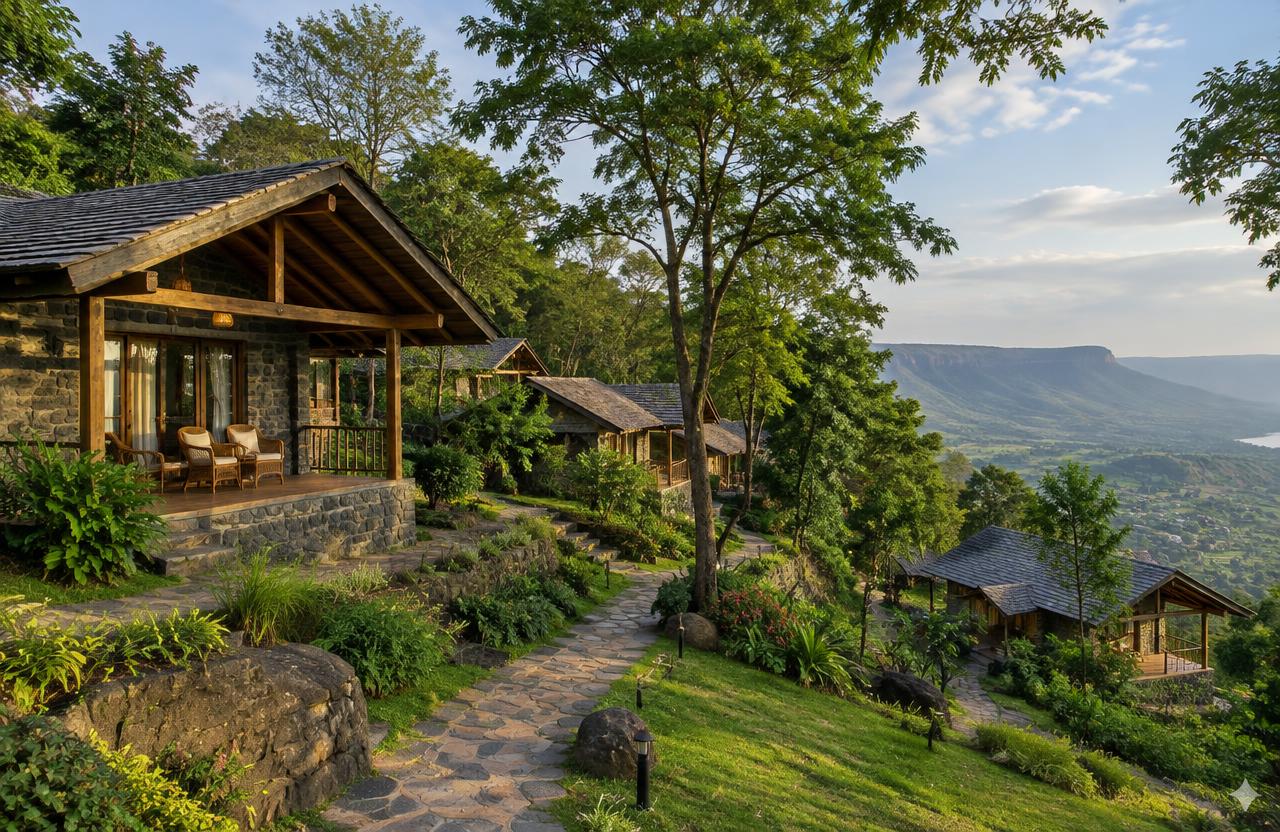
Compact cottages and homestays sized for the tourist economy.
- Cottage design
- Stone & RCC or steel frames
- Toilets & services
- Decks & verandahs
- Paths
- Signage
02Planning checklist
Use this before you sign anything:
- Define budget and must-haves
- Soil test and site survey
- Architectural and structural drawings
- Approvals and NOCs
- BOQ with brands and quantities
- Contract with timeline, penalties and defect liability
- Payment schedule linked to stages
03Common mistakes to avoid
Choosing on the lowest sq.ft. rate, starting without structural drawings, skipping waterproofing, changing design mid-way and paying large advances without milestones are the five mistakes we see most often.
04Quality checks that matter
Concrete cube tests, rebar inspection before every pour, curing for at least 7–14 days, ponding tests for waterproofing, and pressure tests for plumbing should all be documented and shared with you.
05Specification tiers for homestay and cottage construction
At basic tier, cottages are built with a simple stone-and-RCC or steel-frame structure, a sloped Mangalore tile or metal sheet roof, compact attached toilets, and a simple verandah. This suits budget-tourism homestays where guests prioritise location and experience over finish quality.
At standard tier, cottages get a proper deck or sit-out area, upgraded roofing (clay tile rather than metal sheet), better bathroom fittings, and defined pathways connecting cottages to the common dining or reception area. Signage and basic landscaping give the property a more finished, marketable appearance.
At premium tier, expect larger cottages with better natural ventilation design, stone or wood flooring, a proper common dining/reception structure with a small kitchen, well-defined pathway lighting, and distinctive architectural styling (often drawing on local vernacular design) that helps the homestay stand out in a competitive tourism market. The structural frame choice (stone-and-RCC versus pure steel frame) is the main material decision across tiers — steel frames erect faster and suit remote sites with difficult material access, while stone-and-RCC gives a more traditional look valued in heritage or hill-station contexts.
06Worked example: a 6-cottage homestay property near Matheran-adjacent terrain
Take a 6-cottage homestay (each cottage roughly 350 sq.ft.) plus a small common dining structure, contracted at ₹2,600/sq.ft., a project value of roughly ₹6.5 lakh per cottage plus the common structure, totalling in the ₹45–50 lakh range. Cottage design, tailored to the specific terrain and views, typically takes 4–5 weeks given the need to individually site each cottage rather than apply a single repeated layout across a sloping plot.
Site access and levelling, often the most challenging phase on hilly terrain, typically takes 3–4 weeks and may require retaining walls at each cottage platform. Stone or steel-frame structure and roofing for all 6 cottages, built with staggered crews moving between cottage sites, typically take 10–12 weeks.
Toilets, services (water, electricity) and decks/verandahs together take 6–7 weeks. Pathways, signage, common dining structure and final finishing take a further 6–8 weeks. Total programme: roughly 7–8 months. Given typically difficult site access on hilly terrain, scheduling the structural phase to finish before monsoon is especially important here, since site access can become genuinely unsafe in heavy rain on sloped ground.
Payment milestones on a homestay project of this scale typically run around 15% at design and site-access planning, 20% on site levelling and retaining-wall work, 30% released across the cottage structures and roofing as they are completed cottage by cottage, 20% on toilets, services and decks, and the remaining 15% across pathways, signage, the common dining structure and final handover. Because cottages are often completed in a staggered sequence on sloped terrain, tying payment to each completed cottage rather than an overall percentage gives a clearer, more verifiable basis for release.
07Material selection for homestay and cottage projects
For remote or hilly sites with difficult material access, a steel-frame structure with prefabricated panel infill erects faster and needs less heavy material transport than a conventional RCC frame, which matters where the access road cannot support a concrete mixer or pump truck. Where RCC is used, a combination of locally sourced stone for the lower plinth with RCC above balances cost, structural performance and a look suited to hill-station or rural tourism settings.
For roofing, clay or terracotta tiles on a treated timber or galvanised steel truss give better thermal comfort than a metal sheet roof, which can get uncomfortably hot in direct sun — this matters more for guest-facing cottages than for a utility structure. Rainwater drainage around each cottage platform needs careful grading on sloped terrain to avoid water pooling against the foundation during monsoon.
For services, a shared septic system or small-scale STP sized for the property's guest capacity (not assumed from a generic household figure) avoids undersizing waste treatment for what is effectively a small commercial operation with variable, sometimes concentrated, occupancy.
08Site-readiness checklist for homestay construction on remote or hilly plots
Homestay projects on hilly or remote tourist-circuit land carry site-access and terrain-specific readiness requirements beyond a standard building project.
- Land-use classification and tourism-related approvals (if applicable for the specific location) confirmed before construction begins
- Site access road condition assessed for both construction-phase material delivery and later guest vehicle access
- Terrain grading and retaining-wall requirements identified per cottage site, since a one-size layout rarely suits sloped, individually sited cottages
- Water source (borewell, spring, or tanker supply) tested for both yield and quality before finalising the plumbing design
- Power supply confirmed — grid connection, generator backup, or solar — given that remote sites often lack reliable grid power
- Septic or STP system sized for the property's guest capacity, not a generic residential assumption
- Local building material and labour availability confirmed, since remote-site logistics often extend typical material lead times
09Warranty terms typical for homestay and cottage construction
The structural frame (whether stone-and-RCC or steel) typically carries a 7–10 year warranty against structural failure, with steel-frame structures sometimes carrying a slightly different warranty structure than RCC given the different failure modes (corrosion versus concrete cracking) — ask the contractor to specify which applies to your chosen frame type explicitly.
Roofing typically carries a 3–5 year warranty against leakage, and given those are guest-facing structures that generate direct revenue, delayed repair during peak tourist season carries a real cost similar to resort or hotel properties, so an agreed repair response-time commitment is worth including even at this smaller project scale.
Toilets, plumbing and electrical work typically carry 1–2 years workmanship warranty. Because homestay properties are often owner-managed with limited full-time maintenance staff, ask the contractor whether a basic annual maintenance check (ahead of peak season) is available as part of the handover package — this is not standard everywhere but is a reasonable, often inexpensive, addition to request.
Get a free site visit in Mumbai, Navi Mumbai & Thane
MumbaiConstructions is a civil construction company and turnkey contractor serving Mumbai, Navi Mumbai & Thane and the wider Mumbai Metropolitan Region since 2009. Share your plot or building details and a project engineer will visit, check feasibility and send a line-item BOQ within 7 working days — no obligation.
Frequently asked questions
How much does homestay & cottage construction cost in Mumbai?
Indicatively ₹1,800 – ₹3,800 / sq.ft., depending on specification and site conditions.
Can you do only the civil work?
Yes — we work turnkey or on a civil-only or item-rate basis with your architect.