


Quick answer
Rainwater harvesting is mandatory for many new buildings under BMC and NMMC rules, and can recharge groundwater or fill storage tanks. Plan pipes, filters and recharge pits during design.
On this page
- Key takeaways
- The short answer
- Key points explained
- How much water a Mumbai roof can actually harvest
- Regulatory requirement and approval
- Maintenance that keeps the system working
- Recharge versus storage: which to prioritise
- Interaction with borewells and groundwater extraction
- Retrofitting an older building that currently has no system
- A simple cost-benefit framing for owners deciding whether to invest
- How this applies to your project
- Frequently asked questions
Key takeaways
- Roof-top collection
- Filters and first flush
- Recharge pits or tanks
- Low cost if planned early
01The short answer
Rainwater harvesting is mandatory for many new buildings under BMC and NMMC rules, and can recharge groundwater or fill storage tanks. Plan pipes, filters and recharge pits during design.
Mumbai's monsoon (roughly June to September) delivers the bulk of the year's rainfall in a few intense months, which is exactly the condition rainwater harvesting is designed to capture efficiently.
02Key points explained
Roof-top collection — channelling rainwater from terraces and sloped roofs through dedicated downpipes separate from the regular drainage — is the starting point of any system, and its effectiveness depends on keeping the roof surface reasonably clean since the first flush of any rain carries dust and debris. A terrace used for other purposes (drying clothes, a garden) needs its drainage points planned so collection does not conflict with everyday use of the space.
Filters and a first-flush diverter (a simple device that discards the initial, dirtiest flow of water from each rain spell before directing the cleaner subsequent flow into storage or recharge) keep leaves, dust and bird droppings out of the storage tank or recharge structure, and need periodic cleaning to keep working. Without this diverter, the first heavy showers of each monsoon simply wash years of accumulated roof dust straight into the storage tank.
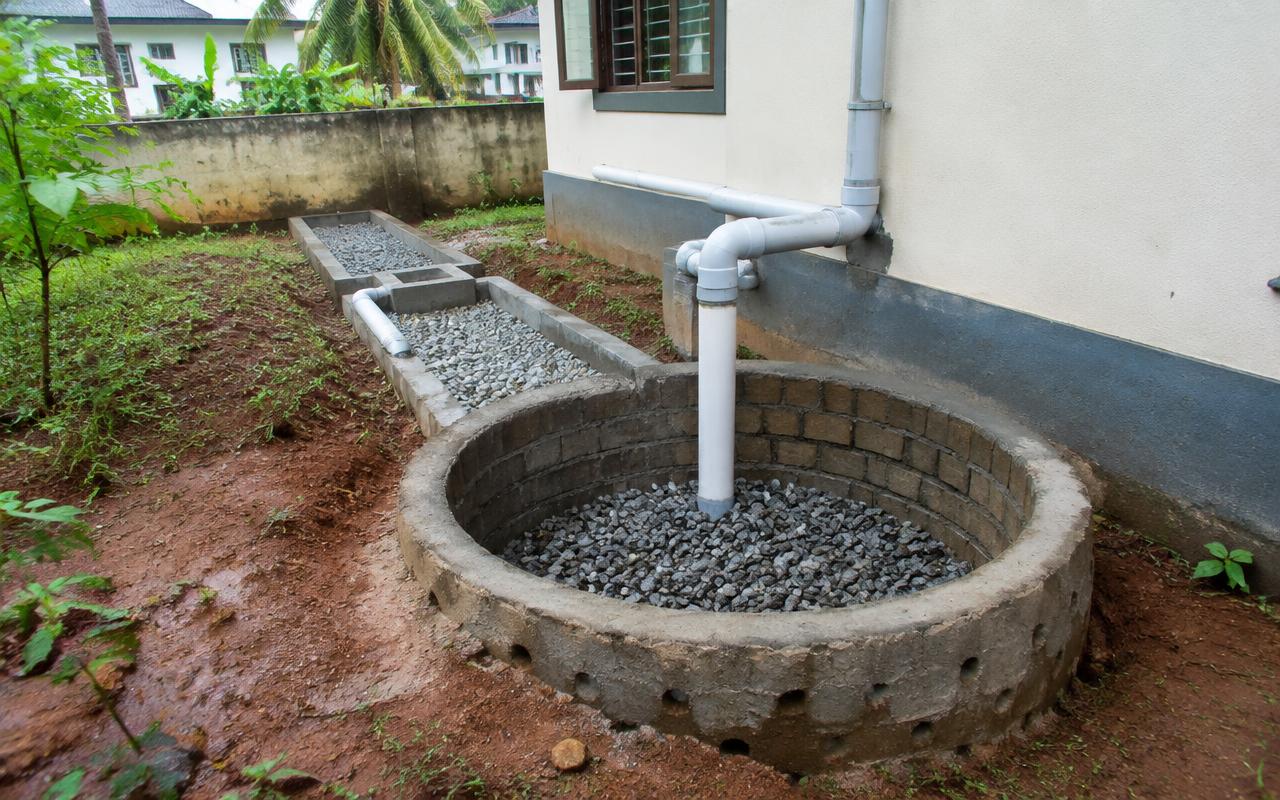
Recharge pits or trenches, filled with layers of graded aggregate and sand, let collected water percolate back into the ground to replenish the water table, while storage tanks (sometimes combined with the recharge system) hold water for direct non-potable use such as gardening, flushing or construction water — many societies use a combination of both. The choice between recharge and storage, or a mix of the two, usually depends on how much open ground is available on the plot for a recharge structure.
The cost is low if planned at the design stage, since the pipe runs, filter chambers and recharge pit locations can be built into the plumbing and landscaping layout from the start; retrofitting rainwater harvesting into a completed building means breaking into finished paving and rerouting downpipes, which costs significantly more for the same result.
These four elements form a simple chain — collection, filtration, and then either recharge or storage — and a system is only as good as its weakest link in that chain: a well-built recharge pit fed by an unfiltered downpipe silts up within a season or two, while a perfectly filtered system with no planned recharge or storage destination simply has nowhere useful for the water to go.
- Roof-top collection
- Filters and first flush
- Recharge pits or tanks
- Low cost if planned early
03How much water a Mumbai roof can actually harvest
A rough estimate uses roof area multiplied by annual rainfall and a runoff coefficient (typically 0.8–0.85 for a hard roof surface, accounting for evaporation and first-flush losses). For a 1,000 sq.ft. terrace in a part of the MMR receiving around 2,000–2,500 mm of annual rainfall, that works out to roughly 1.5–2 lakh litres of potentially harvestable water each monsoon — enough to make a visible dent in a household's or small society's non-potable water use if captured and stored or recharged well.
Scaled up to a society with several thousand square feet of combined terrace area, this same arithmetic can add up to several lakh litres of recharge or storage potential each monsoon, which is exactly the scale municipal rules are aiming to capture when they mandate harvesting for larger plots.
Paved surfaces around a plot — driveways, parking courts, podium decks — can also be designed to contribute to this harvesting potential through permeable paving or dedicated collection drains, extending the catchment area a system can draw from well beyond just the building's own roof.
04Regulatory requirement and approval
BMC mandates rainwater harvesting for new buildings above a specified plot size within its limits, and NMMC, TMC and other MMR municipal bodies carry similar requirements under their own building bye-laws — typically the rainwater harvesting layout has to be submitted and approved alongside the building plan, not added afterwards. Societies that skip this at construction stage sometimes find it flagged later at the Occupancy Certificate stage, causing delays that are entirely avoidable by including the system in the original drawings.
05Maintenance that keeps the system working
A rainwater harvesting system is low-maintenance but not zero-maintenance: filter chambers need to be opened and cleared of silt before each monsoon, first-flush diverters need their discard chamber emptied periodically through the season, and recharge pits should be inspected every few years to confirm they have not silted up and lost their percolation capacity — a pit that no longer drains water within a day or two after rain has effectively stopped working and needs to be dug out and refilled with fresh aggregate.
Assigning this annual pre-monsoon check to a specific person or facility team in a society, rather than leaving it to nobody in particular, is usually the difference between a system that keeps performing for decades and one that silently stops working within a few years.
06Recharge versus storage: which to prioritise
A plot with reasonable open ground and a garden favours recharge pits, since they need no ongoing pumping or tank maintenance and directly benefit the local water table, which in turn can improve borewell yield for the property and its neighbours over time.
A plot with little open ground, or a society wanting a direct, usable water source for gardening and flushing, benefits more from storage tanks, sized against the roof catchment area; many projects simply combine both, directing overflow from a storage tank into a recharge pit so that no collected water is wasted even once the tank is full.
07Interaction with borewells and groundwater extraction
A society or building that draws water from its own borewell benefits directly from rainwater harvesting's recharge function, since replenishing the local aquifer helps sustain borewell yield over the long term — a borewell drawn down faster than local recharge replenishes it tends to show declining yield and, in coastal areas, a rising risk of saline intrusion into the groundwater.
Some municipal rules in the MMR specifically link borewell permissions to a demonstrated rainwater harvesting provision on the same plot, recognising this relationship directly — which is another practical reason to treat rainwater harvesting as integral to the building's water strategy rather than a standalone compliance checkbox.
08Retrofitting an older building that currently has no system
A building completed before rainwater harvesting became a standard requirement can usually still be retrofitted, though at higher cost than a system planned from the start — typical retrofit approaches include adding a surface-mounted downpipe diversion from an existing terrace outlet into a new filter and recharge pit dug into whatever open ground is available, even where the original plumbing cannot easily be altered.
Societies considering this retrofit should get a simple feasibility assessment first, confirming there is enough open ground and the right gradient to route water from the terrace to a viable recharge or storage point, since not every older, densely built plot has the physical space to accommodate a full system even if the building's owners are keen to add one.
09A simple cost-benefit framing for owners deciding whether to invest
For an individual villa, the direct cost saving from reduced water-tanker dependence or municipal water bills may take several years to fully offset a system's construction cost, but the indirect benefit of improved local groundwater availability, particularly relevant for any property relying partly or fully on a borewell, often makes the investment worthwhile well before the direct savings alone would justify it.
For a larger society, the economics are generally more favourable given the larger catchment area relative to the incremental system cost per unit of roof area, which is one more reason rainwater harvesting tends to be standard practice for new township and large residential development even in areas where it is not strictly mandated by the applicable municipal bye-laws.
10How this applies to your project
Every plot is different — soil, access, approvals and budget change the right answer. MumbaiConstructions's engineers review your site and drawings and explain the options with costs, so you can decide with confidence.
Get a free site visit in Mumbai, Navi Mumbai & Thane
MumbaiConstructions is a civil construction company and turnkey contractor serving Mumbai, Navi Mumbai & Thane and the wider Mumbai Metropolitan Region since 2009. Share your plot or building details and a project engineer will visit, check feasibility and send a line-item BOQ within 7 working days — no obligation.
Frequently asked questions
Does MumbaiConstructions help with this?
Yes. We offer free site visits, feasibility advice and a line-item BOQ across Mumbai, Navi Mumbai, Thane, Panvel and nearby areas.
Where do you work?
Mumbai Island City and suburbs, Navi Mumbai, Thane, Kalyan-Dombivli, Panvel, Vasai-Virar and surrounding MMR towns.