


Quick answer
Internal roads, approach roads and township roads in bitumen or concrete. To plan road construction well across Mumbai, Navi Mumbai, Thane and Panvel, freeze the scope and drawings, get a line-item BOQ (indicative ₹1,200 – ₹3,500 / sq.m.), confirm approvals, sign a contract with stage-linked payments, and insist on documented quality checks at every stage.
On this page
- Key takeaways
- What road construction includes
- Planning checklist
- Common mistakes to avoid
- Quality checks that matter
- Basic, Standard and Premium Road Specifications
- Worked Example: A 600-Metre Township Approach Road
- Material Selection for Road Sub-Base and Surface
- Site-Readiness Checklist Before Road Construction Starts
- Warranty on Road Surfacing and Pavement Work
- Frequently asked questions
Key takeaways
- Indicative rate: ₹1,200 – ₹3,500 / sq.m..
- Drawings first, contract second, work third.
- Stage-linked payments protect your money.
- Ask for test reports: cubes, steel, waterproofing.
01What road construction includes
Internal roads, approach roads and township roads in bitumen or concrete.
- Survey
- Sub-grade
- WBM / GSB
- Bitumen / PQC
- Drains
- Markings
02Planning checklist
Use this before you sign anything:
- Define budget and must-haves
- Soil test and site survey
- Architectural and structural drawings
- Approvals and NOCs
- BOQ with brands and quantities
- Contract with timeline, penalties and defect liability
- Payment schedule linked to stages
03Common mistakes to avoid
Choosing on the lowest sq.ft. rate, starting without structural drawings, skipping waterproofing, changing design mid-way and paying large advances without milestones are the five mistakes we see most often.
04Quality checks that matter
Concrete cube tests, rebar inspection before every pour, curing for at least 7–14 days, ponding tests for waterproofing, and pressure tests for plumbing should all be documented and shared with you.
06Worked Example: A 600-Metre Township Approach Road
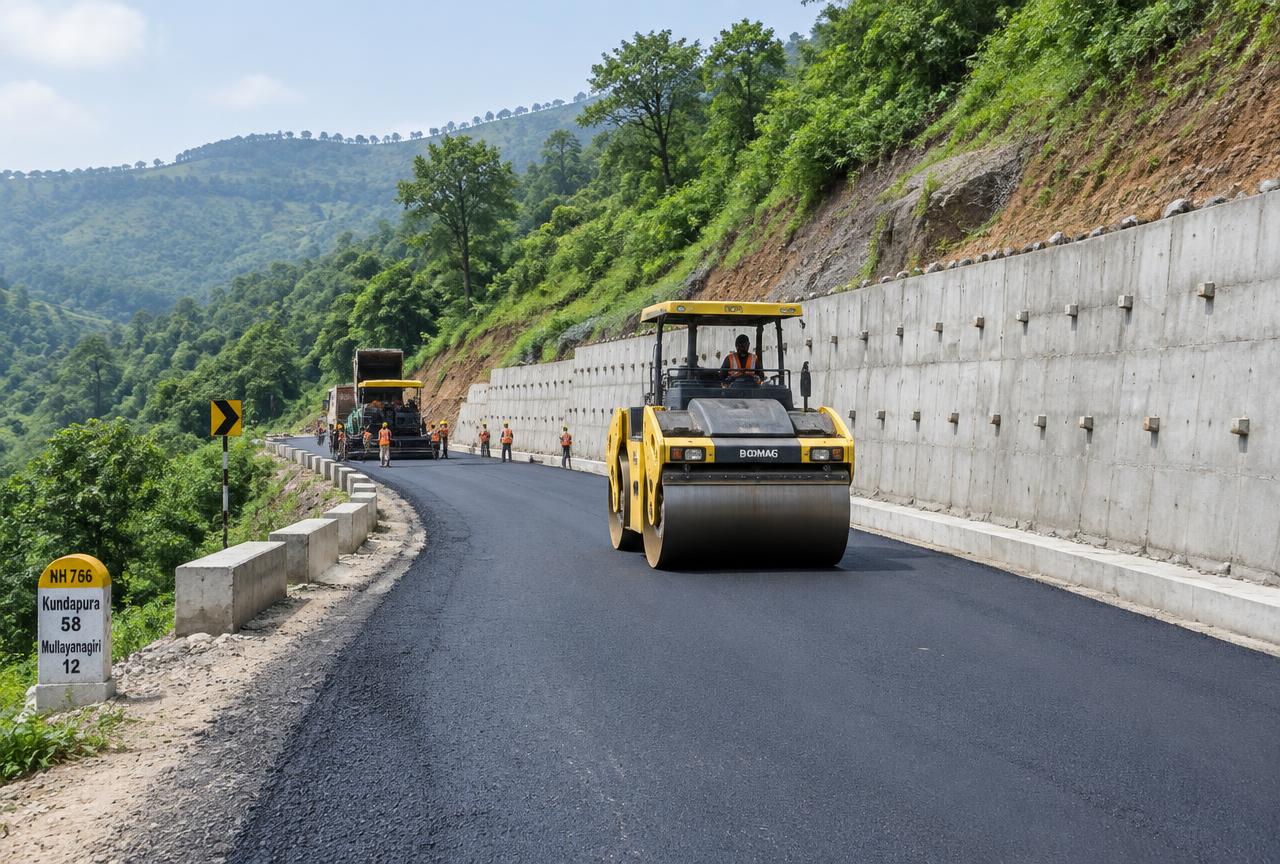
For a 600-metre, two-lane approach road into a township development, the sequence typically runs: survey and sub-grade preparation (2 weeks, including any cut-fill to achieve design levels), GSB and WBM layers compacted and tested (3 weeks), and bitumen course laying (1-2 weeks, weather-dependent since bitumen work cannot proceed in rain).
Side drains, culverts at low points, and road markings follow over another 2 weeks, typically overlapping with the final bitumen course curing period. A project of this scale usually runs 8-10 weeks end to end outside monsoon, but bitumen works in particular must be scheduled to avoid the June-September window entirely, since rain during laying or early curing compromises the surface permanently.
Utility ducting is the detail most likely to force expensive rework if missed at this stage — any water, drainage, electrical, or telecom line that will eventually need to cross under the road should be laid and backfilled before the GSB layer goes down, since cutting a trench through a finished road to add a missed utility line a year later costs several times what laying it upfront would have.
07Material Selection for Road Sub-Base and Surface
GSB material quality is judged on grading and the plasticity index of the aggregate — overly fine or plastic material traps water and weakens under load, which is why a materials test report for the sub-base aggregate should be checked before it is laid, not after. Bitumen grade (typically VG-30 for Mumbai's climate) should be specified rather than left generic, since softer grades rut under heavy vehicle loads in hot weather.
For roads expected to carry heavy construction or logistics traffic, PQC with properly spaced and sealed expansion joints often works out cheaper over a 15-20 year life than repeatedly resurfacing a flexible bitumen road, even though the initial outlay is higher.
Side-drain lining material matters almost as much as the pavement itself on roads in hilly or high-rainfall stretches — an unlined earthen drain erodes within a couple of monsoons and silts up, defeating its purpose, while a concrete-lined drain with a properly sized cross-section keeps functioning with only periodic desilting rather than annual rebuilding.
08Site-Readiness Checklist Before Road Construction Starts
Road work depends on several other trades (utilities, drainage, levels) being finished first, so these confirmations prevent the pavement layers from being disturbed again right after they're laid, which is the costliest kind of rework in road construction.
- Road alignment and levels approved against the layout plan, cross-checked with adjoining plot and road levels so the new road ties in correctly
- Utility ducts (water, drainage, electrical, telecom) laid and backfilled before pavement layers go down, with backfill compacted to the same standard as the surrounding sub-grade
- Soil sub-grade tested (CBR value) to confirm the pavement design assumptions rather than relying on a generic design thickness
- Monsoon-safe window identified for bitumen laying specifically, distinct from the general project schedule since bitumen work has its own weather sensitivity
- Material source and testing certificates arranged for aggregate and bitumen grade before bulk procurement begins
- Traffic or construction-vehicle diversion plan agreed if the road serves an active site, to avoid freshly laid layers being damaged by heavy vehicles before they've cured
09Warranty on Road Surfacing and Pavement Work
Flexible bitumen pavements typically carry a 2-3 year defect-liability period covering rutting, cracking, and pothole formation under normal traffic, extendable with a higher-grade bitumen specification. Rigid PQC pavements carry longer warranties, often 5 years, since concrete pavement failure modes (joint spalling, slab cracking) are slower to develop but also costlier to repair.
Drainage performance along the road is usually warrantied separately and tested by observing water flow during the first monsoon after handover — standing water at any point is treated as a defect requiring re-grading, not just a drain-clearing exercise.
Because road defects are strongly linked to traffic load, a warranty claim on rutting or cracking is usually first checked against whether the road's actual usage matched its design traffic category — a road designed for car and light-vehicle traffic that later carries regular heavy construction trucks will show premature distress that falls outside the original warranty's scope, which is why the design traffic assumption is worth recording explicitly at handover.
Get a free site visit in Mumbai, Navi Mumbai & Thane
MumbaiConstructions is a civil construction company and turnkey contractor serving Mumbai, Navi Mumbai & Thane and the wider Mumbai Metropolitan Region since 2009. Share your plot or building details and a project engineer will visit, check feasibility and send a line-item BOQ within 7 working days — no obligation.
Frequently asked questions
How much does road construction cost in Mumbai?
Indicatively ₹1,200 – ₹3,500 / sq.m., depending on specification and site conditions.
Can you do only the civil work?
Yes — we work turnkey or on a civil-only or item-rate basis with your architect.