


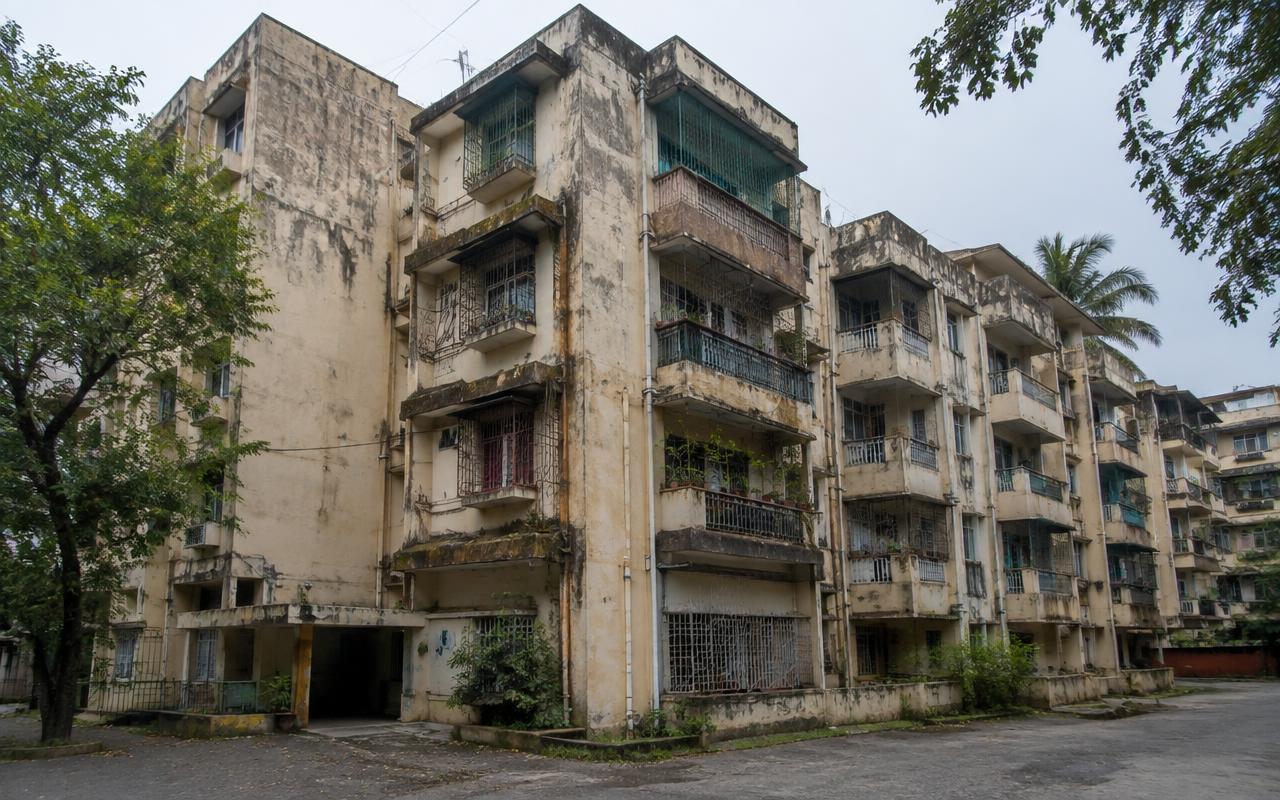
Quick answer
Housing society redevelopment in Andheri follows the Maharashtra government's Section 79A guidelines: a general body resolution, a project management consultant, a transparent tender, and approval by at least 51% of members (most societies aim for consent from all members). Members typically get 25–45% more carpet area, rent during construction and a corpus, and the project takes 30–42 months.
On this page
- Key takeaways
- Why Andheri societies are redeveloping
- The 79A redevelopment process
- Builder model vs self-redevelopment
- Construction cost for redevelopment in Andheri
- Andheri's mixed stock and the busiest redevelopment pipeline in the western suburbs
- A worked example: a 60-member Andheri society
- PMC selection and tender comparison at Andheri's scale
- Disputes common to large Andheri schemes
- Pre-leasing and RERA treatment of the commercial component
- Frequently asked questions
Key takeaways
- Appoint an independent PMC/architect before talking to any builder.
- Compare offers on carpet area, rent, corpus and bank guarantee — not just the headline area.
- Self-redevelopment keeps sale-flat profit with members.
- Approvals in Andheri go through the Brihanmumbai Municipal Corporation (BMC/MCGM).
01Why Andheri societies are redeveloping
Andheri is Mumbai's largest commercial-residential suburb, with constant mid- and high-rise construction. Buildings from the 1960s–1990s are reaching the end of their design life, lack lifts and parking, and face rising repair bills. Higher FSI under DCPR 2034 and TDR availability make redevelopment financially attractive.
02The 79A redevelopment process
Follow the government guidelines to keep the process transparent and legally sound:
- Special general body meeting to start the process
- Appoint a project management consultant (PMC) and architect
- Structural audit and feasibility report
- Tender floated; offers from builders or contractors
- Comparison statement shared with all members
- SGM selects the developer with written consent
- Development agreement registered; bank guarantee obtained
- Permissions, shifting, construction and possession
03Builder model vs self-redevelopment
In the builder model, a developer funds the project and keeps the sale flats. In self-redevelopment, the society appoints a contractor, raises finance and sells the extra flats itself — usually leaving members 30–60% more area or a large corpus.
MumbaiConstructions works as the society's construction partner for self-redevelopment: BOQ-based contract, quality reports to the committee and staged payments linked to progress.
04Construction cost for redevelopment in Andheri
High-rise RCC construction typically runs ₹3,000–₹4,500 per sq.ft. depending on height, basement parking, podium and finishes. Premiums, TDR, GST and rent to members are separate and must be part of the feasibility.
05Andheri's mixed stock and the busiest redevelopment pipeline in the western suburbs
Andheri combines everything from 1960s ground+2 walk-ups in older residential pockets to 1990s-2000s ground+7 towers nearing their own redevelopment window, across both Andheri West and East. Under DCPR 2034, the commercial-residential character of much of Andheri (especially near the MIDC and station-adjacent commercial belts) means some redevelopment plots carry mixed-use potential, letting a society negotiate a scheme with ground-floor commercial free-sale area alongside residential rehab, which is less common in purely residential suburbs.
Road width variance is extreme within Andheri itself — arterial stretches like SV Road and the Western Express Highway service road support much heavier TDR loading than the internal lanes of older residential pockets, so two Andheri societies a kilometre apart can have very different FSI outcomes for similarly sized plots.
Andheri's MIDC-adjacent pockets also see a specific sub-category of redevelopment: cooperative housing originally built for industrial-estate staff, which sometimes carries different allotment-era documentation than standard cooperative housing elsewhere, requiring an extra title-verification step before a scheme can proceed to tender.
06A worked example: a 60-member Andheri society
A 60-member society on a 3,000 sq. m plot (about 32,290 sq. ft) on a reasonably wide internal road, members averaging 520 sq. ft carpet, starts at 31,200 sq. ft existing carpet. With combined base, fungible and TDR loading typical for this road category, buildable potential runs around 2.7 times plot area, roughly 87,180 sq. ft.
Rehab at 33% extra carpet needs about 41,500 sq. ft, leaving close to 45,680 sq. ft for free sale. Construction on the full ~87,000 sq. ft at the high-rise band costs an estimated ₹26-39 crore — a scale at which even a 1-2% difference in the quoted construction rate between bidders translates into several crore, making line-by-line tender comparison essential rather than optional.
If the commercial component is valued separately from residential free-sale area — commercial space in Andheri's station-adjacent pockets typically commands a materially higher rate per sq. ft than residential — even a modest 5,000-8,000 sq. ft commercial allocation within the ~45,680 sq. ft free-sale area can meaningfully improve the corpus a developer can sustainably offer, which is why committees should ask for the commercial and residential free-sale components to be valued and reported separately in any bid.
07PMC selection and tender comparison at Andheri's scale
At this project size, societies should shortlist PMCs with a portfolio of at least three completed Andheri-area high-rise redevelopments, and require each tendering developer to submit a floor-wise cost breakdown rather than a single blended rate, since large projects hide cost padding more easily inside an aggregate number.
Self-redevelopment financing for a 60-member, ~87,000 sq. ft scheme typically needs a syndicated or larger single-lender facility, and banks will usually require a detailed construction schedule with milestone-linked disbursal, plus evidence of the society's own contribution (corpus or TDR sale proceeds) before sanctioning the full facility.
At Andheri's typical project scale, societies should also ask whether a bidder's proposed PMC fee structure is a fixed percentage of construction value or a fixed lump sum, since a percentage-based fee can create a perverse incentive for the PMC to favour a higher construction cost rather than the most efficient one — a fixed-fee or capped-fee structure is generally easier for a committee to align with its own cost-control interest.
08Disputes common to large Andheri schemes
Larger member counts raise the odds of a meaningful dissenting minority, and in mixed-use Andheri plots, commercial-unit owners (shops, offices on lower floors) often negotiate separately from residential members, which can split the society's negotiating position if not managed as one unified process from the start.
Where a developer exits mid-project — more common on large schemes where construction finance gets stretched — the society's recourse is to enforce the bank guarantee and re-tender the remaining work against the part-built structure; committees that kept a clear running account of work certified-complete versus paid-for find this re-tender process considerably faster than those that didn't.
A further dispute common on large Andheri schemes is disagreement over amenity and clubhouse scope — members often expect amenities proportional to a project of this scale, but a developer under cost pressure may try to trim amenity specification after the development agreement is signed; committees should attach a detailed amenity schedule as an annexure to the agreement rather than relying on a general description.
09Pre-leasing and RERA treatment of the commercial component
Where a scheme includes commercial free-sale area, a developer may want to pre-sell or pre-lease commercial units to supplement construction finance, similar to the mixed-use dynamic seen in Ghatkopar — any such pre-sale must be structured under RERA registration for the project, and committees should confirm the developer has registered the project (and any phased building) before signing off on an agreement that assumes pre-sale proceeds as part of the funding plan.
GST treatment also differs between the residential rehab component, generally not treated as a taxable supply to existing members under current redevelopment practice, and any commercial free-sale transaction — societies should get written confirmation from the developer's tax advisor on how GST is being handled across both components, rather than assuming the two are treated identically.
Get a free site visit in Andheri
MumbaiConstructions is a civil construction company and turnkey contractor serving Andheri and the wider Mumbai Metropolitan Region since 2009. Share your plot or building details and a project engineer will visit, check feasibility and send a line-item BOQ within 7 working days — no obligation.
Frequently asked questions
How much extra area do members get in Andheri?
Typically 25–45% extra carpet area in a builder deal, and often more in self-redevelopment, depending on plot size, road width and FSI.
Is 100% consent required for society redevelopment?
The government guidelines require a majority decision, but most societies aim for all members on board to avoid litigation.
Who pays rent during construction?
In a builder model the developer pays monthly rent and shifting charges. In self-redevelopment the society budgets it in the project finance.