


Quick answer
Housing society redevelopment in Dombivli follows the Maharashtra government's Section 79A guidelines: a general body resolution, a project management consultant, a transparent tender, and approval by at least 51% of members (most societies aim for consent from all members). Members typically get 25–45% more carpet area, rent during construction and a corpus, and the project takes 30–42 months.
On this page
- Key takeaways
- Why Dombivli societies are redeveloping
- The 79A redevelopment process
- Builder model vs self-redevelopment
- Construction cost for redevelopment in Dombivli
- Dense, family-residential Dombivli and its steady mid-rise redevelopment
- A worked example: a 30-member Dombivli society
- PMC selection and financing for a smaller Dombivli scheme
- Common disputes in Dombivli redevelopments
- Sequencing a Dombivli plot-amalgamation application with KDMC
- Frequently asked questions
Key takeaways
- Appoint an independent PMC/architect before talking to any builder.
- Compare offers on carpet area, rent, corpus and bank guarantee — not just the headline area.
- Self-redevelopment keeps sale-flat profit with members.
- Approvals in Dombivli go through Kalyan-Dombivli Municipal Corporation (KDMC).
01Why Dombivli societies are redeveloping
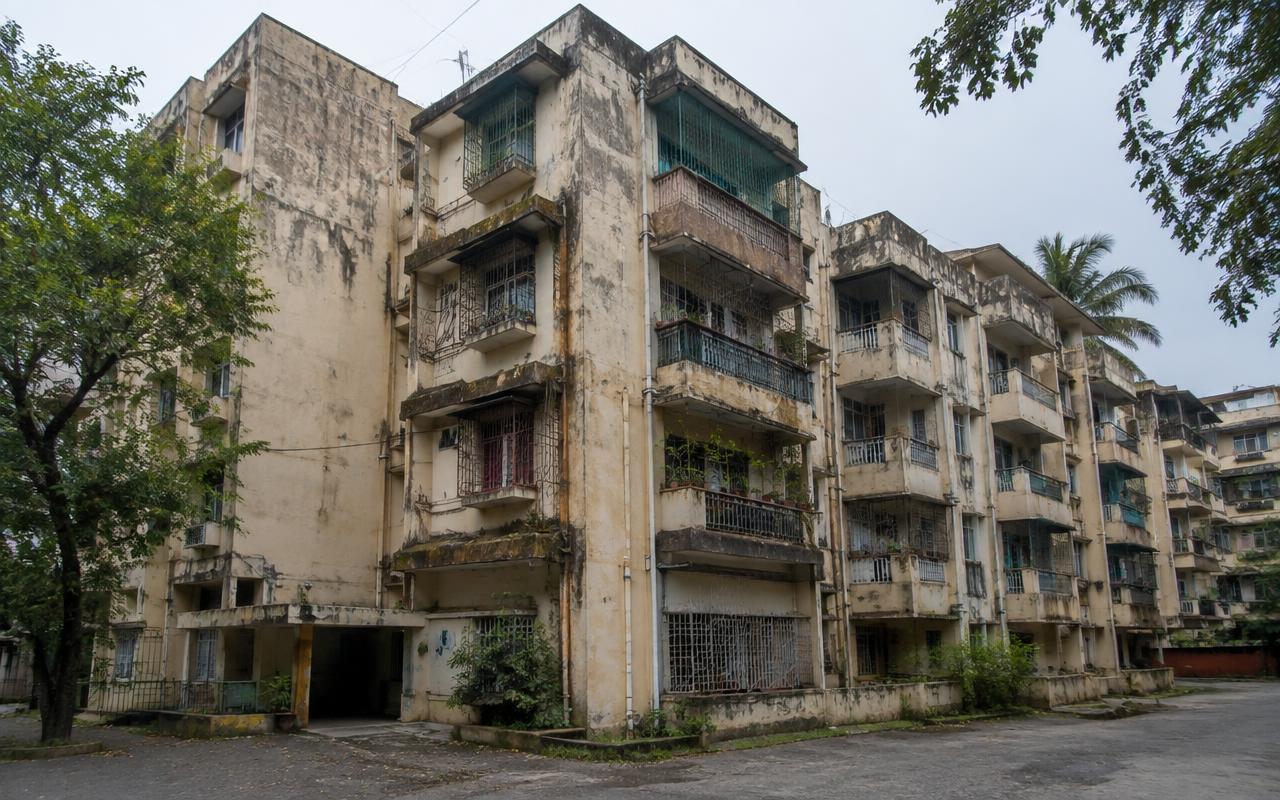
Dombivli is a dense, family-residential city with steady mid-rise redevelopment. Buildings from the 1960s–1990s are reaching the end of their design life, lack lifts and parking, and face rising repair bills. Higher FSI under UDCPR and TDR availability make redevelopment financially attractive.
02The 79A redevelopment process
Follow the government guidelines to keep the process transparent and legally sound:
- Special general body meeting to start the process
- Appoint a project management consultant (PMC) and architect
- Structural audit and feasibility report
- Tender floated; offers from builders or contractors
- Comparison statement shared with all members
- SGM selects the developer with written consent
- Development agreement registered; bank guarantee obtained
- Permissions, shifting, construction and possession
03Builder model vs self-redevelopment
In the builder model, a developer funds the project and keeps the sale flats. In self-redevelopment, the society appoints a contractor, raises finance and sells the extra flats itself — usually leaving members 30–60% more area or a large corpus.
MumbaiConstructions works as the society's construction partner for self-redevelopment: BOQ-based contract, quality reports to the committee and staged payments linked to progress.
04Construction cost for redevelopment in Dombivli
High-rise RCC construction typically runs ₹3,000–₹4,500 per sq.ft. depending on height, basement parking, podium and finishes. Premiums, TDR, GST and rent to members are separate and must be part of the feasibility.
05Dense, family-residential Dombivli and its steady mid-rise redevelopment
Dombivli's redevelopment stock is largely 1970s-90s cooperative ground+4 buildings in a dense, uniform residential grid, with fewer of the extreme plot-size or road-width variations seen in Kalyan's historic core or Thane's mixed high-rise stock. As part of KDMC jurisdiction, Dombivli redevelopment is governed by UDCPR, with the same FSI/premium-FSI/TDR framework and road-width-based loading caps applicable across KDMC's area.
Dombivli's residential density means many plots here are smaller and more tightly packed than in Kalyan or Thane, which pushes some societies toward the same plot-amalgamation strategy seen in Khar — combining adjoining small plots into a single redevelopment scheme to improve the FSI-to-construction-cost ratio.
Dombivli's uniform residential grid also means most of its redevelopment stock reaches its practical redevelopment-eligible age in a fairly compressed window relative to other UDCPR-belt localities, which is part of why Dombivli has seen a wave of near-simultaneous redevelopment activity across many adjoining plots in recent years rather than a steady trickle spread over decades.
06A worked example: a 30-member Dombivli society
A 30-member society on a 1,400 sq. m plot (about 15,070 sq. ft), members averaging 420 sq. ft carpet, starts at 12,600 sq. ft existing carpet. With typical UDCPR loading for a standard Dombivli residential road, buildable potential comes to roughly 2.2 times plot area, about 33,150 sq. ft.
Rehab at 30% extra carpet needs about 16,380 sq. ft, leaving close to 16,770 sq. ft for free sale. Construction on the ~33,000 sq. ft total at the high-rise band is estimated at ₹10-15 crore — at this smaller scale, a two- or three-plot amalgamation (as in the Khar example) can materially improve the project's economics if adjoining societies are willing to coordinate.
If two adjoining 30-member societies of similar profile amalgamate, combined buildable potential doesn't simply double — shared setbacks and a more efficient combined footprint typically produce 10-15% more buildable area than the sum of the two standalone estimates, which is the practical argument for amalgamation beyond the construction-cost efficiency already discussed.
07PMC selection and financing for a smaller Dombivli scheme
For a smaller scheme, the PMC's main value is in accurately assessing whether standalone redevelopment is financially viable or whether amalgamation with a neighbouring plot would produce meaningfully better terms — this comparison should be costed explicitly rather than assumed either way.
Self-redevelopment financing for a smaller Dombivli project is generally easier to secure proportionally (smaller loan quantum, lower absolute risk) than large Thane West or Andheri schemes, but lenders will still want milestone-linked disbursal against a bank guarantee, and a thinner free-sale margin on a small plot means less room for cost overruns before the project's economics come under pressure.
Given this clustering, a Dombivli committee negotiating a standalone, non-amalgamated scheme should still ask whether any immediately adjoining society is independently considering redevelopment around the same time, since a later, uncoordinated amalgamation opportunity can be harder to structure once one of the two buildings has already committed to a separate developer.
08Common disputes in Dombivli redevelopments
Where amalgamation is being considered, the same inter-society dispute pattern seen in Khar applies — disagreement over how free-sale area and corpus are split between participating societies, resolved by fixing a proportional split formula in the joint development agreement before tendering.
Standard pitfalls — dissenting members, OC/non-OC title gaps, bank guarantee enforcement on developer exit — follow the same resolution pattern as elsewhere in the UDCPR growth belt: documented consent thresholds, pre-construction title regularisation, and guarantee enforcement followed by re-tender.
A further Dombivli-specific dispute arises over unequal starting carpet areas between members of the same society, common in older, informally expanded chawl-adjacent buildings, where members who historically extended their units face disagreement with those who didn't over how the extra carpet should be recognised in the new allotment — this needs a documented as-built survey of existing carpet area before rehab allocation is finalised, not a reliance on the original sanctioned plan.
09Sequencing a Dombivli plot-amalgamation application with KDMC
Combining adjoining plots into a single redevelopment scheme requires a formal plot-merger or amalgamation application to KDMC before the combined FSI and TDR calculation can be sanctioned — this is a distinct procedural step from the individual societies' internal consent process, and should be initiated early since municipal processing of the merger application typically needs to clear before the building-plan sanction stage can proceed.
Societies should also confirm that property records, such as the 7/12 extract or equivalent and municipal tax records, for both plots are clean and consistent before filing the merger application, since a title or boundary discrepancy between the two plots' records is a common reason these applications get delayed at the municipal level.
Get a free site visit in Dombivli
MumbaiConstructions is a civil construction company and turnkey contractor serving Dombivli and the wider Mumbai Metropolitan Region since 2009. Share your plot or building details and a project engineer will visit, check feasibility and send a line-item BOQ within 7 working days — no obligation.
Frequently asked questions
How much extra area do members get in Dombivli?
Typically 25–45% extra carpet area in a builder deal, and often more in self-redevelopment, depending on plot size, road width and FSI.
Is 100% consent required for society redevelopment?
The government guidelines require a majority decision, but most societies aim for all members on board to avoid litigation.
Who pays rent during construction?
In a builder model the developer pays monthly rent and shifting charges. In self-redevelopment the society budgets it in the project finance.