


Quick answer
Housing society redevelopment in Ghatkopar follows the Maharashtra government's Section 79A guidelines: a general body resolution, a project management consultant, a transparent tender, and approval by at least 51% of members (most societies aim for consent from all members). Members typically get 25–45% more carpet area, rent during construction and a corpus, and the project takes 30–42 months.
On this page
- Key takeaways
- Why Ghatkopar societies are redeveloping
- The 79A redevelopment process
- Builder model vs self-redevelopment
- Construction cost for redevelopment in Ghatkopar
- A commercial-residential hub with strong redevelopment momentum
- A worked example: a 48-member Ghatkopar society
- PMC selection and tender comparison on a mixed-use plot
- Common disputes in Ghatkopar redevelopments
- Transit-oriented development FSI near Ghatkopar's metro corridor
- Frequently asked questions
Key takeaways
- Appoint an independent PMC/architect before talking to any builder.
- Compare offers on carpet area, rent, corpus and bank guarantee — not just the headline area.
- Self-redevelopment keeps sale-flat profit with members.
- Approvals in Ghatkopar go through the Brihanmumbai Municipal Corporation (BMC/MCGM).
01Why Ghatkopar societies are redeveloping
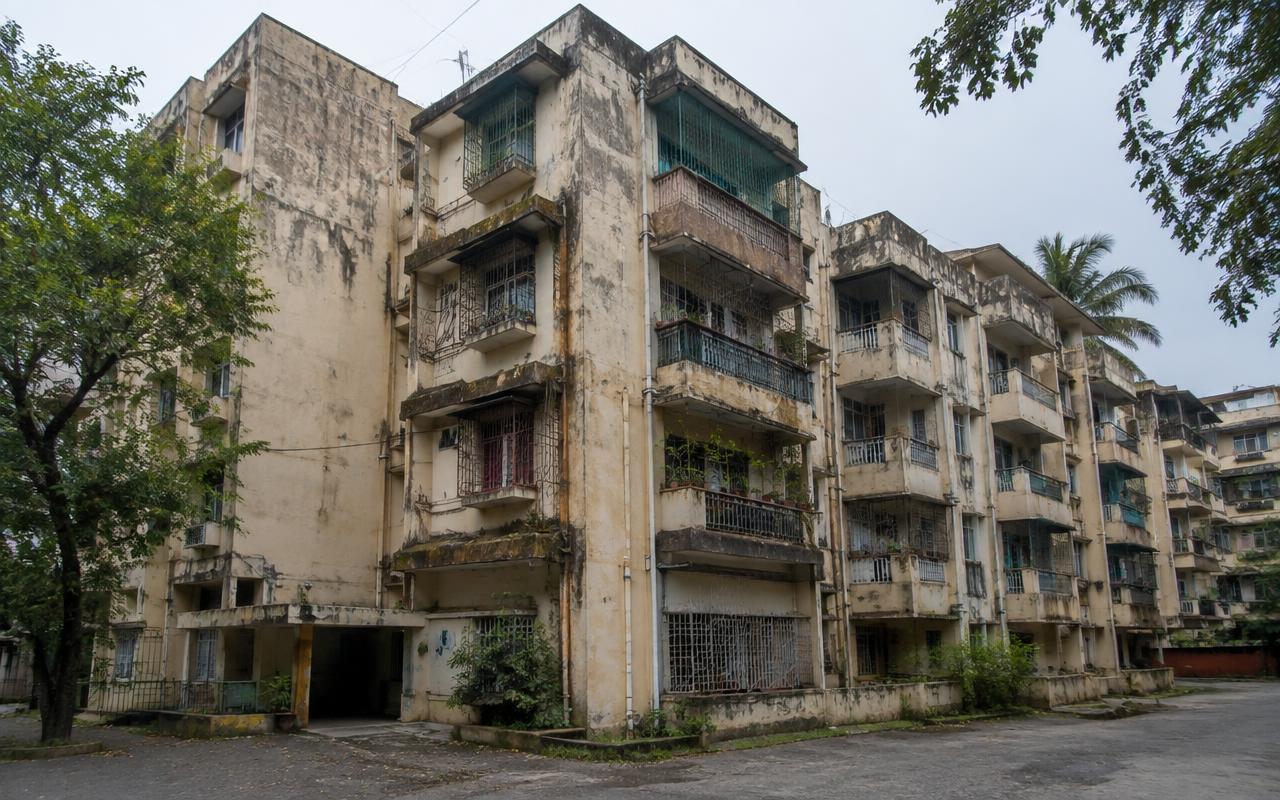
Ghatkopar is a commercial-residential hub with strong society-redevelopment activity. Buildings from the 1960s–1990s are reaching the end of their design life, lack lifts and parking, and face rising repair bills. Higher FSI under DCPR 2034 and TDR availability make redevelopment financially attractive.
02The 79A redevelopment process
Follow the government guidelines to keep the process transparent and legally sound:
- Special general body meeting to start the process
- Appoint a project management consultant (PMC) and architect
- Structural audit and feasibility report
- Tender floated; offers from builders or contractors
- Comparison statement shared with all members
- SGM selects the developer with written consent
- Development agreement registered; bank guarantee obtained
- Permissions, shifting, construction and possession
03Builder model vs self-redevelopment
In the builder model, a developer funds the project and keeps the sale flats. In self-redevelopment, the society appoints a contractor, raises finance and sells the extra flats itself — usually leaving members 30–60% more area or a large corpus.
MumbaiConstructions works as the society's construction partner for self-redevelopment: BOQ-based contract, quality reports to the committee and staged payments linked to progress.
04Construction cost for redevelopment in Ghatkopar
High-rise RCC construction typically runs ₹3,000–₹4,500 per sq.ft. depending on height, basement parking, podium and finishes. Premiums, TDR, GST and rent to members are separate and must be part of the feasibility.
05A commercial-residential hub with strong redevelopment momentum
Ghatkopar's redevelopment stock is mostly 1970s-90s cooperative ground+4 to ground+7 buildings, with a dense commercial spine along the station-adjacent stretch that gives many plots mixed-use potential under DCPR 2034. Societies on or near the commercial corridor sometimes negotiate ground-floor commercial free-sale area as part of their scheme, which changes the economics compared to a purely residential plot of the same size, generally improving the free-sale value per square foot since commercial space commands a different rate than residential.
Road widths vary meaningfully between the commercial spine (wider, supporting heavier TDR loading) and the interior residential lanes (narrower, more constrained), so a society's exact location within Ghatkopar materially affects its buildable potential even before plot size is considered.
Ghatkopar's redevelopment pipeline also benefits from the suburb's relatively strong transport connectivity, with metro, suburban rail and the Eastern Express Highway all converging nearby, which supports stronger free-sale pricing than a comparably built suburb with weaker connectivity — a factor that indirectly improves the corpus and rehab terms a developer can sustainably offer here.
06A worked example: a 48-member Ghatkopar society
A 48-member society on a 2,300 sq. m plot (about 24,760 sq. ft) on a moderately wide road, members averaging 490 sq. ft carpet, starts at 23,520 sq. ft existing carpet. Typical DCPR 2034 loading for this road category gives buildable potential of roughly 2.5 times plot area, about 61,900 sq. ft.
Rehab at 32% extra carpet needs about 31,050 sq. ft, leaving close to 30,850 sq. ft for free sale. Construction on the ~62,000 sq. ft total at the high-rise band is estimated at ₹19-28 crore — a healthy enough free-sale margin that committees should expect a competitive corpus offer from serious bidders, and should be wary of any bid significantly below what this arithmetic would support.
If the ground-floor commercial component in this example is valued separately and commands a materially higher rate per sq. ft than the residential free-sale area, even a modest 4,000-6,000 sq. ft commercial allocation can lift the overall free-sale value meaningfully above what a purely residential plot of the same size would generate — committees should ask for commercial and residential free-sale value to be reported as separate line items in every bid.
07PMC selection and tender comparison on a mixed-use plot
Where a scheme includes commercial free-sale area, the PMC and tender process should treat residential rehab and commercial monetisation as two separate cost-and-revenue tracks within the same bid, so the committee can verify that commercial proceeds are genuinely improving the member offer rather than being absorbed into developer margin without being reflected in better terms.
Self-redevelopment financing for a mixed-use Ghatkopar scheme can sometimes draw on pre-selling or pre-leasing commercial space to supplement construction finance, which residential-only societies elsewhere don't have access to — but this requires the society's PMC and legal advisor to structure any pre-sale carefully against RERA requirements.
Because Ghatkopar's commercial-residential mix makes bid structures more complex than a purely residential scheme, committees should insist that every bidder's financial model be reviewed by the society's own independent chartered accountant or financial advisor before acceptance, rather than relying solely on the PMC's assessment.
08Common disputes in Ghatkopar redevelopments
Where commercial free-sale area is part of the scheme, a recurring dispute is between residential members (who want maximum rehab area) and the development agreement's treatment of commercial proceeds (which the developer may want to retain disproportionately) — resolving this requires the committee to get an independent valuation of the commercial component before agreeing to how its proceeds are split.
Standard pitfalls — dissenting members, OC/non-OC title gaps, bank guarantee enforcement on developer exit — follow the same resolution pattern as elsewhere in the eastern suburbs.
A further Ghatkopar-specific dispute arises over whether metro-corridor proximity entitles the plot to additional transit-oriented-development FSI under DCPR 2034 — bidders sometimes assume this bonus without confirming the plot actually qualifies, which can inflate an initial pitch beyond what the final sanctioned FSI supports; committees should get TOD-FSI applicability confirmed independently before accepting it as part of the area calculation.
09Transit-oriented development FSI near Ghatkopar's metro corridor
DCPR 2034 allows an additional FSI bonus for plots within a defined distance of a metro or suburban rail corridor under its transit-oriented development provisions, and parts of Ghatkopar sit close enough to the metro line to potentially qualify — but applicability depends on the plot's exact distance from the corridor and the specific zoning classification, not just general proximity.
Because this bonus FSI is additional to the standard base, fungible and TDR-loaded FSI already discussed, a society that confirms eligibility early can meaningfully increase its buildable potential beyond what the standard calculation would show — but this needs an independent verification from a surveyor or architect, not just the developer's say-so, before it's built into any rehab or corpus negotiation.
Get a free site visit in Ghatkopar
MumbaiConstructions is a civil construction company and turnkey contractor serving Ghatkopar and the wider Mumbai Metropolitan Region since 2009. Share your plot or building details and a project engineer will visit, check feasibility and send a line-item BOQ within 7 working days — no obligation.
Frequently asked questions
How much extra area do members get in Ghatkopar?
Typically 25–45% extra carpet area in a builder deal, and often more in self-redevelopment, depending on plot size, road width and FSI.
Is 100% consent required for society redevelopment?
The government guidelines require a majority decision, but most societies aim for all members on board to avoid litigation.
Who pays rent during construction?
In a builder model the developer pays monthly rent and shifting charges. In self-redevelopment the society budgets it in the project finance.