


Quick answer
Housing society redevelopment in Jogeshwari follows the Maharashtra government's Section 79A guidelines: a general body resolution, a project management consultant, a transparent tender, and approval by at least 51% of members (most societies aim for consent from all members). Members typically get 25–45% more carpet area, rent during construction and a corpus, and the project takes 30–42 months.
On this page
- Key takeaways
- Why Jogeshwari societies are redeveloping
- The 79A redevelopment process
- Builder model vs self-redevelopment
- Construction cost for redevelopment in Jogeshwari
- Mill-era chawls and hill-slope pockets entering redevelopment
- A worked example: a 50-member Jogeshwari chawl-to-society conversion
- PMC selection where occupancy history is complex
- Pitfalls specific to chawl and hill-slope redevelopment
- Regularising chawl occupancy before the redevelopment consent vote
- Frequently asked questions
Key takeaways
- Appoint an independent PMC/architect before talking to any builder.
- Compare offers on carpet area, rent, corpus and bank guarantee — not just the headline area.
- Self-redevelopment keeps sale-flat profit with members.
- Approvals in Jogeshwari go through the Brihanmumbai Municipal Corporation (BMC/MCGM).
01Why Jogeshwari societies are redeveloping
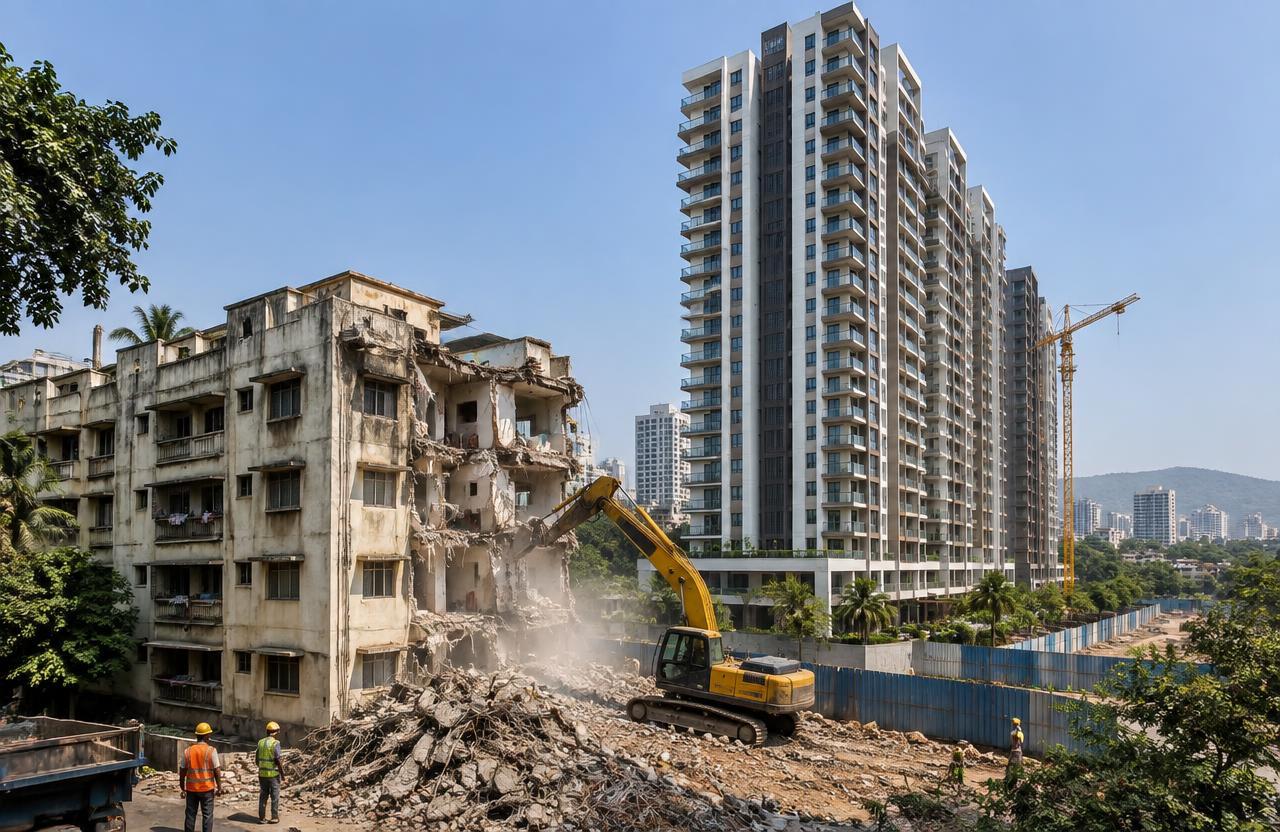
Jogeshwari is a dense suburb with mill-era chawls and hill-slope pockets entering redevelopment. Buildings from the 1960s–1990s are reaching the end of their design life, lack lifts and parking, and face rising repair bills. Higher FSI under DCPR 2034 and TDR availability make redevelopment financially attractive.
02The 79A redevelopment process
Follow the government guidelines to keep the process transparent and legally sound:
- Special general body meeting to start the process
- Appoint a project management consultant (PMC) and architect
- Structural audit and feasibility report
- Tender floated; offers from builders or contractors
- Comparison statement shared with all members
- SGM selects the developer with written consent
- Development agreement registered; bank guarantee obtained
- Permissions, shifting, construction and possession
03Builder model vs self-redevelopment
In the builder model, a developer funds the project and keeps the sale flats. In self-redevelopment, the society appoints a contractor, raises finance and sells the extra flats itself — usually leaving members 30–60% more area or a large corpus.
MumbaiConstructions works as the society's construction partner for self-redevelopment: BOQ-based contract, quality reports to the committee and staged payments linked to progress.
04Construction cost for redevelopment in Jogeshwari
High-rise RCC construction typically runs ₹3,000–₹4,500 per sq.ft. depending on height, basement parking, podium and finishes. Premiums, TDR, GST and rent to members are separate and must be part of the feasibility.
05Mill-era chawls and hill-slope pockets entering redevelopment
Jogeshwari carries a denser mix than most western suburbs: mill-era and post-mill chawl clusters in its older pockets, standard 1970s-80s cooperative ground+4 buildings, and newer hill-slope settlements along the Aarey-adjacent edge. Chawl redevelopment differs from standard cooperative society redevelopment in that many chawl structures have multiple occupants per original tenement with complex sub-letting history, which needs resolving before a Section 79A-style redevelopment consent process can even be run cleanly.
Hill-slope and hillside-adjacent plots in Jogeshwari's eastern pockets face additional geotechnical and slope-stability scrutiny before sanction, independent of the DCPR 2034 FSI calculation — a soil and slope-stability report is typically required at the approval stage for these plots, adding a step that flatter plots elsewhere in the suburb don't need.
A further complication specific to Jogeshwari's hill-slope pockets is that some settlements there predate formal plotting entirely, meaning the land itself may need regularisation under applicable slum or informal-settlement redevelopment provisions rather than being treated as a standard cooperative society redevelopment — a distinction that changes which approval process and consent framework actually applies.
06A worked example: a 50-member Jogeshwari chawl-to-society conversion
A chawl-origin society with 50 registered members on a 1,600 sq. m plot (about 17,220 sq. ft), members averaging 350 sq. ft carpet (typical of chawl-era units), starts at 17,500 sq. ft existing carpet. With standard DCPR 2034 loading for this road category, buildable potential is roughly 2.2 times plot area, about 37,890 sq. ft.
Rehab at a higher proportional uplift common in chawl redevelopment — often 40%+ extra carpet given the small starting base — needs about 24,500 sq. ft, leaving roughly 13,400 sq. ft for free sale, a notably tighter margin than a standard cooperative society redevelopment of similar plot size. This is why chawl-origin schemes often need a longer construction period or a phased handover to keep the project financially viable.
If even 10% of the 50 registered occupants can't produce clear documentation by the time the consent process needs to close, the scheme's eligible-member count, and therefore its rehab area commitment, can shift significantly — a PMC should run occupancy verification as an early, standalone workstream well before area calculations are finalised, since re-running the numbers after eligibility disputes arise is slower and more contentious than resolving eligibility first.
07PMC selection where occupancy history is complex
A PMC for a Jogeshwari chawl-origin project needs specific experience untangling occupancy and sub-letting records before the redevelopment consent process starts, since an incomplete member list is the single most common reason these projects stall at the consent stage. Tender comparison should specifically ask bidders how they propose to handle members who can't immediately produce clear occupancy documentation.
Self-redevelopment financing for chawl-origin societies is harder to secure than for standard cooperative societies of the same size, because lenders weight title clarity heavily in their risk assessment — a society that resolves occupancy documentation before approaching a lender gets materially better financing terms than one that tries to resolve it in parallel with the loan application.
Given the documentation complexity common to Jogeshwari's chawl and hill-slope societies, legal due-diligence costs here typically run higher than for a standard cooperative redevelopment of similar size — committees should budget for this as a distinct line item in their PMC or legal advisor's fee structure rather than assuming standard legal costs will cover it.
08Pitfalls specific to chawl and hill-slope redevelopment
Beyond the usual dissenting-member and bank-guarantee-enforcement issues common across the MMR, Jogeshwari schemes see disputes over which occupants qualify as members entitled to rehab area at all, particularly where sub-tenancy was informal — this is generally resolved through a documented eligibility-verification process run before the development agreement is finalised, often with legal assistance to classify each occupant's claim.
On hill-slope plots, a failed or delayed geotechnical clearance is a distinct risk that doesn't arise on flatter plots elsewhere in the suburb — committees should get a preliminary slope-stability assessment done before committing to a floor count with any bidder, since a reduced height mandated after geotechnical review can force a costly redesign later.
A further Jogeshwari-specific dispute arises where sub-tenants who've occupied a unit for decades but were never formally recorded as members push for independent rehab allotment rather than being treated as dependents of the original tenement holder — this is usually resolved by a documented family-tree or occupancy-history reconstruction exercise, sometimes requiring affidavits and local enquiry, before the development agreement finalises the member schedule.
- Verify member eligibility and occupancy documentation before signing the development agreement
- Get a preliminary geotechnical/slope report before committing to a floor count on hill-slope plots
- Expect tighter free-sale margins than standard cooperative schemes of similar plot size
09Regularising chawl occupancy before the redevelopment consent vote
Chawl-origin societies in Jogeshwari typically need an occupancy-regularisation exercise before the Section 79A-style consent process can proceed cleanly — this means reconciling the original tenement register against current occupants, identifying which occupants hold protected tenancy rights, and resolving any informally sub-let units, often with legal assistance to classify each claim.
Only once this register is settled can the society reliably determine its final member count and therefore its total rehab area commitment — skipping this step and starting the tender process on an unverified member list is one of the most common reasons chawl-origin redevelopment timelines in Jogeshwari run well beyond the initial estimate.
Get a free site visit in Jogeshwari
MumbaiConstructions is a civil construction company and turnkey contractor serving Jogeshwari and the wider Mumbai Metropolitan Region since 2009. Share your plot or building details and a project engineer will visit, check feasibility and send a line-item BOQ within 7 working days — no obligation.
Frequently asked questions
How much extra area do members get in Jogeshwari?
Typically 25–45% extra carpet area in a builder deal, and often more in self-redevelopment, depending on plot size, road width and FSI.
Is 100% consent required for society redevelopment?
The government guidelines require a majority decision, but most societies aim for all members on board to avoid litigation.
Who pays rent during construction?
In a builder model the developer pays monthly rent and shifting charges. In self-redevelopment the society budgets it in the project finance.