


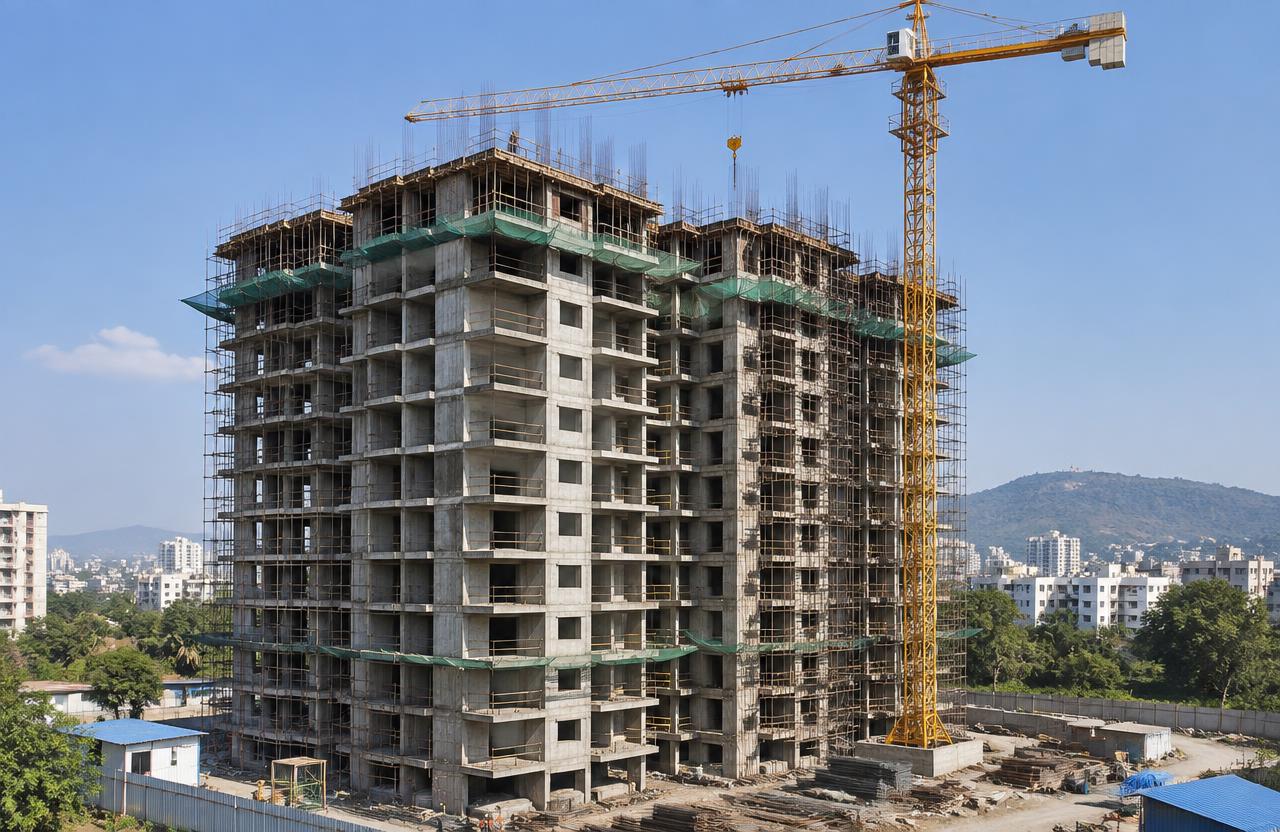
Quick answer
Housing society redevelopment in Khar follows the Maharashtra government's Section 79A guidelines: a general body resolution, a project management consultant, a transparent tender, and approval by at least 51% of members (most societies aim for consent from all members). Members typically get 25–45% more carpet area, rent during construction and a corpus, and the project takes 30–42 months.
On this page
- Key takeaways
- Why Khar societies are redeveloping
- The 79A redevelopment process
- Builder model vs self-redevelopment
- Construction cost for redevelopment in Khar
- Khar's bungalow-to-apartment stock and its FSI headroom
- A worked example: a 20-member Khar bungalow society
- Selecting a PMC and comparing tenders for a two-plot amalgamation
- Common pitfalls in Khar amalgamation projects
- Transit rent and relocation during an amalgamated Khar scheme
- Frequently asked questions
Key takeaways
- Appoint an independent PMC/architect before talking to any builder.
- Compare offers on carpet area, rent, corpus and bank guarantee — not just the headline area.
- Self-redevelopment keeps sale-flat profit with members.
- Approvals in Khar go through the Brihanmumbai Municipal Corporation (BMC/MCGM).
01Why Khar societies are redeveloping
Khar is a leafy residential suburb with steady bungalow-to-apartment redevelopment. Buildings from the 1960s–1990s are reaching the end of their design life, lack lifts and parking, and face rising repair bills. Higher FSI under DCPR 2034 and TDR availability make redevelopment financially attractive.
02The 79A redevelopment process
Follow the government guidelines to keep the process transparent and legally sound:
- Special general body meeting to start the process
- Appoint a project management consultant (PMC) and architect
- Structural audit and feasibility report
- Tender floated; offers from builders or contractors
- Comparison statement shared with all members
- SGM selects the developer with written consent
- Development agreement registered; bank guarantee obtained
- Permissions, shifting, construction and possession
03Builder model vs self-redevelopment
In the builder model, a developer funds the project and keeps the sale flats. In self-redevelopment, the society appoints a contractor, raises finance and sells the extra flats itself — usually leaving members 30–60% more area or a large corpus.
MumbaiConstructions works as the society's construction partner for self-redevelopment: BOQ-based contract, quality reports to the committee and staged payments linked to progress.
04Construction cost for redevelopment in Khar
High-rise RCC construction typically runs ₹3,000–₹4,500 per sq.ft. depending on height, basement parking, podium and finishes. Premiums, TDR, GST and rent to members are separate and must be part of the feasibility.
05Khar's bungalow-to-apartment stock and its FSI headroom
Khar's redevelopment pipeline is dominated by 1950s-70s standalone bungalows and twin-bungalow plots on its internal lanes (Khar Danda, 14th-33rd Road), plus a layer of 1980s cooperative ground+4 buildings closer to the station. Under DCPR 2034, these plots draw on base FSI, fungible FSI and purchasable TDR, with the loadable TDR capped by the width of the abutting road — Khar's narrower internal lanes generally support less loading than the wider stretches near Linking Road, which is why two similarly sized plots a few lanes apart can see noticeably different buildable areas.
Because most Khar bungalow plots are smaller than a typical cooperative housing plot elsewhere, amalgamation of adjoining plots is a common strategy here — combining two or three neighbouring bungalow societies into a single redevelopment scheme improves the FSI-to-construction-cost ratio and can make a project viable that would be marginal on a single small plot.
Khar's two bungalow-origin building types — the fully standalone bungalow and the subdivided twin-bungalow plot — also differ in how cleanly title can be established for redevelopment, since twin-bungalow plots sometimes have an undivided or ambiguously partitioned land record even where the physical structures have long been treated as separate households; a title search before tendering is worth the modest upfront cost to avoid a dispute surfacing after a development agreement is signed.
06A worked example: a 20-member Khar bungalow society
Consider a 20-member society split across two adjoining bungalow plots totalling 1,400 sq. m (about 15,070 sq. ft), with members currently averaging 550 sq. ft carpet — 11,000 sq. ft of existing carpet. With amalgamation and typical loading for Khar's internal-lane road widths, buildable potential comes to roughly 2.4 times plot area, or about 36,170 sq. ft.
Offering each member 30% additional carpet consumes about 14,300 sq. ft of rehab area, leaving close to 21,870 sq. ft for free sale. At the standard high-rise construction band, building out the full ~36,000 sq. ft costs an estimated ₹11-16 crore, a figure the committee can use to sanity-check whether the free-sale proceeds a bidder is promising actually cover construction plus a reasonable developer margin and corpus.
If only one of the two amalgamating plots agrees to maximum TDR loading while the other prefers a more conservative design, the blended buildable area falls — a 10% reduction in loadable TDR on one of the two plots can shrink total buildable potential by roughly 1,500-2,000 sq. ft, which is why the joint development agreement should fix each plot's loading assumption before tendering rather than leaving it to be resolved during construction.
07Selecting a PMC and comparing tenders for a two-plot amalgamation
Amalgamated schemes need a PMC comfortable coordinating two or three separate societies' consents, documentation and handover schedules simultaneously — ask specifically how they've sequenced possession dates across linked societies before. Tender comparison should flag any bidder who quotes a single blended rate for the combined plot without breaking out each society's rehab area and corpus separately, since that structure makes it hard to audit fairness between the two societies later.
Self-redevelopment across an amalgamated plot generally needs a joint development agreement among the participating societies before approaching a lender, and financing is usually structured as one consolidated facility with disbursal linked to combined project milestones rather than per-society milestones.
As with Bandra, additional carpet area received by members under an amalgamated scheme typically attracts stamp duty at the point of the new allotment agreement, and because amalgamation can involve a slightly more complex documentation chain across multiple plots, societies should get this cost estimated by their legal advisor early rather than treating it as a line item to resolve only at possession.
08Common pitfalls in Khar amalgamation projects
The most frequent dispute is between the two (or three) societies over how free-sale area and corpus are split, especially when the plots are unequal in size or when one building has more OC-holding members than the other. Dissenting members inside any one of the amalgamating societies can also stall the whole scheme, since amalgamation typically requires consent thresholds to be met in each participating society independently, not just in aggregate.
These are generally resolved by fixing the area and corpus split formula (proportional to each society's contributed plot area and existing built-up area) in the joint development agreement before tendering, and by running consent meetings separately for each society so a holdout in one building doesn't get conflated with the others.
A further friction point in amalgamated bungalow schemes is disagreement over the sequence of demolition and handover — if one bungalow's household moves out into transit accommodation well before the other, that household bears a longer displacement period, so development agreements here typically specify a synchronised demolition and transit schedule across both plots rather than leaving timing to the developer's convenience.
- Fix the inter-society area/corpus split formula before inviting bids
- Run separate consent meetings per participating society
- Confirm the bank guarantee covers each society's rehab commitment individually
09Transit rent and relocation during an amalgamated Khar scheme
Bungalow-plot members in Khar typically vacate into rented transit accommodation for the construction period, with the development agreement fixing a monthly transit rent per member usually linked to the prevailing rental rate for a comparable flat nearby — for a redevelopment running two to three years, this rent commitment is a material line item the developer must fund, and should be secured against the same bank guarantee that backs construction, not left as an unsecured promise.
Because amalgamation projects often run slightly longer than a single-plot redevelopment given the extra coordination between societies, committees should negotiate a rent-escalation clause for any construction delay beyond the agreed timeline, so members aren't left absorbing rising rental costs themselves if the project overruns.
Societies negotiating transit rent should also fix the rent amount with reference to a specific, named comparable property or locality rate agreed at signing, rather than leaving it to be renegotiated later — an open-ended rent clause is a common source of friction once the developer's cash flow tightens during a long construction period.
Get a free site visit in Khar
MumbaiConstructions is a civil construction company and turnkey contractor serving Khar and the wider Mumbai Metropolitan Region since 2009. Share your plot or building details and a project engineer will visit, check feasibility and send a line-item BOQ within 7 working days — no obligation.
Frequently asked questions
How much extra area do members get in Khar?
Typically 25–45% extra carpet area in a builder deal, and often more in self-redevelopment, depending on plot size, road width and FSI.
Is 100% consent required for society redevelopment?
The government guidelines require a majority decision, but most societies aim for all members on board to avoid litigation.
Who pays rent during construction?
In a builder model the developer pays monthly rent and shifting charges. In self-redevelopment the society budgets it in the project finance.