


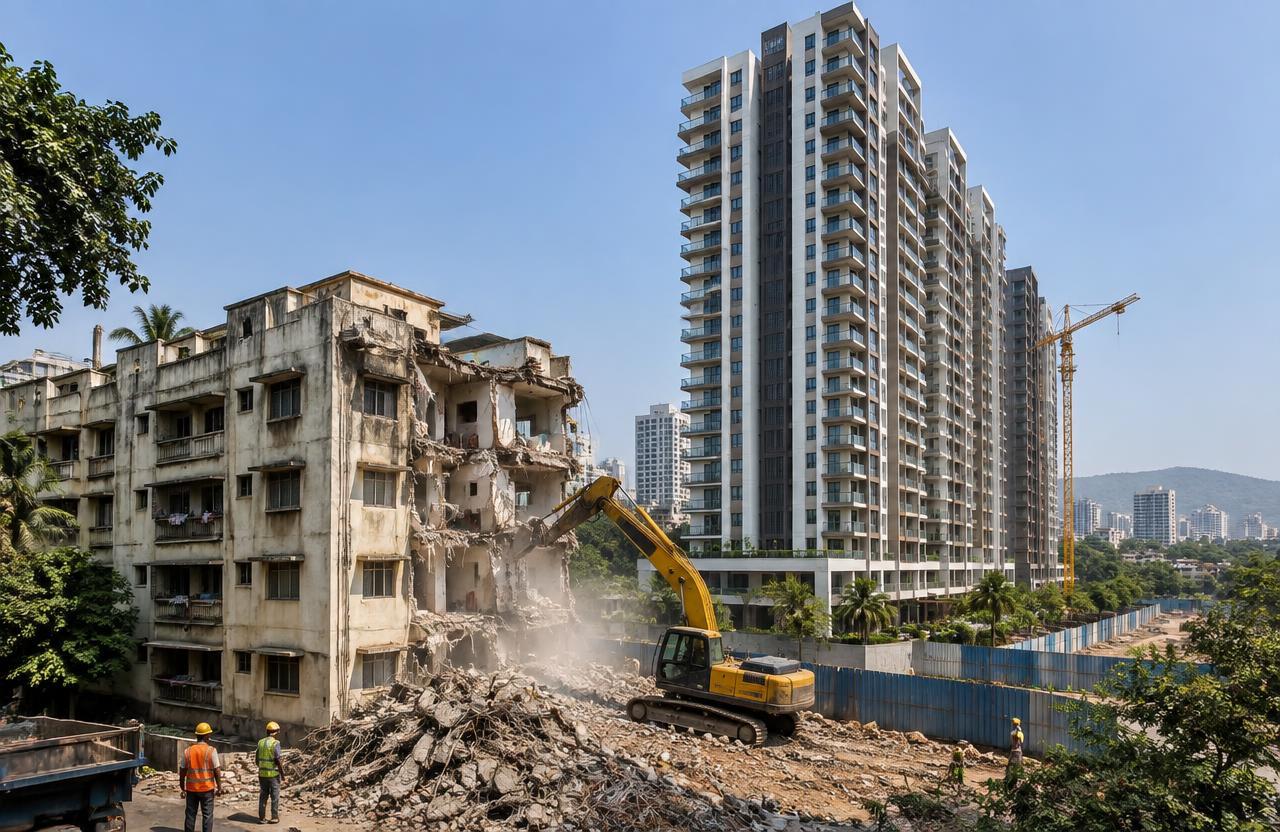
Quick answer
Housing society redevelopment in Mira Road follows the Maharashtra government's Section 79A guidelines: a general body resolution, a project management consultant, a transparent tender, and approval by at least 51% of members (most societies aim for consent from all members). Members typically get 25–45% more carpet area, rent during construction and a corpus, and the project takes 30–42 months.
On this page
- Key takeaways
- Why Mira Road societies are redeveloping
- The 79A redevelopment process
- Builder model vs self-redevelopment
- Construction cost for redevelopment in Mira Road
- A dense high-rise corridor with strong redevelopment and new-build demand
- A worked example: a 56-member Mira Road society
- PMC selection and financing for a newer-stock redevelopment wave
- Common disputes in Mira Road redevelopments
- New-build competition and its effect on Mira Road free-sale pricing
- Frequently asked questions
Key takeaways
- Appoint an independent PMC/architect before talking to any builder.
- Compare offers on carpet area, rent, corpus and bank guarantee — not just the headline area.
- Self-redevelopment keeps sale-flat profit with members.
- Approvals in Mira Road go through Thane Municipal Corporation (TMC).
01Why Mira Road societies are redeveloping
Mira Road is a dense high-rise suburb on the western corridor with strong redevelopment and new-build demand. Buildings from the 1960s–1990s are reaching the end of their design life, lack lifts and parking, and face rising repair bills. Higher FSI under UDCPR and TDR availability make redevelopment financially attractive.
02The 79A redevelopment process
Follow the government guidelines to keep the process transparent and legally sound:
- Special general body meeting to start the process
- Appoint a project management consultant (PMC) and architect
- Structural audit and feasibility report
- Tender floated; offers from builders or contractors
- Comparison statement shared with all members
- SGM selects the developer with written consent
- Development agreement registered; bank guarantee obtained
- Permissions, shifting, construction and possession
03Builder model vs self-redevelopment
In the builder model, a developer funds the project and keeps the sale flats. In self-redevelopment, the society appoints a contractor, raises finance and sells the extra flats itself — usually leaving members 30–60% more area or a large corpus.
MumbaiConstructions works as the society's construction partner for self-redevelopment: BOQ-based contract, quality reports to the committee and staged payments linked to progress.
04Construction cost for redevelopment in Mira Road
High-rise RCC construction typically runs ₹3,000–₹4,500 per sq.ft. depending on height, basement parking, podium and finishes. Premiums, TDR, GST and rent to members are separate and must be part of the feasibility.
05A dense high-rise corridor with strong redevelopment and new-build demand
Mira Road's stock is younger on average than most locations on this list — a large share of its residential buildings date from the 1990s-2010s, meaning the current redevelopment wave here is concentrated in its earliest, 1990s-vintage ground+4/5 cooperative buildings rather than a broad swath of the suburb. As part of Mira Bhayandar Municipal Corporation jurisdiction, redevelopment is governed by UDCPR, with FSI, premium FSI and TDR loading following the same road-width-capped framework used across the UDCPR growth belt.
Mira Road's corridor-style development along its main arterial road means plots directly fronting it generally see much heavier TDR loading potential than the residential lanes set back from it, creating a sharper buildable-area contrast across short distances than in more uniformly laid-out suburbs like Dombivli.
Mira Road's relatively young overall building stock also means the suburb's redevelopment pipeline will likely grow substantially over the next decade as more of its 1990s-2000s buildings reach redevelopment-eligible age, following a pattern closer to what Thane experienced a decade or more ago — current redevelopment activity here is an early wave rather than a mature, steady-state pipeline.
06A worked example: a 56-member Mira Road society
A 56-member society on a 2,600 sq. m plot (about 27,990 sq. ft) set back from the main arterial corridor, members averaging 440 sq. ft carpet, starts at 24,640 sq. ft existing carpet. With typical UDCPR loading for this road category, buildable potential comes to roughly 2.4 times plot area, about 67,180 sq. ft.
Rehab at 30% extra carpet needs about 32,030 sq. ft, leaving close to 35,150 sq. ft for free sale. Construction on the ~67,000 sq. ft total at the high-rise band is estimated at ₹20-30 crore. A comparable plot directly on the arterial corridor would see noticeably higher buildable potential given heavier TDR loading there, which is why two Mira Road societies of similar plot size can see quite different free-sale margins depending on their exact frontage.
A comparable 2,600 sq. m plot directly on the main arterial corridor, rather than set back from it, could see buildable potential rise to roughly 2.8-3.0 times plot area given heavier TDR loading there — pushing total buildable area toward 73,000-78,000 sq. ft and free-sale area correspondingly higher, which is the scale of difference exact frontage makes even holding plot size and member count constant.
07PMC selection and financing for a newer-stock redevelopment wave
Because Mira Road's redevelopment wave is relatively early compared to Thane or the western suburbs, fewer local PMCs have a long track record here specifically — committees should weigh a bidder's broader UDCPR-area experience (including Thane or Kalyan-Dombivli projects) alongside any Mira Road-specific references, rather than insisting on Mira Road experience exclusively.
Self-redevelopment financing follows the general UDCPR-belt pattern of milestone-linked disbursal against a bank guarantee; lenders generally treat Mira Road's risk profile similarly to Thane's given its comparable high-rise density, though with a shorter local redevelopment track record to draw underwriting data from.
Given this early-wave status, Mira Road committees should weight a bidder's financial strength and completion track record especially heavily, since the relative lack of a long local track record for any single developer means reputation signals available elsewhere in the UDCPR belt are less reliable here.
08Common disputes in Mira Road redevelopments
Standard pitfalls apply: dissenting members, OC-holder versus non-OC-holder title gaps, and bank guarantee enforcement followed by re-tender if a developer exits mid-project, resolved through the same mechanisms used across the UDCPR growth belt.
A Mira Road-specific friction point is disagreement over how much weight to give a corridor-frontage plot's higher buildable potential when negotiating with a developer who may initially quote terms based on comparable but less favourably located plots — committees should insist on a site-specific FSI/TDR assessment for their exact plot rather than accepting a general area-wide estimate.
09New-build competition and its effect on Mira Road free-sale pricing
Mira Road sees substantial ongoing new-build, non-redevelopment construction alongside its redevelopment pipeline, which means a redeveloped building's free-sale units compete directly with freshly launched new projects in the same micro-market — this competitive pressure can affect how quickly a developer can sell free-sale inventory and therefore how aggressively they can price a corpus or rehab offer to a society.
A society evaluating competing bids should ask each developer how they plan to price and absorb free-sale inventory given this competition, since a bid built on an optimistic sales-velocity assumption can leave the developer financially stretched mid-project if free-sale units don't move as quickly as planned — a risk that ultimately falls back on the society if it triggers a funding shortfall.
Get a free site visit in Mira Road
MumbaiConstructions is a civil construction company and turnkey contractor serving Mira Road and the wider Mumbai Metropolitan Region since 2009. Share your plot or building details and a project engineer will visit, check feasibility and send a line-item BOQ within 7 working days — no obligation.
Frequently asked questions
How much extra area do members get in Mira Road?
Typically 25–45% extra carpet area in a builder deal, and often more in self-redevelopment, depending on plot size, road width and FSI.
Is 100% consent required for society redevelopment?
The government guidelines require a majority decision, but most societies aim for all members on board to avoid litigation.
Who pays rent during construction?
In a builder model the developer pays monthly rent and shifting charges. In self-redevelopment the society budgets it in the project finance.