


Quick answer
Structural audits, jacketing, crack repair and strengthening. To plan structural repair & retrofitting well across Mumbai, Navi Mumbai, Thane and Panvel, freeze the scope and drawings, get a line-item BOQ (indicative On audit), confirm approvals, sign a contract with stage-linked payments, and insist on documented quality checks at every stage.
On this page
- Key takeaways
- What structural repair & retrofitting includes
- Planning checklist
- Common mistakes to avoid
- Quality checks that matter
- Basic, Standard and Premium Structural Repair Specifications
- Worked Example: Column Jacketing for a 25-Year-Old Building
- Material Selection for Structural Repair
- Warranty on Structural Repair and Retrofitting Work
- Frequently asked questions
Key takeaways
- Indicative rate: On audit.
- Drawings first, contract second, work third.
- Stage-linked payments protect your money.
- Ask for test reports: cubes, steel, waterproofing.
01What structural repair & retrofitting includes
Structural audits, jacketing, crack repair and strengthening.
- Audit & NDT
- Design
- Jacketing
- Crack injection
- Rebar treatment
- Protective coating
02Planning checklist
Use this before you sign anything:
- Define budget and must-haves
- Soil test and site survey
- Architectural and structural drawings
- Approvals and NOCs
- BOQ with brands and quantities
- Contract with timeline, penalties and defect liability
- Payment schedule linked to stages
03Common mistakes to avoid
Choosing on the lowest sq.ft. rate, starting without structural drawings, skipping waterproofing, changing design mid-way and paying large advances without milestones are the five mistakes we see most often.
04Quality checks that matter
Concrete cube tests, rebar inspection before every pour, curing for at least 7–14 days, ponding tests for waterproofing, and pressure tests for plumbing should all be documented and shared with you.
06Worked Example: Column Jacketing for a 25-Year-Old Building
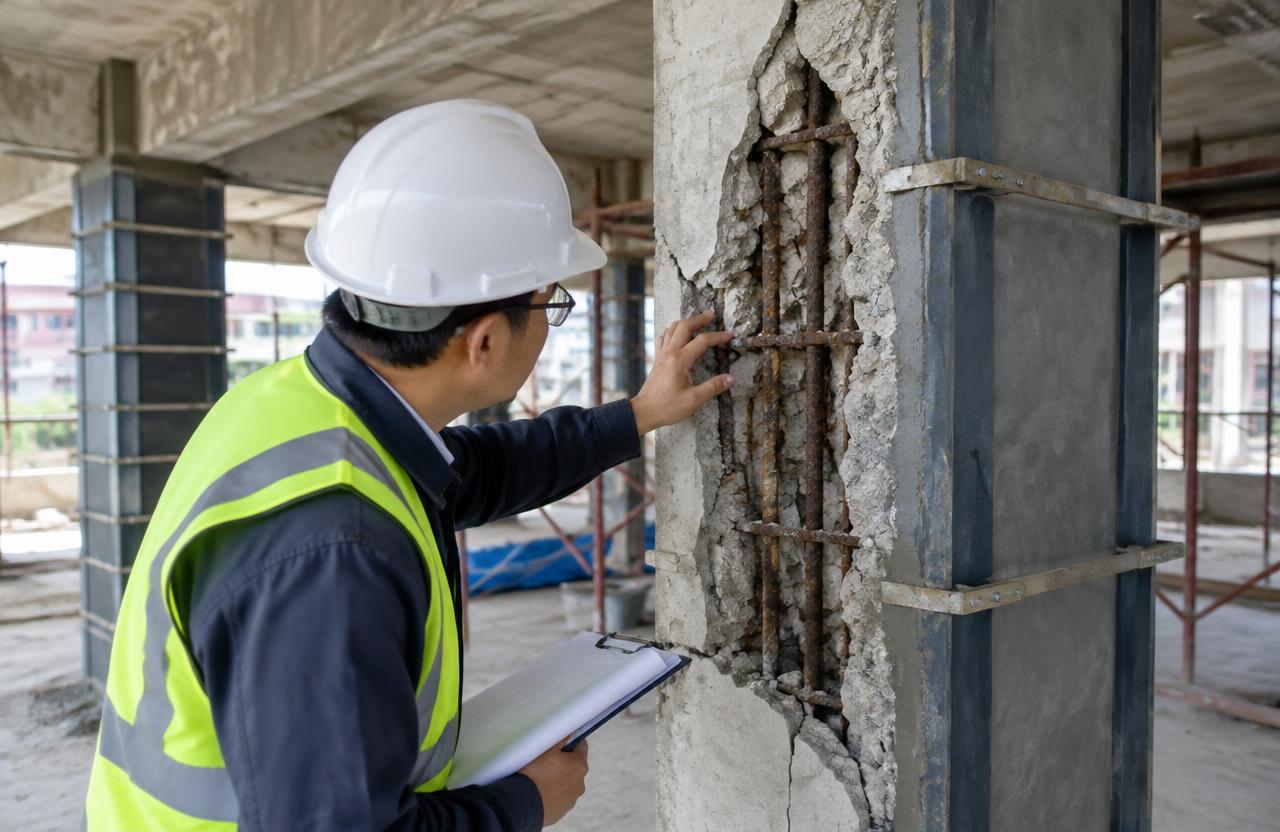
For a 25-year-old building showing visible rebar corrosion and cracking at ground-floor columns, the process starts with a structural audit including visual survey, rebound hammer and ultrasonic pulse velocity testing, and in some cases core sampling to confirm actual concrete strength (2-3 weeks, since lab results on core samples take time). Based on the audit, a jacketing design is prepared specifying the additional concrete and reinforcement needed to restore (and ideally exceed) original capacity.
Execution starts with removing loose, delaminated concrete and treating exposed rebar with a rust-converting or passivating coating, then adding supplementary reinforcement tied into the existing column, followed by formwork and micro-concrete or standard concrete jacketing poured in a continuous operation per column. For a building with 15-20 affected columns, this execution phase typically takes 6-8 weeks, with each column needing a full curing cycle before load is reapplied or adjacent columns are started, to avoid overloading partially-repaired members.
Temporary propping of beams and slabs above the columns being jacketed is a step that is sometimes skipped to save time, which is a mistake — a column under active repair has reduced capacity for the duration of the work, and proper temporary shoring of the load above it is what keeps the building safe through the repair process itself, not just after it's finished.
07Material Selection for Structural Repair
Micro-concrete (a flowable, shrinkage-compensated repair concrete) is generally preferred over standard concrete for jacketing work in confined formwork, since it fully fills tight gaps around existing reinforcement without the vibration access that standard concrete needs. Where rebar has active corrosion, a rust-converting primer followed by a corrosion-inhibiting coating is applied before any new concrete is placed — skipping this step and simply encasing corroded rebar in fresh concrete only delays the corrosion's reappearance, it doesn't stop it.
For crack injection, epoxy grout is used for structural cracks needing full bond restoration, while polyurethane grout is preferred for active water-leaking cracks since it expands and seals even in damp conditions where epoxy bonding would be compromised.
Where corrosion has caused meaningful section loss in the original rebar, supplementary reinforcement should be calculated and tied in by a structural engineer rather than added on a rule-of-thumb basis — overestimating the additional steel needed adds unnecessary cost and congestion in an already tight jacket, while underestimating it defeats the purpose of the repair, so this is one area where the engineering calculation genuinely earns its cost.
The root cause of the original corrosion is worth identifying before repair work begins rather than treating it as an afterthought — if it traces back to a waterproofing failure at a terrace or balcony edge directly above the affected column, repairing the column without also fixing that waterproofing source simply restarts the same corrosion process a few years later, at which point the repair itself will need repeating.
08Warranty on Structural Repair and Retrofitting Work
Structural repair work typically carries a 5-10 year warranty on the repaired elements specifically, covering recurrence of the same distress (re-cracking, renewed corrosion) at the treated locations, provided the structure isn't subjected to loads beyond what the repair design assumed. This warranty is narrower in scope than a new-construction structural warranty since it applies only to the repaired members, not the building's entire structural system.
Because structural repair projects start from an audit, the audit report, NDT results, and repair design calculations should all be retained as part of the warranty documentation — any future dispute or follow-up audit will be assessed against this baseline record rather than against general code requirements alone.
A follow-up audit at roughly the midpoint of the warranty period is good practice on any significant jacketing or retrofitting project, since it catches a recurrence of corrosion or new distress elsewhere in the structure early, while remediation is still comparatively simple, rather than waiting for the warranty period to lapse before the building is looked at again.
Get a free site visit in Mumbai, Navi Mumbai & Thane
MumbaiConstructions is a civil construction company and turnkey contractor serving Mumbai, Navi Mumbai & Thane and the wider Mumbai Metropolitan Region since 2009. Share your plot or building details and a project engineer will visit, check feasibility and send a line-item BOQ within 7 working days — no obligation.
Frequently asked questions
How much does structural repair & retrofitting cost in Mumbai?
Indicatively On audit, depending on specification and site conditions.
Can you do only the civil work?
Yes — we work turnkey or on a civil-only or item-rate basis with your architect.