


Quick answer
Vitrified, marble, granite, wooden and industrial flooring laid level, with clean joints and proper slopes. To plan tiling & flooring contractors well across Mumbai, Navi Mumbai, Thane and Panvel, freeze the scope and drawings, get a line-item BOQ (indicative ₹45 – ₹250 / sq.ft. (labour + material)), confirm approvals, sign a contract with stage-linked payments, and insist on documented quality checks at every stage.
On this page
- Key takeaways
- What tiling & flooring contractors includes
- Planning checklist
- Common mistakes to avoid
- Quality checks that matter
- Basic, Standard and Premium Flooring Specifications
- Worked Example: Flooring for a 1,800 Sq.Ft. Apartment
- Material Selection for Different Flooring Types
- Site-Readiness Checklist Before Flooring Work Begins
- Warranty on Tiling and Flooring Work
- Frequently asked questions
Key takeaways
- Indicative rate: ₹45 – ₹250 / sq.ft. (labour + material).
- Drawings first, contract second, work third.
- Stage-linked payments protect your money.
- Ask for test reports: cubes, steel, waterproofing.
01What tiling & flooring contractors includes
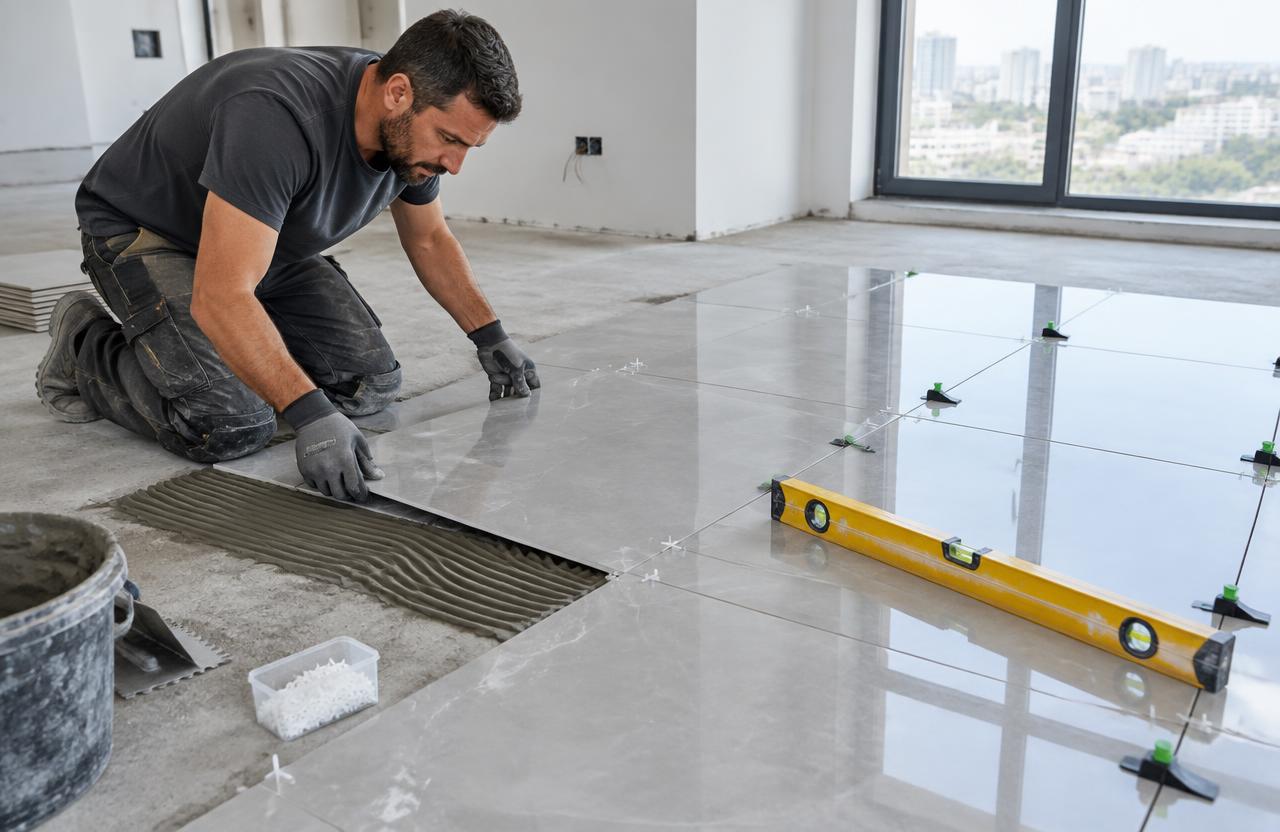
Vitrified, marble, granite, wooden and industrial flooring laid level, with clean joints and proper slopes.
- Floor & wall tiling
- Marble & granite
- Wooden flooring
- Epoxy & industrial floors
- Bathroom tiling
- Polishing & grouting
02Planning checklist
Use this before you sign anything:
- Define budget and must-haves
- Soil test and site survey
- Architectural and structural drawings
- Approvals and NOCs
- BOQ with brands and quantities
- Contract with timeline, penalties and defect liability
- Payment schedule linked to stages
03Common mistakes to avoid
Choosing on the lowest sq.ft. rate, starting without structural drawings, skipping waterproofing, changing design mid-way and paying large advances without milestones are the five mistakes we see most often.
04Quality checks that matter
Concrete cube tests, rebar inspection before every pour, curing for at least 7–14 days, ponding tests for waterproofing, and pressure tests for plumbing should all be documented and shared with you.
06Worked Example: Flooring for a 1,800 Sq.Ft. Apartment
For a full flooring job across a 1,800 sq.ft. apartment with vitrified tiles in living areas, anti-skid tiles in wet areas, and wooden flooring in bedrooms, the typical sequence is: substrate preparation and level-checking (3-4 days, critical since an uneven substrate causes hollow tiles regardless of installation skill), tile-adhesive application and tile laying room by room (1.5-2 weeks for this area, sequenced to avoid foot traffic on freshly laid sections), and grouting after a minimum 24-48 hour setting period per section.
Wooden flooring in bedrooms is typically installed after tiling is complete to avoid dust and moisture exposure during the wetter tiling work, adding 3-5 days including underlay and skirting. Polishing (for marble/granite areas, if used) and final grout sealing close out the project, bringing total duration for an apartment this size to roughly 3-4 weeks.
A sound-test or tap-test of every tile after the adhesive has fully cured, before grouting locks the joints in place, is a quality step worth insisting on explicitly — a hollow-sounding tile caught at this stage can simply be lifted and re-bedded, while the same hollow tile discovered after grouting (or worse, after furniture is placed on it) requires disruptive rework to fix.
07Material Selection for Different Flooring Types
Large-format tiles (800x800mm and above) genuinely need polymer-modified adhesive rather than plain cement-sand bedding, since the larger format is less forgiving of minor substrate unevenness and a cement-only bed is far more prone to developing hollow spots that eventually crack under point load. For bathroom and balcony floors, anti-skid-rated tiles with a slip-resistance rating suited to wet conditions are a safety requirement, not just a finish preference, and should never be substituted with a standard glossy tile for cost reasons.
Wooden flooring in Mumbai's humid climate specifically needs a moisture-barrier underlay regardless of whether the wood is solid or engineered, since ground or sub-floor moisture migration is the most common cause of cupping and warping complaints in this region, even on upper floors away from ground moisture.
Natural stone (marble, granite) also needs a specific sealant applied after polishing to resist staining from everyday spills, and this sealant isn't a one-time application — it typically needs reapplication every couple of years depending on foot traffic, which is a maintenance expectation worth setting with the owner at handover rather than leaving as an assumed, unstated responsibility.
08Site-Readiness Checklist Before Flooring Work Begins
Flooring is one of the last trades in sequence, which means it inherits every unresolved issue from the stages before it, so these confirmations are worth making before material is even delivered to site.
- Substrate screed level-checked and defects corrected before tile or stone laying starts, rather than expecting the tile bed to compensate for an uneven screed
- All plumbing and electrical conduit work below floor level completed and pressure-tested, since cutting into a finished floor to fix a missed conduit is far costlier than catching it beforehand
- Waterproofing in wet areas completed and ponding-tested before flooring begins over it, so any seepage is caught while the surface is still accessible to rework
- Door and frame heights confirmed against the final flooring thickness to avoid clearance issues once the new floor build-up is in place
- Material quantities ordered with adequate wastage allowance from a single batch/lot to avoid shade variation between batches partway through a room
- Furniture and other trades' access sequenced so finished flooring isn't damaged by later work, with protective covering planned for high-traffic areas during the remaining fit-out
09Warranty on Tiling and Flooring Work
Tile and stone flooring installation typically carries a 2-3 year workmanship warranty covering hollow tiles, cracking, and grout failure, separate from the tile manufacturer's own material warranty against manufacturing defects. Wooden flooring usually carries a shorter 1-2 year installation warranty, since timber movement from humidity is partly an inherent material characteristic rather than purely a workmanship issue.
Epoxy and industrial flooring warranties are typically tied to a specified minimum film thickness and substrate preparation standard — a warranty claim on peeling or wear is usually first checked against whether the applied thickness met the specification, which is why thickness verification during application (not just after) is worth insisting on for industrial floors.
Grout discolouration and minor hairline shrinkage cracks in grout lines are generally treated as routine maintenance rather than a warranty item, since grout is inherently more porous and prone to staining than the tile itself — the practical expectation an owner should carry is periodic regrouting or sealing of grout lines every few years, not an indefinite warranty against this kind of wear.
Get a free site visit in Mumbai, Navi Mumbai & Thane
MumbaiConstructions is a civil construction company and turnkey contractor serving Mumbai, Navi Mumbai & Thane and the wider Mumbai Metropolitan Region since 2009. Share your plot or building details and a project engineer will visit, check feasibility and send a line-item BOQ within 7 working days — no obligation.
Frequently asked questions
How much does tiling & flooring contractors cost in Mumbai?
Indicatively ₹45 – ₹250 / sq.ft. (labour + material), depending on specification and site conditions.
Can you do only the civil work?
Yes — we work turnkey or on a civil-only or item-rate basis with your architect.