


Quick answer
Terrace, basement, bathroom and tank waterproofing with ponding tests. To plan waterproofing well across Mumbai, Navi Mumbai, Thane and Panvel, freeze the scope and drawings, get a line-item BOQ (indicative ₹45 – ₹180 / sq.ft.), confirm approvals, sign a contract with stage-linked payments, and insist on documented quality checks at every stage.
On this page
- Key takeaways
- What waterproofing includes
- Planning checklist
- Common mistakes to avoid
- Quality checks that matter
- Basic, Standard and Premium Waterproofing Specifications
- Worked Example: Terrace Waterproofing for a 2,000 Sq.Ft. Roof
- Material Selection for Different Waterproofing Applications
- Warranty on Waterproofing Work
- Frequently asked questions
Key takeaways
- Indicative rate: ₹45 – ₹180 / sq.ft..
- Drawings first, contract second, work third.
- Stage-linked payments protect your money.
- Ask for test reports: cubes, steel, waterproofing.
01What waterproofing includes
Terrace, basement, bathroom and tank waterproofing with ponding tests.
- Inspection
- Surface prep
- Membrane / coating
- Protection screed
- Ponding test
- Warranty
02Planning checklist
Use this before you sign anything:
- Define budget and must-haves
- Soil test and site survey
- Architectural and structural drawings
- Approvals and NOCs
- BOQ with brands and quantities
- Contract with timeline, penalties and defect liability
- Payment schedule linked to stages
03Common mistakes to avoid
Choosing on the lowest sq.ft. rate, starting without structural drawings, skipping waterproofing, changing design mid-way and paying large advances without milestones are the five mistakes we see most often.
04Quality checks that matter
Concrete cube tests, rebar inspection before every pour, curing for at least 7–14 days, ponding tests for waterproofing, and pressure tests for plumbing should all be documented and shared with you.
06Worked Example: Terrace Waterproofing for a 2,000 Sq.Ft. Roof
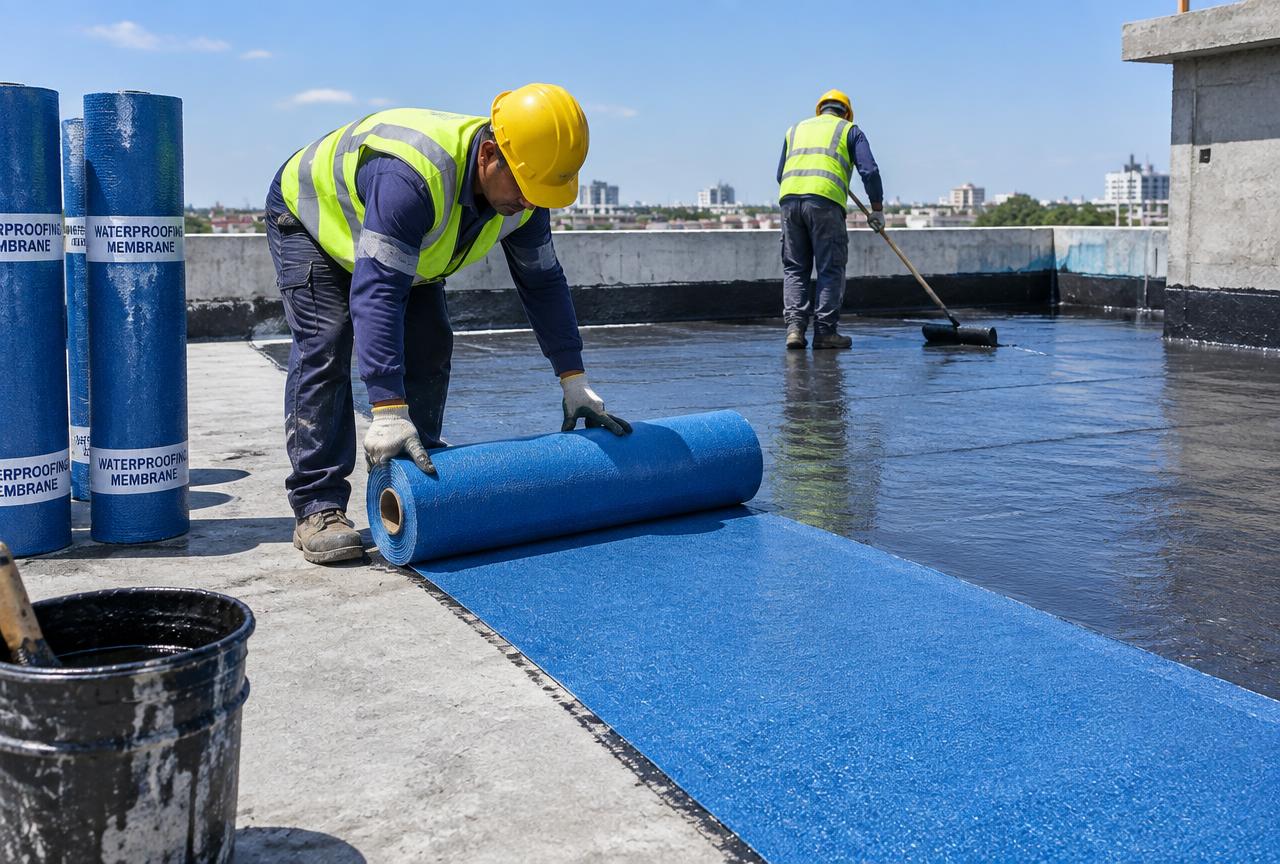
For a 2,000 sq.ft. terrace, the typical sequence is: inspection and identification of existing cracks or previous repair patches (1-2 days), surface preparation including removal of loose material and crack grouting (2-3 days), and application of the chosen membrane or coating system in the specified number of coats with mandatory drying time between each (3-5 days for membrane systems, slightly less for cementitious coating).
The protection screed, laid to the correct fall toward the outlets, follows over 2-3 days and needs its own curing period before the ponding test. The ponding test itself is held for 48-72 hours minimum with water dammed at every outlet and corner checked from below — any damp patch found during this window means rework before handover, not a warranty claim to be dealt with later. Total project time for this scale is typically 2-3 weeks including all curing and testing windows.
Parapet and upstand junctions deserve as much attention in this sequence as the flat surface — a membrane that performs perfectly across the main terrace area but was only loosely dressed up the parapet wall, rather than properly terminated and mechanically fixed at the top, is a common reason terraces that pass their initial ponding test still develop a leak at the parapet joint within the first year or two.
07Material Selection for Different Waterproofing Applications
Terrace and exposed roof areas need a membrane system with UV resistance and the flexibility to handle thermal expansion-contraction cycling, which is why PU or APP membrane systems outperform plain cementitious coating on exposed terraces over the long run. Basement and underground tank waterproofing faces the opposite challenge — constant moisture and hydrostatic pressure rather than UV and thermal cycling — so crystalline waterproofing admixtures and external membrane application before backfilling matter more than UV resistance.
Bathroom waterproofing is a smaller area but arguably the highest-risk application in a home, since it sits directly above finished ceilings below — a membrane system taken up the wall at least 300-450mm (full height behind a shower) with properly sealed pipe penetrations is non-negotiable here, as most bathroom leaks originate at a pipe collar that was waterproofed around rather than sealed properly.
For any application, the primer and membrane should come from the same compatible system rather than being mixed across different product lines based on whichever is cheapest at the time — incompatible primer-membrane combinations are a genuine and underappreciated cause of early adhesion failure, and this is one area where sticking to a single consistent, specified system matters more than the specific brand chosen.
08Warranty on Waterproofing Work
Waterproofing is one of the few civil trades sold with an explicit written warranty as standard practice — typically 5-7 years for cementitious systems and 10 years for membrane systems, often with the manufacturer's own material warranty layered on top of the contractor's workmanship warranty. The warranty document should specify exactly what triggers a claim (any visible seepage or damp patch) and the contractor's response time commitment, not just the warranty period length.
What voids a waterproofing warranty fastest is unauthorised drilling, nailing, or structural penetration through the waterproofed surface after handover — for instance, mounting a satellite dish or solar panel bracket on a warrantied terrace without informing the original contractor — since this punctures a membrane system the contractor cannot be held responsible for afterward.
It is worth getting the warranty's inspection and response terms in writing just as much as its duration — a warranty that promises ten years but offers no clear commitment on how quickly the contractor will respond to a reported leak, or what counts as acceptable evidence of a claim, is considerably weaker in practice than a shorter warranty with clear, specific response commitments.
Get a free site visit in Mumbai, Navi Mumbai & Thane
MumbaiConstructions is a civil construction company and turnkey contractor serving Mumbai, Navi Mumbai & Thane and the wider Mumbai Metropolitan Region since 2009. Share your plot or building details and a project engineer will visit, check feasibility and send a line-item BOQ within 7 working days — no obligation.
Frequently asked questions
How much does waterproofing cost in Mumbai?
Indicatively ₹45 – ₹180 / sq.ft., depending on specification and site conditions.
Can you do only the civil work?
Yes — we work turnkey or on a civil-only or item-rate basis with your architect.