


Quick answer
Concrete Road & Paving in Mumbai typically costs ₹1,800 – ₹3,800 / sq.m. in 2026. The final price depends on site access, soil and structure, specification and brands, and contract type. CRZ-governed coastal sites usually cost 15–25% more.
On this page
- Key takeaways
- Indicative rates
- What drives the cost
- What a good BOQ looks like
- Basic, standard and premium PQC specification
- Sample cost split for a concrete paved stretch
- Regional variance driven by RMC access and curing conditions
- Negotiation and payment structure for concrete paving
- Frequently asked questions
Key takeaways
- Typical range: ₹1,800 – ₹3,800 / sq.m..
- Ask for quantities, rates and brands per item.
- Keep a 5–8% contingency.
- Turnkey contracts reduce coordination cost.
01Indicative rates
For concrete road & paving we usually quote ₹1,800 – ₹3,800 / sq.m. across Mumbai, Navi Mumbai and Thane. CRZ-governed and creek-facing sites add clearance and marine-grade material costs.
02What drives the cost
The main factors:
- Site access and material haul distance
- Soil and foundation type
- Structural system and spans
- Specification and brands
- Contract type: turnkey, lump sum or item rate
- Season and schedule
03What a good BOQ looks like
Every item should list description, unit, quantity, rate and brand — for example, M25 concrete in cubic metres or vitrified tiles of a named brand and size in square feet. That makes quotes comparable and protects you from surprises.
- Sub-base — itemised with quantity and rate
- PQC — itemised with quantity and rate
- Joints — itemised with quantity and rate
- Paver blocks — itemised with quantity and rate
- Kerbs — itemised with quantity and rate
- Drains — itemised with quantity and rate
05Sample cost split for a concrete paved stretch
On a typical concrete road or paved plaza package, the sub-base (granular or cement-treated) is 20–25% of cost, the PQC slab itself (material, placement, finishing, curing) is the largest component at 40–45%, joint cutting, sealing and dowel bars together run 10–12%, and paver blocks where used for shoulders or walkways are a further 10–15% depending on the proportion of paved versus poured area.
Kerbs and drains close out the BOQ at roughly 8–10%. Because PQC needs a minimum 28-day curing period before it can bear traffic, projects on tight timelines sometimes substitute early-strength admixtures, which adds 3–5% to the slab cost but allows earlier opening — a trade-off worth discussing explicitly rather than discovering after the road is cast.
Joint cutting timing is a detail worth confirming explicitly in the schedule — contraction joints need to be sawn within a fairly narrow window after placement (too early and the concrete edge ravels, too late and uncontrolled cracking occurs elsewhere in the slab), so a contractor's crew availability to cut joints on schedule, not just their ability to pour concrete on schedule, is part of what you're actually paying for in the PQC line item.
Where the pour sequence spans multiple working days, the junction between an older and newer pour (a construction joint, distinct from a planned contraction joint) needs its own detailing — typically a key joint or dowelled connection — and this should be planned into the pour sequence at quoting stage rather than improvised on site wherever the previous day's pour happened to stop.
06Regional variance driven by RMC access and curing conditions
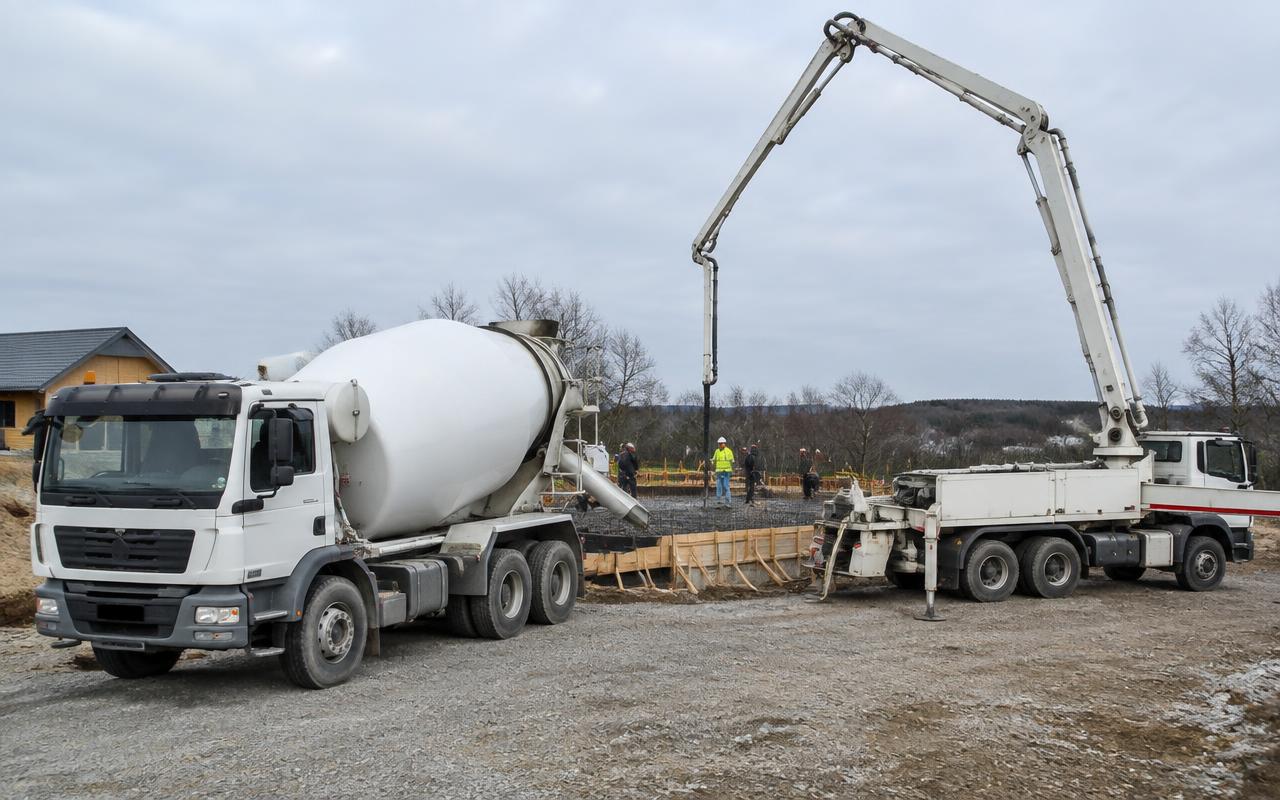
Concrete road work depends on a steady, large-volume RMC supply at a consistent mix design, so sites well served by RMC plants — much of Thane, Navi Mumbai and the Panvel corridor — get more competitive slab rates than sites in congested parts of the island city, where batching plants are farther away and transit time risks the concrete losing workability before placement, sometimes forcing smaller batch sizes and more joints.
Monsoon timing also affects cost more here than on bituminous roads, because PQC curing is far more sensitive to washout from rain in the first 24–48 hours — projects timed to cast during the monsoon window typically carry a 5–8% premium for covering and protection measures.
The smaller-batch, more-joints consequence of long transit time is worth flagging specifically, because more joints mean more potential points of future cracking and faulting — a contractor quoting a competitive rate for a city-centre concrete road job should be asked directly how they plan to manage RMC transit time and whether that changes the joint spacing from what would otherwise be standard.
Ambient temperature also affects curing more than it might seem on a tropical site — concrete cast during Mumbai's hotter pre-monsoon months sets and loses surface moisture faster than concrete cast in cooler winter months, which changes how aggressively curing compound or wet-covering needs to be applied in the first 24 hours to avoid surface shrinkage cracking.
07Negotiation and payment structure for concrete paving
A common lowball is omitting dowel bars and joint sealant from the base quote and presenting them as an 'optional upgrade' later, when they are standard practice for any trafficked concrete pavement. Ask for the joint detail (spacing, dowel bar diameter and sealant type) to be specified in the original BOQ, not offered as an add-on.
Payment is item-rate per slab panel or per chainage segment poured and cured, with 10% mobilization, progressive billing per completed and cured stretch, and 5–10% retention held until the full curing period is complete and a visual/physical inspection confirms no premature cracking — releasing payment before the curing period ends removes the contractor's incentive to protect fresh concrete from traffic or rain.
Barricading freshly poured panels against vehicle and foot traffic for the full curing period should be an explicit, costed line item in the contract rather than assumed — a concrete road or plaza opened early because barricading wasn't budgeted for is one of the more common and entirely avoidable causes of early-life surface damage on this type of work.
A short defect-liability period spanning at least one monsoon, similar to bituminous road practice, is worth building into a concrete paving contract too — faulting at joints or surface scaling (a sign of poor curing or an inadequate air-entrainment in the mix) often only becomes visible after the pavement has been through real wet-weather traffic, not on the day it's handed over looking flat and uniform.
Get a free site visit in Mumbai
MumbaiConstructions is a civil construction company and turnkey contractor serving Mumbai and the wider Mumbai Metropolitan Region since 2009. Share your plot or building details and a project engineer will visit, check feasibility and send a line-item BOQ within 7 working days — no obligation.
Frequently asked questions
Why do concrete road & paving quotes vary so much?
Different specifications, hidden exclusions and missing items. Compare on an identical BOQ.
Do you offer a fixed price?
Yes — after drawings are final we can offer a lump-sum turnkey price.