


Quick answer
Storm drains, sewer lines, STPs, underground and overhead tanks. To plan drainage, stp & water tanks well across Mumbai, Navi Mumbai, Thane and Panvel, freeze the scope and drawings, get a line-item BOQ (indicative On BOQ), confirm approvals, sign a contract with stage-linked payments, and insist on documented quality checks at every stage.
On this page
- Key takeaways
- What drainage, stp & water tanks includes
- Planning checklist
- Common mistakes to avoid
- Quality checks that matter
- Basic, Standard and Premium Drainage and Tank Specifications
- Worked Example: An Underground Sump and Overhead Tank for a 40-Unit Society
- Material Selection for Tanks, Drains and STPs
- Site-Readiness Checklist Before Drainage and Tank Work
- Warranty on Tanks, Drainage Lines and STPs
- Frequently asked questions
Key takeaways
- Indicative rate: On BOQ.
- Drawings first, contract second, work third.
- Stage-linked payments protect your money.
- Ask for test reports: cubes, steel, waterproofing.
01What drainage, stp & water tanks includes
Storm drains, sewer lines, STPs, underground and overhead tanks.
- Design
- Excavation
- Pipelines
- Chambers
- Tanks
- Testing
02Planning checklist
Use this before you sign anything:
- Define budget and must-haves
- Soil test and site survey
- Architectural and structural drawings
- Approvals and NOCs
- BOQ with brands and quantities
- Contract with timeline, penalties and defect liability
- Payment schedule linked to stages
03Common mistakes to avoid
Choosing on the lowest sq.ft. rate, starting without structural drawings, skipping waterproofing, changing design mid-way and paying large advances without milestones are the five mistakes we see most often.
04Quality checks that matter
Concrete cube tests, rebar inspection before every pour, curing for at least 7–14 days, ponding tests for waterproofing, and pressure tests for plumbing should all be documented and shared with you.
06Worked Example: An Underground Sump and Overhead Tank for a 40-Unit Society
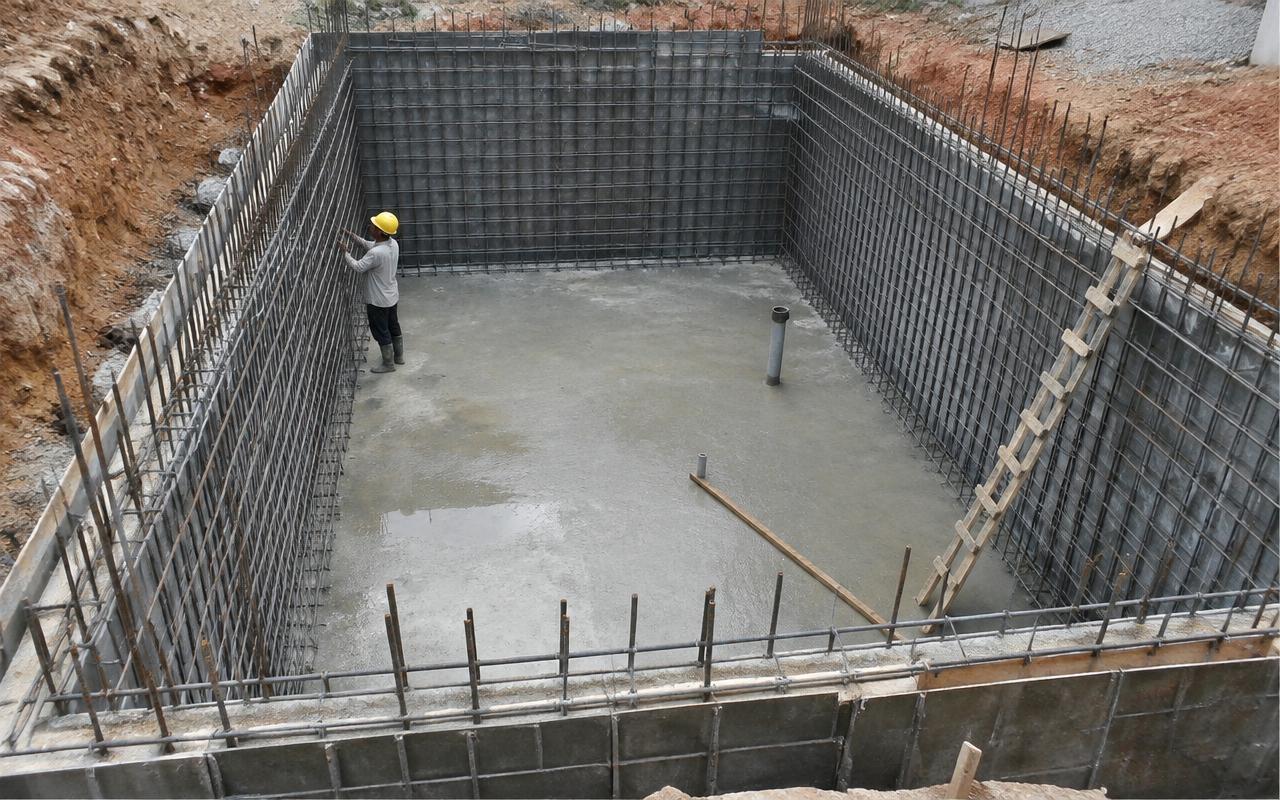
For a 40-unit residential society, a typical underground sump (sized to roughly 1-1.5 days of total demand) and matching overhead tank project runs 6-8 weeks. Excavation and RCC construction of the underground sump take 2-3 weeks including a mandatory 14-day curing period before waterproofing can begin.
Waterproofing (PU or APP membrane on external faces plus a protected screed internally) and the first ponding test take another 1-2 weeks, with the ponding test held for a minimum 48-72 hours to catch slow seepage that a quick visual check would miss. The overhead tank platform and tank construction proceed in parallel on a separate crew, and pipeline connections, pumps, and pressure testing of the full distribution network close out the project in the final 1-2 weeks.
For this scale of society, the sump is typically compartmentalised into two or more chambers rather than built as a single tank, so that one compartment can be isolated and cleaned without shutting off the entire building's water supply — a detail that costs relatively little extra at construction but materially changes how disruptive routine maintenance is for every resident for the life of the building.
07Material Selection for Tanks, Drains and STPs
For underground water tanks, PU or APP membrane waterproofing applied to the external face before backfilling, combined with a waterproof-admixture internal screed, gives genuine double protection — relying on internal coating alone is a common shortcut that fails once the external face is in permanent contact with damp soil. All tank fittings (inlet, outlet, overflow, washout) should be stainless or hot-dip galvanised rather than plain mild steel, since these points sit in constant moisture and corrode fastest.
For STP installations, the aeration and filtration media specification matters more long-term than the tank's civil construction — an undersized or poor-quality treatment media leads to effluent quality failures that show up only after the plant has been running for months, by which point retrofitting is expensive.
Where a tank or STP sits in a CRZ-influenced coastal location, marine-grade fittings and reinforcement cover aren't optional upgrades but a practical necessity — standard-grade steel and fittings in a chloride-rich coastal atmosphere corrode at a rate that can shorten a tank's usable life by half or more compared to the same structure built inland, which is why MCZMA clearance conditions for such sites often specify material grade directly.
08Site-Readiness Checklist Before Drainage and Tank Work
Underground tank and pipeline work is awkward and costly to revisit once backfilled, so these confirmations are worth making before excavation for the tank or trench begins, not after the concrete has already been poured.
- Soil and water-table levels checked at the exact tank/sump location, since a high water table changes both excavation method and waterproofing detailing
- Pipeline alignment checked against existing underground utilities to avoid clashes during excavation, ideally confirmed with a trial pit rather than drawings alone
- CRZ clearance confirmed via MCZMA if the site lies within the coastal zone, before excavation begins, since work started without clearance can be halted mid-project
- Power supply confirmed for pumps, both during construction dewatering and for final commissioning of the completed system
- Access for excavation machinery and concrete delivery confirmed for the tank/sump location, particularly where it sits in a tight basement or service area
- Society or client sign-off obtained on tank capacity sizing before construction, since enlarging a completed tank is far costlier than right-sizing it upfront
09Warranty on Tanks, Drainage Lines and STPs
Underground tanks and sumps typically carry a waterproofing-specific warranty of 7-10 years, verified by the initial ponding test and reconfirmed by the owner observing for seepage through at least one monsoon. Pipeline and drainage work carries a shorter 2-3 year warranty against leaks and blockages, since pipe joints are more exposed to ground movement and root ingress over time than a sealed tank structure.
STP mechanical and electrical components (pumps, blowers, control panels) usually carry a manufacturer's warranty separate from the civil construction warranty, typically 1-2 years, and this distinction should be clear in the handover documentation since STP complaints often involve both civil and mechanical causes.
A practical point owners often miss is that a tank's waterproofing warranty is typically contingent on the tank not being structurally modified afterward — drilling a new inlet or outlet point into an already-waterproofed tank wall without professional involvement effectively creates a fresh, unwarrantied penetration point, regardless of how sound the original waterproofing was.
Get a free site visit in Mumbai, Navi Mumbai & Thane
MumbaiConstructions is a civil construction company and turnkey contractor serving Mumbai, Navi Mumbai & Thane and the wider Mumbai Metropolitan Region since 2009. Share your plot or building details and a project engineer will visit, check feasibility and send a line-item BOQ within 7 working days — no obligation.
Frequently asked questions
How much does drainage, stp & water tanks cost in Mumbai?
Indicatively On BOQ, depending on specification and site conditions.
Can you do only the civil work?
Yes — we work turnkey or on a civil-only or item-rate basis with your architect.