


Quick answer
Drainage, STP & Water Tanks in Mumbai typically costs On BOQ in 2026. The final price depends on site access, soil and structure, specification and brands, and contract type. CRZ-governed coastal sites usually cost 15–25% more.
On this page
- Key takeaways
- Indicative rates
- What drives the cost
- What a good BOQ looks like
- Sample BOQ for an STP + water tank package
- Basic, standard and premium tank and STP specification
- Coastal versus inland cost variance for tanks and drainage
- Negotiation and payment guidance for drainage/STP packages
- Frequently asked questions
Key takeaways
- Typical range: On BOQ.
- Ask for quantities, rates and brands per item.
- Keep a 5–8% contingency.
- Turnkey contracts reduce coordination cost.
01Indicative rates
For drainage, stp & water tanks we usually quote On BOQ across Mumbai, Navi Mumbai and Thane. CRZ-governed and creek-facing sites add clearance and marine-grade material costs.
02What drives the cost
The main factors:
- Site access and material haul distance
- Soil and foundation type
- Structural system and spans
- Specification and brands
- Contract type: turnkey, lump sum or item rate
- Season and schedule
03What a good BOQ looks like
Every item should list description, unit, quantity, rate and brand — for example, M25 concrete in cubic metres or vitrified tiles of a named brand and size in square feet. That makes quotes comparable and protects you from surprises.
- Design — itemised with quantity and rate
- Excavation — itemised with quantity and rate
- Pipelines — itemised with quantity and rate
- Chambers — itemised with quantity and rate
- Tanks — itemised with quantity and rate
- Testing — itemised with quantity and rate
04Sample BOQ for an STP + water tank package
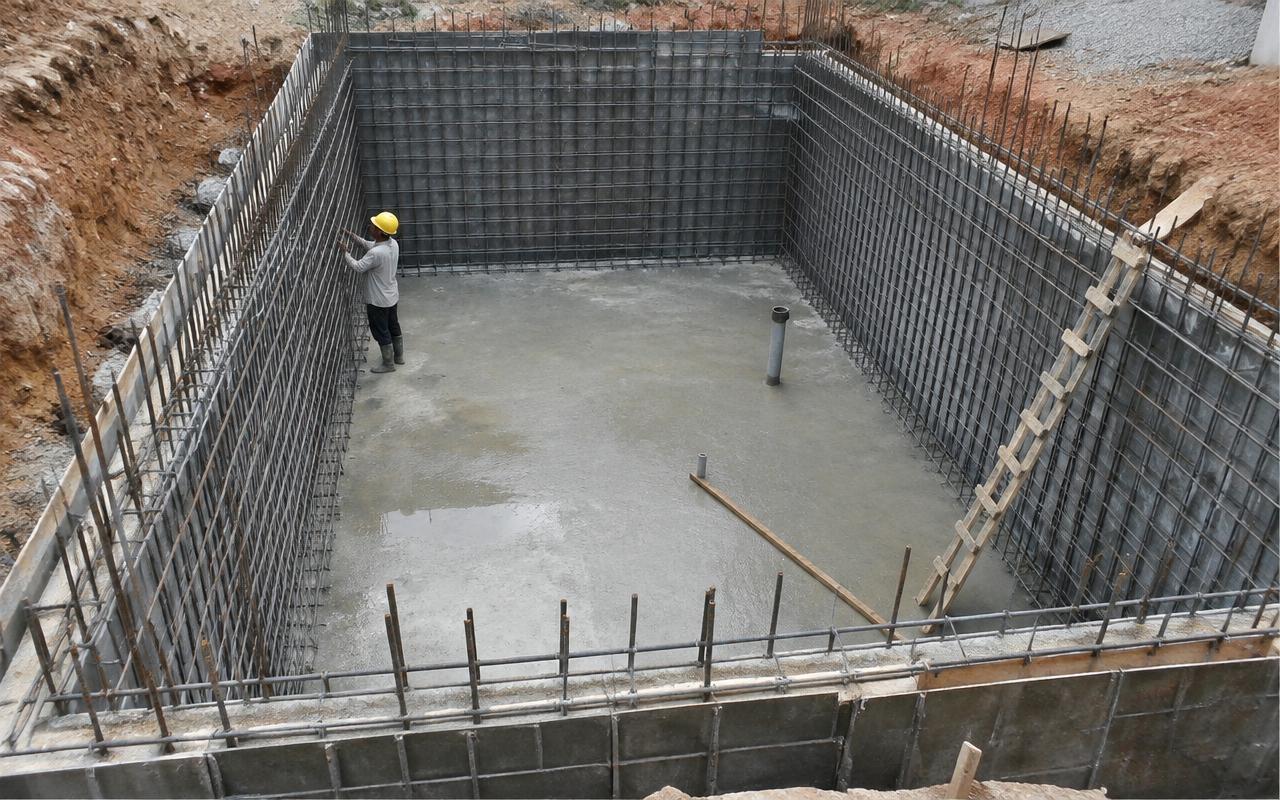
For a residential or commercial complex installing an underground sump, overhead tank and a small sewage treatment plant (STP) on a BOQ basis, design (hydraulic and structural) is typically 3–5% of the package. Excavation for tanks and pipe trenches is 10–12%, pipeline supply and laying (sewer, storm water, treated water recirculation lines) is 18–22%, manholes and inspection chambers are 10–12%, and the tanks themselves (sump, OHT, and STP civil + equipment) form the largest share at 35–40%.
Testing and commissioning — hydraulic testing of tanks for leakage, pressure testing of pipelines, and performance testing of the STP against discharge norms before handover — is only 3–5% of cost but is the stage most often rushed or skipped on tight schedules, which is exactly when leaks and odour complaints surface a few months after occupancy.
STP equipment specifically (blowers, diffusers, pumps, control panel) carries its own maintenance cost profile separate from the civil structure around it, and it's worth asking the contractor to break out equipment cost from civil cost within that 35–40% tank share — equipment typically needs periodic servicing and eventual replacement on a different timeline than the concrete tank structure, and budgeting for both separately avoids surprises a few years into occupancy.
Pipeline routing cost is sensitive to the site's overall layout in a way that's easy to underestimate from a simple area-based rate — a complex or constrained site that forces pipe runs around existing structures, under driveways, or through tighter trench widths than ideal adds materially to the pipeline share, which is why two sites of similar size and occupancy can still see a meaningfully different total for this package.
- Design (hydraulic + structural): 3–5%
- Excavation (tanks + trenches): 10–12%
- Pipelines: 18–22%
- Chambers/manholes: 10–12%
- Tanks (sump, OHT, STP civil + equipment): 35–40%
- Testing & commissioning: 3–5%
06Coastal versus inland cost variance for tanks and drainage
Sites close to the coast or creek-influenced ground — stretches of Mumbai's western waterfront, parts of Navi Mumbai near the creek, and low-lying Panvel pockets — see tank and underground structure costs run 15–25% higher than inland sites, because a high water table means tanks need to resist external hydrostatic uplift (sometimes requiring anti-floatation design) in addition to standard waterproofing, and excavation itself needs continuous dewatering during construction. Inland sites with a deeper water table avoid both of those cost additions.
CRZ-adjacent sites may also face siting restrictions on where an STP's treated-water discharge point can be located, which can add pipeline length (and cost) to route discharge to a compliant point rather than the nearest convenient one.
Anti-floatation design deserves specific mention for empty or partially empty underground tanks near the coast — an empty sump sitting in saturated ground can actually float upward under hydrostatic pressure if it isn't weighted or anchored adequately, a failure mode that doesn't exist on inland sites with a deep water table and is easy to overlook if the design was adapted from an inland template rather than developed for the specific site conditions.
07Negotiation and payment guidance for drainage/STP packages
A frequent lowball tactic is quoting STP capacity at the bare statutory minimum for current occupancy, with no margin for future occupancy growth, then charging a near-full new-installation cost for capacity upgrades later. Another is excluding hydraulic testing and commissioning support from the quote, treating it as a separate 'handover service.'
Ask for STP sizing calculations against projected (not just current) occupancy, and get testing and commissioning explicitly included with a defined acceptance criterion (discharge quality parameters) before final payment. Billing is typically item-rate, with 10–15% mobilization, progressive payment per completed tank/chamber/pipeline segment, and 10% retention held until testing and commissioning are formally signed off — not merely until civil work looks finished.
It's also worth agreeing upfront who is responsible for the STP's operational handover — training the facility's maintenance staff or outsourced housekeeping team on daily checks, and supplying an operations manual specific to the installed equipment — since an STP that's technically commissioned but never properly handed over operationally tends to drift out of compliance within months, regardless of how well it was built.
A short post-handover support period (commonly 3–6 months) where the installing contractor remains on call for operational teething issues is worth negotiating into the contract explicitly, since the people actually running the STP day to day are rarely the same people who built it, and that handover gap is where avoidable operational problems most often creep in during the first few months of real use.
Get a free site visit in Mumbai
MumbaiConstructions is a civil construction company and turnkey contractor serving Mumbai and the wider Mumbai Metropolitan Region since 2009. Share your plot or building details and a project engineer will visit, check feasibility and send a line-item BOQ within 7 working days — no obligation.
Frequently asked questions
Why do drainage, stp & water tanks quotes vary so much?
Different specifications, hidden exclusions and missing items. Compare on an identical BOQ.
Do you offer a fixed price?
Yes — after drawings are final we can offer a lump-sum turnkey price.