


Quick answer
Foundation & Piling in Mumbai typically costs On design in 2026. The final price depends on site access, soil and structure, specification and brands, and contract type. CRZ-governed coastal sites usually cost 15–25% more.
On this page
- Key takeaways
- Indicative rates
- What drives the cost
- What a good BOQ looks like
- What a piling BOQ looks like once the design is final
- Soil type drives the MMR price spread more than location does
- Where piling quotes get lowballed
- How foundation and piling packages are typically paid
- Frequently asked questions
Key takeaways
- Typical range: On design.
- Ask for quantities, rates and brands per item.
- Keep a 5–8% contingency.
- Turnkey contracts reduce coordination cost.
01Indicative rates
For foundation & piling we usually quote On design across Mumbai, Navi Mumbai and Thane. CRZ-governed and creek-facing sites add clearance and marine-grade material costs.
02What drives the cost
The main factors:
- Site access and material haul distance
- Soil and foundation type
- Structural system and spans
- Specification and brands
- Contract type: turnkey, lump sum or item rate
- Season and schedule
03What a good BOQ looks like
Every item should list description, unit, quantity, rate and brand — for example, M25 concrete in cubic metres or vitrified tiles of a named brand and size in square feet. That makes quotes comparable and protects you from surprises.
- Soil investigation — itemised with quantity and rate
- Design — itemised with quantity and rate
- Piling — itemised with quantity and rate
- Pile caps — itemised with quantity and rate
- Raft — itemised with quantity and rate
- Plinth beams — itemised with quantity and rate
04What a piling BOQ looks like once the design is final
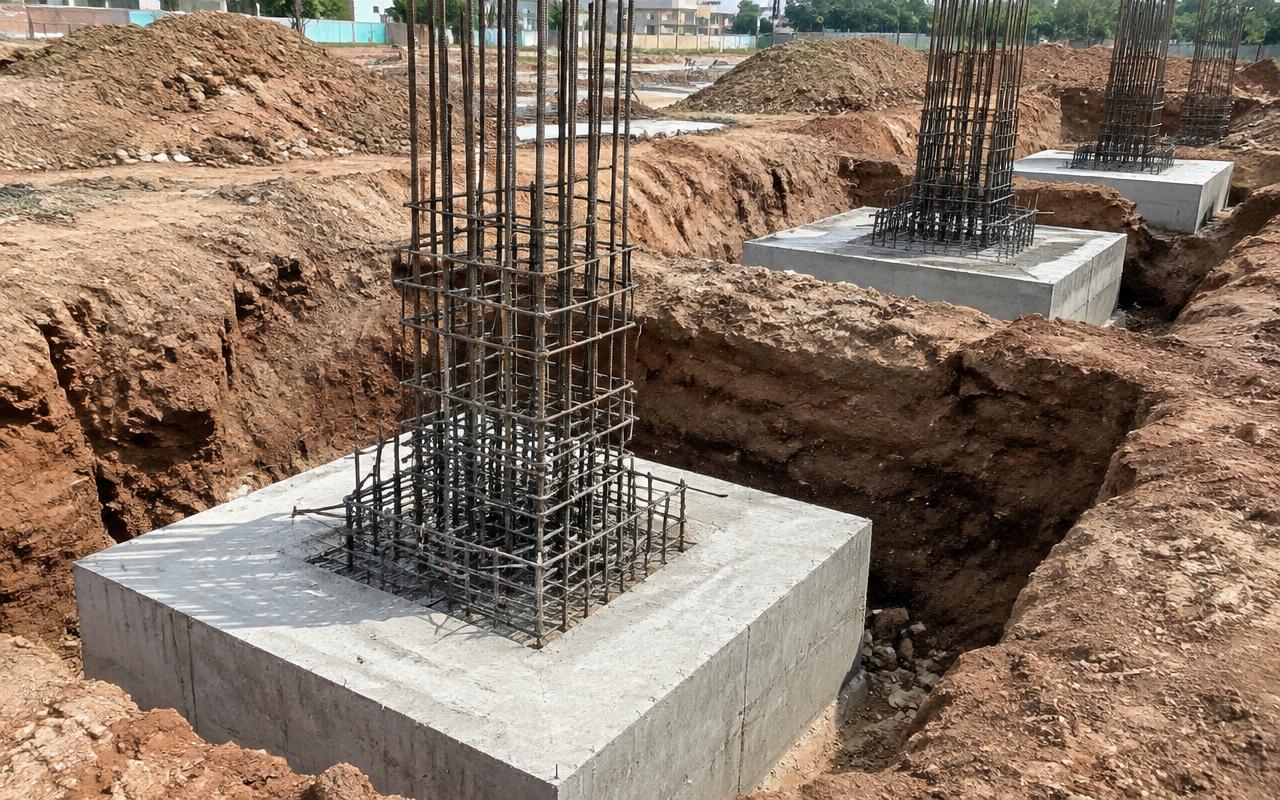
Foundation and piling costs are entirely design-driven, so a meaningful BOQ only exists after soil investigation and structural design are done — but the typical cost split on a bored cast-in-situ pile job for a mid-rise building looks fairly consistent. Piling itself (boring, casing, reinforcement cage, concrete) is usually 45–55% of the foundation package, pile caps and tie beams another 20–25%, and the raft or grade slab (where used) 10–15%.
Soil investigation and the structural design fee sit outside that split as a fixed upfront cost, typically 3–6% of the total foundation value depending on the number of boreholes required, but this is the one cost that should never be skipped or shortcut — undersizing the investigation is the single biggest cause of pile capacity disputes mid-project.
Plinth beams, which tie the pile caps together at ground level and carry the ground-floor wall loads, typically add another 8–12% and are sometimes quoted separately from the rest of the foundation package since they're executed slightly later in the sequence, after pile caps are cast and backfilled. It's worth confirming plinth beams are included in the foundation quote rather than assumed to be part of the superstructure package, since this is a common point of ambiguity between the foundation contractor and the RCC structure contractor on projects that split the two scopes.
Pile count and layout also depend on column load distribution in ways that aren't always obvious from the architectural plan alone — a building with a transfer structure at a lower floor to create column-free space above concentrates significantly higher load onto fewer piles at that location, and this should be reflected in the piling BOQ as a distinct, heavier-capacity group rather than priced at the same per-pile rate as the rest of the foundation.
- Soil investigation + design: 3–6% (fixed, upfront)
- Piling (boring, casing, cage, concrete): 45–55%
- Pile caps + tie beams: 20–25%
- Raft/grade slab: 10–15%
- Plinth beams: 8–12%
05Soil type drives the MMR price spread more than location does
Within the same city, pile cost varies more by soil profile than by neighbourhood. Reclaimed land along the Mumbai and Thane creek belts, and low-lying parts of Navi Mumbai near the mangrove fringe, often need piles driven significantly deeper to reach competent strata, which increases both boring time and reinforcement cage length per pile. Basaltic rock closer to the surface in parts of the western suburbs and Panvel's hillier pockets can mean shorter piles but higher rock-socketing cost per metre, since boring through rock is slower and wears equipment faster than boring through soil.
A site's soil report — not its postal address — is what should set the budget; two plots a kilometre apart in Navi Mumbai can have a 20–30% difference in per-pile cost if one sits on reclaimed fill and the other on rock.
This is also why a soil report done for a neighbouring plot, even one next door, should never be relied on as a substitute for your own investigation — strata can vary meaningfully over short distances, particularly on reclaimed or filled ground where fill depth and composition were never uniformly controlled. The cost of a dedicated soil investigation is small relative to the cost of a foundation sized off the wrong assumptions.
06Where piling quotes get lowballed
Because final quantities depend on strata actually encountered, piling is one of the easiest packages to lowball on paper and recover on site. Common tactics: quoting a per-pile rate assuming a shallower design depth than the geotechnical report supports, excluding the cost of disposing of excavated soil and bentonite slurry, and quoting reinforcement cage cost as a flat allowance rather than against the actual cage design.
Before award, require the quote to state the assumed pile depth and diameter per the structural design (not a generic assumption), a disposal and slurry-management cost either included or itemised separately, and a clearly defined rate for 'extra depth' per metre in case actual strata forces deeper piles than designed — this single clause prevents the most frequent foundation-stage cost overrun.
It's also worth asking what equipment the contractor intends to mobilise and confirming that equipment is actually suited to the strata the soil report describes — a rig sized for soft soil boring struggles and slows dramatically if it unexpectedly hits rock, and a contractor who under-specified their equipment to win on price will often pass that slowdown cost back to the client as a time-related claim rather than absorbing it themselves.
07How foundation and piling packages are typically paid
Piling is billed item-rate per pile, with rate bands depending on diameter and depth bracket agreed upfront, since lump-sum pricing doesn't work well when actual depth is only confirmed as each pile is bored. A standard structure is 15–20% advance against mobilization of the piling rig (a real cost for the contractor, since rigs are expensive to transport and set up), then progressive billing per completed and tested pile.
Retention of 5–10% is held until pile integrity testing (and load testing on a sample percentage, where specified) confirms capacity, because a pile that looks complete can still fail a low-strain integrity test — releasing full payment before those results are in hand is the most common mistake clients make on foundation packages.
On larger projects with dozens or hundreds of piles, it's also standard to agree a sampling rate for load testing upfront — commonly a small percentage of total piles, selected either at random or targeted at piles where boring logs showed unusual conditions — rather than negotiating which piles get tested after the fact, when the contractor has an obvious incentive to suggest testing only the piles least likely to raise concerns.
It's worth noting that the pile integrity test results and load test results should be shared with the client or their structural engineer directly by the testing agency, rather than filtered through the piling contractor first — a contractor under schedule pressure has an incentive to present results in the most favourable light, and direct reporting removes that incentive entirely.
Get a free site visit in Mumbai
MumbaiConstructions is a civil construction company and turnkey contractor serving Mumbai and the wider Mumbai Metropolitan Region since 2009. Share your plot or building details and a project engineer will visit, check feasibility and send a line-item BOQ within 7 working days — no obligation.
Frequently asked questions
Why do foundation & piling quotes vary so much?
Different specifications, hidden exclusions and missing items. Compare on an identical BOQ.
Do you offer a fixed price?
Yes — after drawings are final we can offer a lump-sum turnkey price.