


Quick answer
An RCC swimming pool for a villa or clubhouse costs roughly ₹22–₹55 lakh depending on size, finish and filtration, with waterproofing and plant-room design being critical.
On this page
- Key takeaways
- The short answer
- Key points explained
- Cost breakdown by component
- Skimmer versus overflow (infinity-edge) design
- Why waterproofing failures happen
- Running costs and seasonal upkeep
- What to confirm before signing a pool contract
- Heated pools and additional equipment considerations
- How this applies to your project
- Frequently asked questions
Key takeaways
- RCC shell with waterproofing
- Filtration plant
- Tile or mosaic finish
- Regular maintenance
01The short answer
An RCC swimming pool for a villa or clubhouse costs roughly ₹22–₹55 lakh depending on size, finish and filtration, with waterproofing and plant-room design being critical.
Most of that range is driven by the tile or mosaic finish and the filtration equipment selected, not by the concrete shell itself, which is why two pools of the same size can differ in price by lakhs depending purely on specification.
02Key points explained
An RCC shell with integral waterproofing — either a crystalline additive mixed into the concrete, an applied polymer-modified cementitious coating, or a fully adhered PVC/membrane liner — is the baseline for any permanent pool; skipping a dedicated waterproofing system and relying only on dense concrete is the most common reason pools develop seepage into the surrounding structure within a few years. This is especially relevant where the pool sits on or near a habitable basement or podium level, since a seeping pool above an occupied space is far more disruptive to fix than one on open ground.
The filtration plant (pump, sand or cartridge filter, and a chlorination or salt-chlorination system) is what keeps the water safe to swim in day to day; it is sized to turn over the entire pool volume within roughly 6–8 hours, and under-sizing it to save cost is the single biggest driver of algae and cloudy water complaints later. A correctly sized plant also runs more efficiently on electricity over the long run than an undersized one working constantly to keep up.
Tile or mosaic finish — ceramic, vitrified, or imported glass mosaic — is chosen as much for looks as for slip resistance on the pool deck and steps; glass mosaic costs significantly more than ceramic tile but holds colour and resists chlorine staining far longer. Deck and step tiles in particular should carry a slip-resistance rating suited to a wet-foot area, since this is a basic safety consideration insurers and clubhouse managers increasingly ask about.
Regular maintenance (daily skimming, weekly backwashing of the filter, and chemical balancing of pH and chlorine) is what protects the upfront investment; a pool that is not maintained for even a few months can need the finish re-grouted or re-tiled well before its structural life is up. A clubhouse pool used by many residents needs this discipline even more than a private villa pool, since bather load directly affects how fast water chemistry drifts out of balance.
These four elements build on each other in sequence: waterproofing protects the structure, filtration protects water quality, the finish protects the waterproofing from direct wear and UV exposure, and maintenance protects all three from gradually degrading — skimping on any one weakens the whole system, which is why a cheap pool quote that cuts corners on waterproofing or filtration specifically tends to cost more in cumulative repairs than it saved at construction.
- RCC shell with waterproofing
- Filtration plant
- Tile or mosaic finish
- Regular maintenance
03Cost breakdown by component
For a mid-size villa pool (roughly 300–400 sq.ft. surface area, 4–5 ft depth), the RCC shell and excavation typically account for ₹6–9 lakh, waterproofing for ₹1.5–3 lakh, the filtration and plant room equipment for ₹4–8 lakh depending on brand and automation level, tiling or mosaic finish for ₹4–10 lakh, and pool deck, coping stone and fencing for the remainder.
A clubhouse pool for a society, being larger and needing a more robust filtration cycle for shared use, scales toward the upper half of the ₹22–55 lakh band, and often adds a separate kids' pool, a deck shower point and a lifeguard or safety signage package that a private villa pool skips. Heating, underwater lighting and an automated pool cover are common optional add-ons that can each add a meaningful slice to the final bill, so it is worth itemising them separately in the quote rather than assuming they are included.
04Skimmer versus overflow (infinity-edge) design
A skimmer pool is the simpler and cheaper design — water sits a few inches below the deck and is drawn through wall-mounted skimmer boxes; it is the default choice for most villa and clubhouse pools in the region.
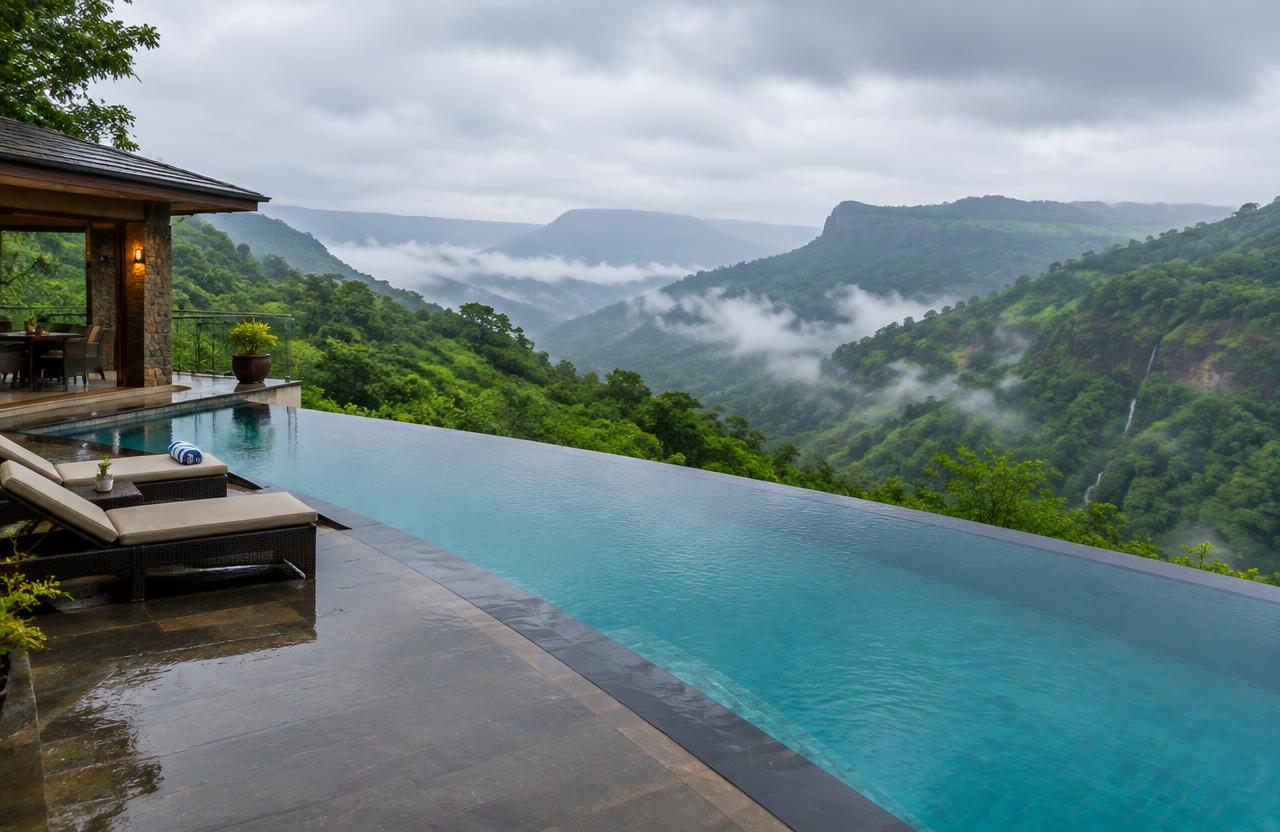
An overflow or deck-level pool, where water sheets continuously over one or more edges into a collection channel (the basis of an infinity-edge look), needs a larger balance tank, a bigger pump, and a more carefully levelled coping — it typically adds 20–30% to the plant-room and civil cost but gives the premium visual effect developers often want for a flagship clubhouse. The coping level on an overflow pool has almost no tolerance for error, since even a few millimetres of unevenness shows up as an uneven water sheet along the edge.
05Why waterproofing failures happen
The most common cause of a leaking pool is not the main shell but penetrations — the pipe inlets, outlets, lights and skimmer boxes cast into the wall — because these junctions are where the waterproofing membrane or coating is hardest to apply evenly; a contractor who details and double-checks every penetration point before the pool is plastered saves far more in future repair cost than one who focuses only on the flat wall and floor areas.
A pressure test (filling the shell and holding water for 48–72 hours before the finish layer goes on) is the standard way to catch a leak while it is still cheap to fix, and is worth insisting on as a contract milestone — once tiling is complete, locating a leak behind the finish becomes a far more invasive and expensive exercise.
06Running costs and seasonal upkeep
A villa or clubhouse pool typically carries a monthly running cost for electricity (filtration pump operation), chemicals (chlorine or salt-cell consumables, pH adjusters) and periodic professional servicing, which owners should budget for separately from the one-time construction cost — an under-filtered or poorly maintained pool ends up costing more in corrective cleaning and re-chemical-balancing than a pool maintained consistently from day one.
During Mumbai's monsoon, heavy rain dilutes pool chemistry and can introduce debris and run-off, so pools often need more frequent chemical rebalancing and filter backwashing through the wet months; a pool cover, where used, reduces this seasonal burden noticeably by keeping rainwater and debris out between uses.
07What to confirm before signing a pool contract
Beyond the headline cost, ask for the filtration plant's turnover rate in hours (not just its brand name), the waterproofing system specified by name and the warranty attached to it, the exact tile or mosaic brand and series rather than an 'equivalent' description, and whether the quote includes the pressure test as a verifiable milestone before tiling begins.
A pool contract that specifies all four of these clearly is one where the owner can actually hold the contractor to the agreed standard later — a vague quote that bundles 'pool construction complete' as a single line item gives an owner very little to point to if the pool develops problems after handover.
08Heated pools and additional equipment considerations
A heated pool, increasingly requested for clubhouse and premium villa projects to extend usable months beyond the warmer season, adds a heat pump or boiler system to the plant room along with insulated plumbing runs, and typically increases both construction cost and the ongoing electricity or fuel cost of operating the pool noticeably compared to an unheated design — this is worth weighing against how many additional months of use heating genuinely buys in Mumbai's climate, where ambient temperatures rarely drop low enough to make a pool fully unusable year-round even without heating.
Automated pool covers, UV or ozone secondary sanitisation systems, and app-based remote monitoring of water chemistry are newer additions some premium projects now specify — each adds upfront cost but can reduce manual maintenance effort and chemical consumption over the pool's life, a trade-off worth discussing explicitly with the contractor rather than assuming any one option is automatically worth its premium.
09How this applies to your project
Every plot is different — soil, access, approvals and budget change the right answer. MumbaiConstructions's engineers review your site and drawings and explain the options with costs, so you can decide with confidence.
Get a free site visit in Mumbai, Navi Mumbai & Thane
MumbaiConstructions is a civil construction company and turnkey contractor serving Mumbai, Navi Mumbai & Thane and the wider Mumbai Metropolitan Region since 2009. Share your plot or building details and a project engineer will visit, check feasibility and send a line-item BOQ within 7 working days — no obligation.
Frequently asked questions
Does MumbaiConstructions help with this?
Yes. We offer free site visits, feasibility advice and a line-item BOQ across Mumbai, Navi Mumbai, Thane, Panvel and nearby areas.
Where do you work?
Mumbai Island City and suburbs, Navi Mumbai, Thane, Kalyan-Dombivli, Panvel, Vasai-Virar and surrounding MMR towns.